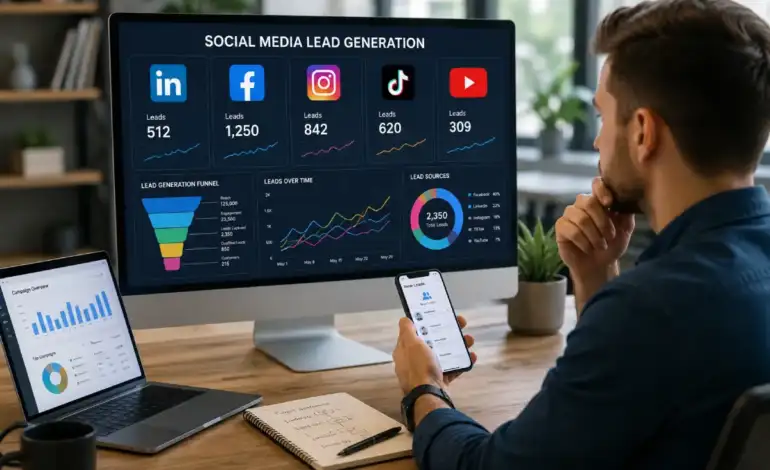
Best Social Media Apps for Lead Generation and Business Growth
Last Updated: June 19, 2026
Here‘s the truth; most companies are wasting months of efforts on the wrong social media channel. They are creating content, advertising and still can wonder where are the leads. The problem usually isn’t effort. It’s fit.
Social media apps for lead generation aren’t one-size-fits-all. LinkedIn attracts decision-makers. Facebook reaches local buyers. TikTok builds awareness fast. Each platform rewards a different strategy — and punishes the wrong one.
There are currently over 5.24 billion people use social media worldwide, so its hard to say you don‘t have an audience. There are currently over 5.24 billion people use social media worldwide, so its hard to say you don‘t have an audience. According to DataReportal’s latest Global Digital Overview, social media continues to reach well over half of the world’s population, making platform selection more important than audience availabilityIt‘s about knowing where your customers are and what it takes to turn a follower into a paying customer.
This guide will take you through the most popular platforms, those features which deliver real results and how to create a system whereby social traffic becomes a predictable business growth engine..
How Social Media Generates Business Leads
Let‘s get one thing straight here. Social media does not bring you leads the same way a Google search does. If someone opens up Google and searches for “best CRM software”, then they are clearly shopping. When they open Instagram and see this one. The mindset is completely different.
That’s why most businesses approach social media leads wrong. They expect immediate conversions and quit when they don’t see them in week two.
Social media works across multiple stages of the buying journey — sometimes all at once. A well-timed Facebook ad can reach someone who wasn’t even thinking about your product yesterday and have them booked for a call by Friday. But it doesn’t happen by accident.
The basic flow looks like this:
- Reach– your content or ad is seen by people who haven‘t heard of you…yet
- Engage — your posts, stories, or DMs build enough interest that they stop scrolling
- Capture — a lead form, bio link, or landing page collects their contact info
- Nurture — email sequences, retargeting, or DMs do the follow-up work
Paid social makes the capture step significantly easier. Platform such as Facebook, Instagram, LinkedIn allow user to submit a contact info without redirecting the user. No redirect. No delay. No distraction. That frictionless experience is exactly why in-app lead forms outperform traditional landing pages for cold audiences.
The trap most marketers fall into is skipping straight to capture without doing the reach and engage steps properly. When you ask a stranger for their email before they know who you are, conversion rates tank.
📌 Key Takeaway: Social media leads work when your platform matches your audience’s mindset at that stage of the journey — not just their demographic profile.
Best Apps for Lead Generation Campaigns
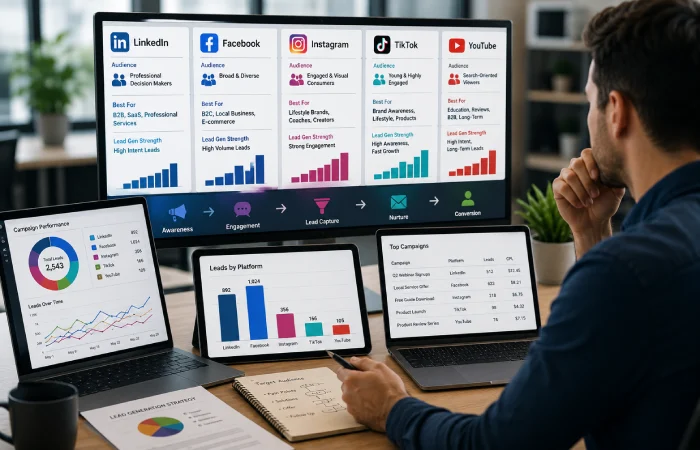
Here’s the platform breakdown that actually matters in 2026. Not just who has the most users, but which ones move the needle for specific business types.
LinkedIn — The Gold Standard for B2B
If you’re selling to businesses, LinkedIn isn’t optional. It accounts for roughly 80% of all B2B social media leads. LinkedIn’s dominance in B2B marketing is consistently reflected in industry research. HubSpot’s State of Marketing Report regularly identifies LinkedIn as one of the highest-performing social channels for B2B lead generation, particularly for reaching decision-makers and professional buyers. That’s not a rounding error — it’s a landslide. Facebook and X combined account for the other 20%.
The reason comes down to user intent. People show up on LinkedIn with their professional identity front and center. Job title, industry, company size — it’s all right there. That means your targeting can be surgical in a way that no other platform allows.
LinkedIn Lead Gen Forms are the standout feature here. They pre-fill from the user’s profile, so there’s no typing, no friction, no reason to bail. Conversion rates on these forms sit around 13% on average — more than five times the industry standard. Now compare that to a standard landing page, converting at 2–3%, and the numbers become very persuasive very quickly.
Best for: SaaS. Professional services, agencies, executive recruiters, consultants, all B2B sales teams.
What works on LinkedIn right now:
- Lead Gen Forms with a strong content offer — audit, whitepaper, free strategy session
- Sponsored posts targeting by job title, seniority level, company size, or industry
- Long-form thought leadership content that builds authority before the ask
- Reaching out after someone engages with your post — warm leads convert at 5–8%, cold outreach sits at 1.7%
Facebook — Still the King for B2C and Local
Facebook has over 3 billion monthly active users as of 2026. That number is easy to dismiss as ‘everyone’s grandparents now’ — but that misses the point. The targeting engine is what makes Facebook irreplaceable for B2C businesses.
Ability to target audiences for purchase history, life events, income or interests or by geographic location. You can re-target visitors who have been to your site within the past week or develop a look-a-like based on your most valuable customers. No other platform gives small businesses that kind of precision at Facebook’s scale.
For almost each local service related category (dentists, HVAC companies, fitness gyms and studios, law firms) Facebook Lead Ads has always produced the lowest CPLs than any others media at all.
Best for: Businesses offering local services, online shops, coaches, property agents, event organizers, all B2C brands of any size..
What works right now:
- Facebook Lead Ads — in-app forms that don’t require a landing page
- Retargeting website visitors with specific offer-based ads within 7–14 days of their visit
- Facebook Groups as organic community hubs that generate warm inbound leads over time
- Messenger chatbots that qualify leads automatically before passing to sales
Instagram — Visual Brands and Service Businesses
Instagram’s lead generation strength is a bit different from Facebook’s. It’s less about direct response and more about creating enough desire that people come looking for you.
The path from Instagram follower to lead usually runs through the bio link, Stories, or DMs. None of those are particularly technical — but they do require consistency. Those companies that make 1 post a week and ask for a lead flood are constantly let down. The companies that remain seen, respond to DM‘s quickly and regularly change their bio link, will maintain a solid consistent pipeline.
Reels have become the top-of-funnel driver on Instagram right now. A single Reel can land in front of non-followers through the Explore page — which means organic reach is still real here, unlike some other platforms.
Best for: E-commerce, lifestyle, fitness coaching, health and wellness, interior design, photography, food and beverage.
What’s working:
- Link in Bio tools (Linktree, Beacons, Later’s link page) with multiple CTAs — download, book, subscribe
- Story polls and question stickers to qualify audience interest before pitching
- DM automation tools that instantly respond to keywords and start qualifying conversations
- Collab posts with micro-influencers in your niche — their audience trusts them, and that trust transfers
TikTok — Fast Growth, Young Audiences, Rising Fast
Many traditional marketers still don‘t realize that TikTok is a platform to be used for lead generation. They just can‘t afford to overlook it, particularly if their target audience is anyone under 40.
TikTok Lead Ads makes for in-app capture familiar, frictionless experience to those using Facebook and LinkedIn. But the true opportunity is in organic reach. A new account with no followers can reach 50k views on its first video if the content resonates. That‘s prohibitively hard to obtain on any other big platform right now.
The problem is that, TikTok users have a nose for anything that smells like ad, people will quickly turn to it. Content that looks like a polished commercial gets scrolled past immediately. What works is authenticity like founder-led content, behind the scenes style clips, educational posts that don‘t seem scripted.
Most suitable for: Consumer brands, e-commerce, food, fitness, lifestyle, entertainment or any business targeting a younger than 40 consumer..
What works:
- TikTok Lead Ads paired with a strong offer — free trial, discount, giveaway entry
- Educational short-form videos that answer a real question in your niche
- Bio link driving traffic to a dedicated landing page or lead magnet
- Live sessions with a real-time offer or limited-time CTA
YouTube — The Long Game That Keeps Paying Off
YouTube is different from every other platform on this list. It’s slow to start and requires more production effort — but it’s the only social platform that compounds over time in a meaningful way. A YouTube video published today can still be generating leads three years from now because it shows up in Google search results.
For businesses that sell complex or high-consideration products — software, coaching programs, professional services — YouTube builds the kind of trust that’s very hard to manufacture on short-form platforms. When someone spends 12 minutes watching you explain a problem they’re dealing with, they’re not a cold lead anymore.
Best for: SaaS, consulting, financial services, online education, agencies, any business with a longer sales cycle
- Educational problem-solving videos with strong verbal CTAs at the 30%, 60%, and 100% mark
- Links in descriptions going directly to lead magnets or booking pages
- YouTube Ads with lead generation objectives for faster results while the channel grows
- Pinned comments promoting your best offer — many viewers read these before the description
📌 Key Takeaway: The platform fit is more important than the platform size. LinkedIn for B2B decision makers. Facebook/Instagram for B2C. TikTok for volume and awareness.
Read More: Best Social Media Apps for Content Creators
Features That Improve Lead Quality
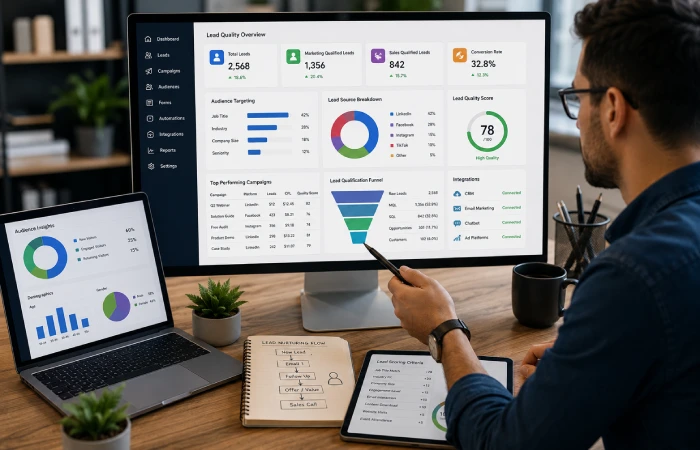
Generating leads is table stakes. Generating qualified leads — people who actually buy — is the whole game.
This is where most social media campaigns fall apart. Marketers love a low cost per lead, but don‘t always look to see if the lead ever converted. A $4 lead that never buys isn‘t any cheaper than a $40 lead that closes. It’s just a faster way to waste your budget.
These are the platform features that filter for quality, not just quantity.
Native In-App Lead Forms
Pre-filled forms are the single biggest driver of higher conversion rates on social media. When a user clicks your ad and their name, email, and phone number are already populated from their profile, the psychological barrier to submit drops dramatically.
LinkedIn’s Lead Gen Forms convert at 10–15% on average. Standard landing pages sit at 2–5%. That gap isn’t small — it’s the difference between 10 leads and 50 leads from the same ad budget.
Audience Targeting Depth
More targeted: your ad is being shown to people more likely to actually want what you have. On LinkedIn, you can target at the exact job title, seniority level, company size and industry, or even using the individual companies themselves. Facebook uses interest and behavior signals, plus lookalike modeling from your existing customer base.
Broad targeting gets you volume. Precise targeting gets you leads worth talking to.
CRM Integration
The biggest lead quality improvement most businesses can make costs nothing. It’s connecting their social lead forms directly to their CRM — HubSpot, Salesforce, Zoho, or even a basic Airtable setup. When lead data flows automatically into your pipeline, your sales team can follow up in minutes instead of days.
Speed is everything here. A lead that is replied to five minutes after an enquiry online is much more likely to become a customer than one you deal with 48 hours later.
Qualifying Questions
Adding one or two qualifying questions to your lead form — budget range, timeline, company size, specific challenge — filters out tire-kickers before they reach your sales team. Yes, it reduces raw lead volume. No that‘s not an issue. Having fewer, more meaningful conversations is better than having more, highly damaging (wasted) sales calls.
📌 Key Takeaway: Concentrate on platform attributes that pre-qualify (not just capture contact info). A brief list of the “right” people will always beat a long list of the “wrong” people..
Converting Social Media Traffic into Leads
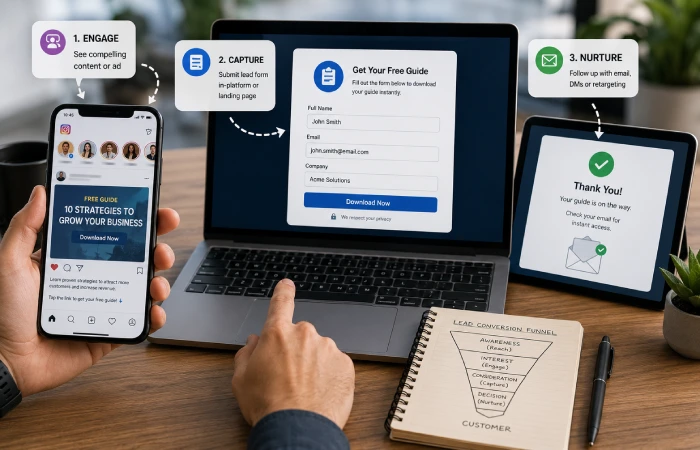
Traffic without conversion is just vanity. Getting people to click your content or ad is step one — what happens after the click determines whether you get a lead or lose them forever.
The Conversion Path
Every successful social media lead funnel follows roughly the same structure:
- Content or ad → catches attention with a specific, relevant hook
- Click → takes the user somewhere with one clear next step
- Form or landing page → collects their information with minimal friction
- Thank you page → confirms the action and offers the next logical step
- Follow-up → fast, relevant, personal
Where most funnels break down is message match. If your ad promises a free audit and your landing page is your generic homepage, the disconnect kills conversions. The page someone lands on needs to feel like a continuation of the ad — same language, same offer, same visual tone.
What Makes the Difference on Landing Pages
- One CTA only. Every additional option dilutes conversions.
- Social proof above the fold — testimonials, client logos, specific results
- Mobile-first design. Most social traffic hits on a phone.
- Form fields: 3–5 max for cold traffic. Each extra field drops conversions.
The Follow-Up Window
Here’s a stat that tends to surprise people: leads contacted within five minutes of submitting a form are dramatically more likely to convert than those followed up with even an hour later. The reason is simple — they’re still in buying mode. They submitted the form, they’re thinking about your offer, they’re ready to talk.
Warm leads — people who engaged with your content before submitting — convert at 5–8%. Cold outreach leads sit around 1.7%. That’s an 8x difference in close rate based entirely on how you warmed them up before the ask.
📌 Key Takeaway: Traffic only converts when the path from click to form is clear, fast, and friction-free — and when follow-up happens before the moment passes.
Measuring Lead Generation Performance
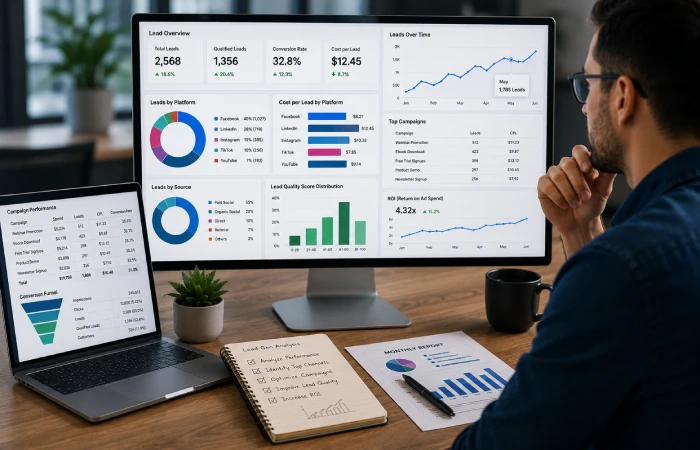
Most businesses track the wrong social media numbers. Follower counts, likes, impressions — these are activity metrics. They tell you what happened on the platform. They don’t tell you whether you’re making money.
The metrics below are the ones that connect social media activity to actual business results.
| Metric | What It Actually Tells You | Why It Matters |
| Cost Per Lead (CPL) | How efficiently your ad budget creates leads | Catches campaigns that look active but waste money |
| Lead Conversion Rate | What % of ad clicks become leads | Reveals landing page or form problems fast |
| Lead-to-Customer Rate | What % of leads actually buy | The true indicator of lead quality |
| Return on Ad Spend (ROAS) | Revenue generated per dollar spent on ads | Links spend on social directly to revenue |
| Time to Conversion | How long leads take to close | Helps forecast pipeline and optimize follow-up timing |
Platform Benchmarks Worth Knowing
LinkedIn’s visitor-to-lead conversion rate runs about 2.74% — roughly three to four times higher than Facebook’s 0.77% or X’s 0.69%. LinkedIn Lead Gen Forms average 10–15% conversion. Facebook Instant Forms land around 8–12%. Standard landing pages across industries convert at 2–5% for cold traffic.
These numbers are useful as a starting baseline. But your industry, your offer, and your audience will shift them meaningfully. The point isn’t to hit the average — it’s to know what ‘good’ looks like so you can identify what needs fixing.
Setting Up Tracking That Actually Works
- UTM parameters on every social link — source, medium, campaign name, and ad variation
- CRM connected directly to all lead forms — no manual exports, no copy-paste errors
- Track leads by source so you always know which platform, ad, and offer drove results
- Review CPL every week. Review lead-to-customer rate every month.
One last thing worth saying: the goal isn’t to be on every platform. It’s to be excellent on two. Those who reach out in six channels, sharing poor content in each one, don‘t do as well as those who penetrate one or two channels with real consistency.
Pick the platform where your best customers already spend time. Build a clean conversion path. Measure what’s working. Then scale what you can afford to replicate.
That’s not a complex strategy. But it’s the one that actually generates leads.
FAQs
Which social media app is best for B2B lead generation?
LinkedIn — and it’s not particularly close. Produces approximately 80% of all B2B social media leads, and allows you to target by job title, seniority, industry, and company size no other platform affords that much granularity with a professional audience.
Is Facebook or LinkedIn better for lead generation?
All depends on who you‘re selling to. LinkedIn is superior for B2B with a 2.74% visitor-to-lead conversion rate versus Facebook‘s 0.77%. Facebook is superior for B2C, local businesses, and retargeting because of its sheer amount of users and lower CPL.
How do I generate leads on Instagram?
Use a Link in Bio with several CTAs. Test story ads with a Lead goal. Use DM automation for inbound questions. Partner with niche micro-influencers who have a following and have their trust.
What’s a good conversion rate for social media lead generation?
LinkedIn Lead Gen Forms average 10–15%. Facebook Instant Forms average 8–12%. A landing page converting cold social traffic at 3–5% is considered solid for most industries.
Can TikTok actually work for lead generation?
Yes especially for consumer brands and a younger demographic. TikTok Lead Ads means capturing leads within the app itself; organic TikTok reach is still significantly better than any of the other major platforms. It just can‘t look like an ad.
How much does social media lead generation cost?
It varies a lot by platform and industry. LinkedIn CPL typically runs $75–$200. Facebook CPL lands between $10–$50 in most categories. Lead Gen Forms on LinkedIn reduce CPL by 25–35% compared to sending traffic to an external landing page.
How do I measure whether social media lead gen is actually working?
Track CPL, lead conversion rate, lead-to-customer rate, and ROAS. Don’t report on follower growth or post impressions as success metrics — they don’t pay the bills.

I’m Thomas — Editor & Admin of incmarketingplace, Blogger, and Senior SEO Analyst. writer at Inc Marketing Place, sharing insights on SEO, branding, content marketing, and online business growth. I focuses on creating practical and easy-to-understand content for marketers, entrepreneurs, and growing businesses