Best Secure & Private Social Media Apps (2026 Guide)

Last Updated: September 18, 2026
Nobody reads the terms of service. I know that, you know that, and — most importantly — Facebook, Instagram, and TikTok know that too. As to why the sentence mentioning that your behavioral data is being sold to third-party advertising brokers is buried somewhere around page number 7.
Here‘s the unfortunate reality about the apps that most of us use on a daily basis: the free apps aren‘t free. You’re paying with information. Location data, browsing patterns, how long you hovered over a particular post at 11pm on a Tuesday — that stuff gets packaged up and sold. The average user gives away anywhere between 15 and 20 pieces of personal data to social sites. That is two or three times more than five years ago.
So people are starting to look elsewhere. 73% of users say they’re more worried about data privacy now than they were a few years back. 36% have deleted at least one social media account specifically because of privacy concerns. These aren’t numbers from some niche security conference — this is a mainstream shift.
And the good news, which I’ll get to in a second, is that the alternatives have genuinely improved. Private social media apps used to mean clunky, half-finished tools that nobody you knew was on. That’s not really the case anymore.
First, What Actually Makes an App ‘Private’?
It is something that gets confused all the time, so it‘s good to be clear. There are two distinct things that people commonly refer to when they want a ‘private’ app, and they‘re not equivalent.
One is encryption – so no one can read what you‘ve sent except you and your recipient. Anyone in between the two of you, not even the platform, will be unable to look at what you Send. The other is data minimization — meaning the platform doesn’t collect personal information about you, doesn’t build a profile, doesn’t sell anything to advertisers.
Some apps do one of these. The best ones do both. And most mainstream social networks do neither.
Meta, to use the most obvious example, collected around 80% of all legally-available consumer data categories as of the last major independent analysis. Instagram sat at 69%. TikTok was around 46%. These are massive numbers. They’re also the entirely predictable result of building a business where advertising is the revenue model — the more they know about you, the more valuable each ad impression becomes.
Red flags that an app probably isn’t private, whatever the marketing says:
- Signup requires your real phone number — that’s a data point tied to your identity
- Messages are stored on the company’s servers after delivery (check the privacy policy)
- The company’s main revenue source is advertising
- Encryption is an optional ‘secret mode’ rather than just how the thing works
- Privacy settings require a law degree to navigate — that’s a design choice, not an oversight
Private Social Media Platforms: Where to Actually Go

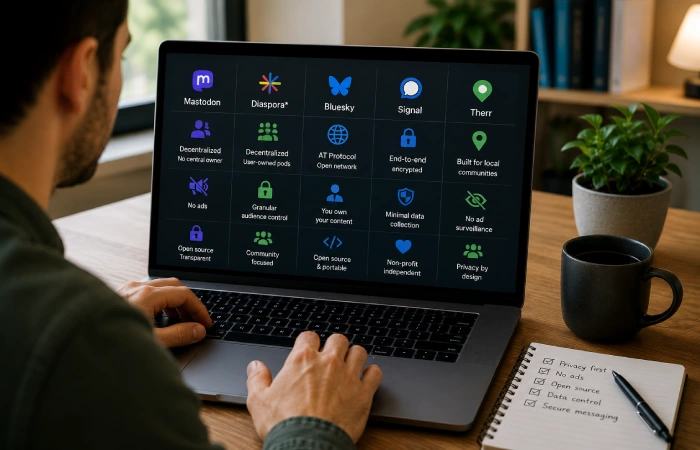
The most significant development in this space over the last few years is the rise of federated, decentralized networks. Instead of one company owning the infrastructure, you get thousands of independent servers — run by universities, nonprofit organizations, enthusiasts, whoever — all talking to each other via open protocols.
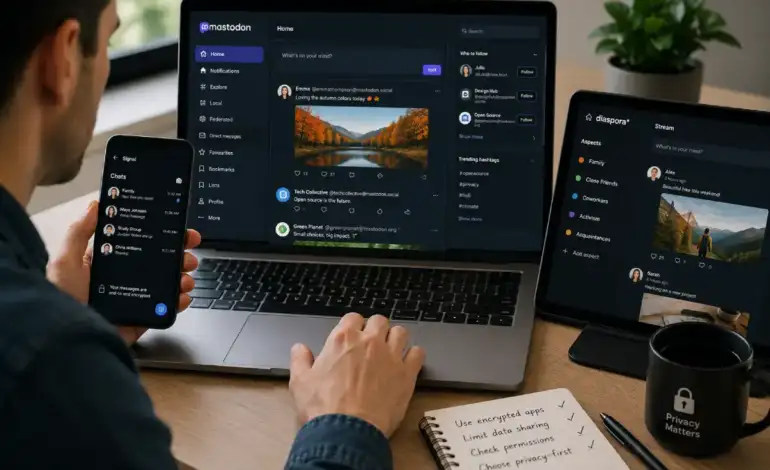
Mastodon is the most mature of these. It’s been around since 2016 and grew enormously in late 2022 when a significant chunk of Twitter users started looking for alternatives. The experience is similar enough to Twitter that most people get it within about twenty minutes. But there’s no Mastodon Inc. sitting on your data. The server you join is likely run by a small organization or community, and the whole network is open-source code that anyone can audit.
The slightly weird thing about Mastodon is picking a server. You join mastodon.social, or fosstodon.org if you’re into tech, or any number of topic-based communities. It feels arbitrary at first. It matters less than you’d think — you can follow anyone on any server, and you can move your account later if you want. But new users often get stuck on this decision longer than necessary. Just pick one. You can change it.
Diaspora* takes a similar decentralized approach with a more Facebook-ish interface. The feature I find most underrated: granular audience control. On Facebook you basically choose between ‘friends’ and ‘public.’ On Diaspora* you create aspects — categories of people — and post to specific ones. So your coworkers see the professional stuff and your family doesn’t, or vice versa. It’s the kind of thing Facebook has promised and half-delivered for fifteen years.
Bluesky has picked up real momentum. It’s built on the AT Protocol, which means in theory you own your content and could take it to another platform built on the same protocol. Whether that portability actually works in practice is still being tested, but the principle is meaningful — contrast it with Instagram, where leaving means losing everything you posted.
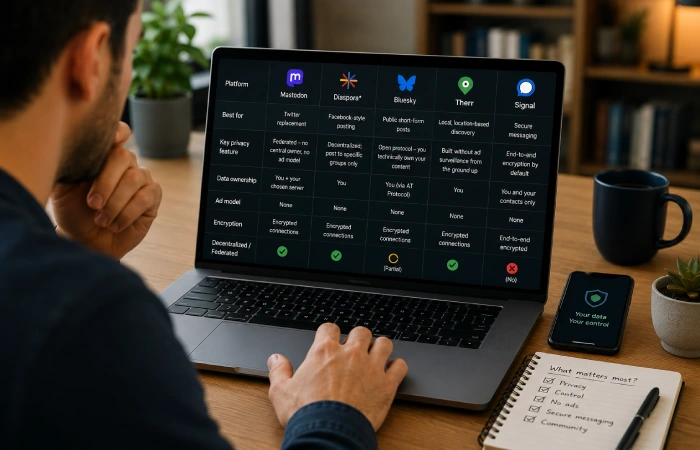
| Platform | Best For | Key Privacy Feature |
| Mastodon | Twitter replacement | Federated — no central owner, no ad model |
| Diaspora* | Facebook-style posting | Decentralized; post to specific groups only |
| Bluesky | Public short-form posts | Open protocol — you technically own your content |
| Therr | Local, location-based discovery | Built without ad surveillance from the ground up |
Secure Messaging Apps: This Category Has Actually Won
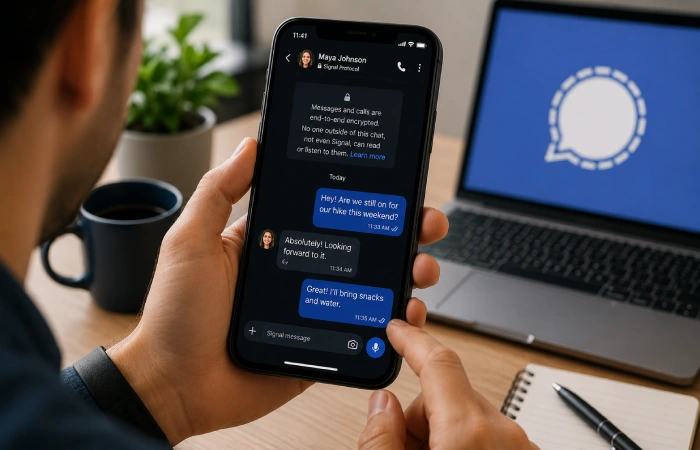
To end on an optimistic note about privacy tech, consider secure messaging. A decade ago, end-to-end encrypted chat was a tool mostly used by reporters or political activists. Today, Signal has perhaps tens of millions of users, and it‘s just another chat app. It just happens to be genuinely secure.
Signal is the one to recommend first because the case for it is almost embarrassingly strong. According to the official Signal privacy and transparency documentation, the service is designed to retain as little user information as possible while keeping conversations end-to-end encrypted by default.. The encryption is robust, the code is open-source and has been audited, the organization is a nonprofit, it doesn’t run ads, and the app experience is indistinguishable from WhatsApp for day-to-day use. The only info it retains is of your phone number & the time you last signed in. That‘s all.
Threema is for those who would walk away from Signal because of its requirement to have a phone number. No sign-up details needed no email, no phone, nothing but a random identifier. Metadata protection is exceptional here. It costs about $5, which sounds like an objection until you remember that you are actively paying to not be the product. Worth it, personally.
Session goes further still. Messages are routed through a decentralized network, which makes traffic analysis — figuring out who’s talking to whom and when — very difficult. There’s no phone number or email involved at any point. The tradeoff is that the delivery of the messages is a little slower, and the user base will be a little smaller but if that‘s what you need in terms of privacy, that‘s the tool.
A point to call out that continues to surprise people is that Telegram isn‘t end-to-end encrypted by default. The Electronic Frontier Foundation’s secure messaging guidance has long emphasized the importance of default end-to-end encryption rather than optional privacy modes that users must manually enable. ordinary messages are stored on Telegram‘s servers. ‘Secret Chats’ exist and are E2EE, but you have to turn them on manually, and they don’t work for groups. Telegram is a good messaging app in many ways. However Telegram is not a secure messaging app in the same manner as Signal, and it remains confused all the time.
| App | E2EE Default | Phone Number Required | Metadata Protection |
| Signal | Yes | Yes | Strong |
| Threema | Yes | No | Very strong |
| Session | Yes — decentralized routing | No | Strongest available |
| Briar | Yes — works offline too | No | Strong |
Encrypted Social Apps: The Middle Ground
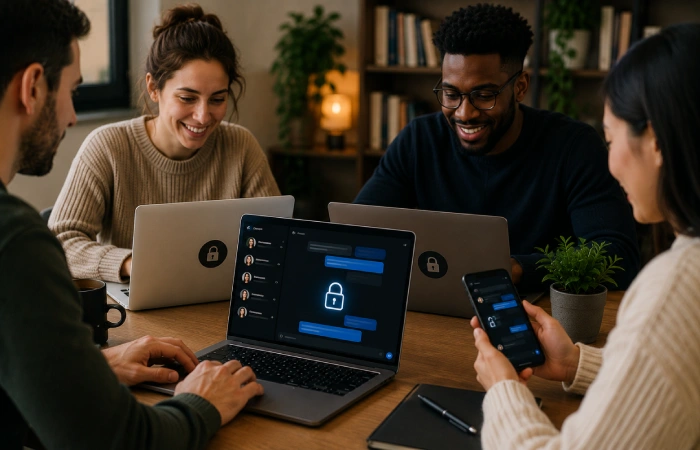
There is a category between ‘one-on-one messaging’ and ‘full social network’ that‘s good to be aware of. These are platforms that support groups, communities, and channels — but with encryption built in rather than bolted on as an afterthought.
Signal Groups work for small, trusted communities. Element is more powerful — it runs on the Matrix protocol, which is open and federated, and supports large groups, threads, voice calls, and integrations with other tools. A lot of organizations and online communities that care about owning their infrastructure have moved there.
The limitation with this category is mostly reach. Your friends are probably not on Element. Getting people to switch takes effort. However, for individual groups professional organizations, advocacy groups, sensitive issues these tools are genuinely superior to Slack or Discord when it comes to privacy.
Safe Social Networking: Staying Connected Without Getting Harvested
Not everyone’s threat model requires disappearing from social media entirely. Some people just want less of their behavior being sold to advertisers, without having to explain to their family why they’ve moved to a platform nobody has heard of.
Pinterest scores surprisingly well in independent privacy analyses — the Incogni Social Media Privacy Ranking in 2025 put it significantly above Facebook, Instagram, and TikTok. Quora ranked similarly well. Neither platform’s core functionality requires building a detailed behavioral profile of its users, which is probably why they collect less.
For most people, faster than switching platform is just hitting up the settings of the apps you‘re already using. Turn off ad personalization. Turn off location access. Opt out of data sharing with third parties. These options exist on most platforms; they’re just buried three or four menus deep on purpose. Spending twenty minutes doing this genuinely matters.
What makes a platform actually safer to use:
- Defaults to private — you shouldn’t have to dig through settings to protect your basic info
- No location data attached to posts unless you deliberately add it
- Privacy policy you can actually read in under ten minutes
- Responds to data deletion requests in a reasonable timeframe
Why This Is All Happening Now
Gen Z — broadly defined as people born roughly between 1997 and 2012 — grew up entirely inside the surveillance economy. They’ve never known social media without algorithmic feeds and targeted advertising. And according to recent research, 81% of them say they’re concerned about how their data is used. Only 14% actually trust major platforms to handle it responsibly.
That gap — concerned but still using the platforms — exists because until recently the alternatives were bad. There was nowhere to go that felt usable. That’s changed. Signal works. Mastodon works. Bluesky works. The argument that privacy requires sacrificing usability is weaker now than it’s been at any point in the history of social media.
The underlying dynamic is this: platforms funded by advertising need to profile you to survive. Platforms funded by other means — subscriptions, one-time purchases, donations, grants — don’t. The business model determines the privacy architecture more than any policy statement does. Since the company has no financial reason to collect your data, it most likely will not.
Three things I believe are good to ask yourself before you put your data into any platform: Who owns/controls the infrastructure and can they do it alone and do they change their policies? How is the business making money? And should you leave today will you be able to take your content away?
Quick Reference: Top Apps Side by Side
| App | Category | Default Encryption | Data Collected | Free? |
| Signal | Messaging | E2EE | Minimal | Yes |
| Threema | Messaging | E2EE | Near-zero | Paid (~$5) |
| Session | Messaging | E2EE + decentralized | Near-zero | Yes |
| Mastodon | Social network | N/A | Minimal | Yes |
| Diaspora* | Social network | N/A | Minimal | Yes |
| Element | Groups / communities | E2EE optional | Minimal | Yes |
| Social platform | Standard | Moderate | Yes |
Conclusion
The annoying thing about privacy advice is that it’s always ‘it depends.’ It depends on your threat model, it depends on who you‘re talking to, it depends on what you‘re willing to give up to switch.
But there is a baseline solution that applies to nearly everyone: switch out your primary messaging application for Signal. Do it this week. It takes ten minutes, the app is free, and the experience is barely different from what you’re used to. That single change puts your private conversations out of reach of advertising networks and, in most cases, law enforcement requests without a serious legal process behind them.
Then, it‘s on a sliding scale. Mastodon/Bluesky if you want social networking without harvesting of all your data. Threema or Session if you need to go further with messaging. Pinterest or Quora if you want to stay on mainstream platforms with less exposure.
None of this requires becoming a privacy extremist. It just requires making different decisions than the defaults that were chosen for you by companies with financial incentives that aren’t aligned with your interests.
FAQs
Q: What’s the most private social media app in 2026?
What do you mean by social? When it comes to messaging Signal is an obvious winner
E2EE by default, not-for-profit run, minimal data collected, all open source code. When it comes to social networking, Mastodon and Diaspora* are best because they are decentralized and don‘t rely on a business model based on feed.
Q: Is Telegram actually secure?
Not out of the box. Normal conversations aren‘t end-to-end encrypted, they‘re stored on Telegram servers, and Secret Chats are E2EE but you have to turn them on and they don‘t work in groups. Telegram is a good app, but it isn‘t secure platform for messaging in the same way that Signal is, and calling it so is often misleading.
Q: Which apps don’t sell my data?
Any app that doesn’t run on advertising has little reason to sell your data. Signal, Threema, Session, Mastodon and Diaspora* all fall here funded directly by donors, one-off payments or grants, rather than advertising.
Q: Are these apps actually usable?
Signal is nothing different than WhatsApp for daily usage. Mastodon takes some time to learn how to choose servers but it‘s way easier once you are configured. Threema and Session are easier than they seem. You don‘t need any tech knowledge.
Q: Can I be anonymous on social media?
Full anonymity is hard to guarantee. But using Session or Threema (no phone number required), combined with a VPN and an email that isn’t tied to your real identity, gets you meaningfully closer than the average social media user. Not invisible — but genuinely difficult to profile.
Q: Why does mainstream social media collect so much data?
The advertising model requires it. Advertisers pay for the opportunity to target particular individuals with particular traits. The more detailed the persona, the more expensive the ad slot. There’s no version of ‘free social media funded by advertising’ that doesn’t involve collecting data — the data collection is the mechanism that makes the ad revenue possible.

I’m Thomas — Editor & Admin of incmarketingplace, Blogger, and Senior SEO Analyst. writer at Inc Marketing Place, sharing insights on SEO, branding, content marketing, and online business growth. I focuses on creating practical and easy-to-understand content for marketers, entrepreneurs, and growing businesses