

How to Build an Email List From Scratch: 2026 Guide

Last Updated: September 18, 2026
Every social platform can throttle your reach, shadowban a post, or change its algorithm overnight. An email list is the one audience a business actually owns — no intermediary decides whether a subscriber sees the message. Building one from zero takes more than a signup box in a footer, though. This guide covers picking a lead magnet, designing an opt-in form that’s both effective and compliant, building a landing page, and the fastest ways to grow from there, as part of a broader email marketing strategy rather than a one-time setup task.
Creating an email list from zero also takes a lead magnet, an opt-in page, and a landing page in order to gain subscribers permission-only instead of purchasing or leasing contacts.
Lead magnet ideas
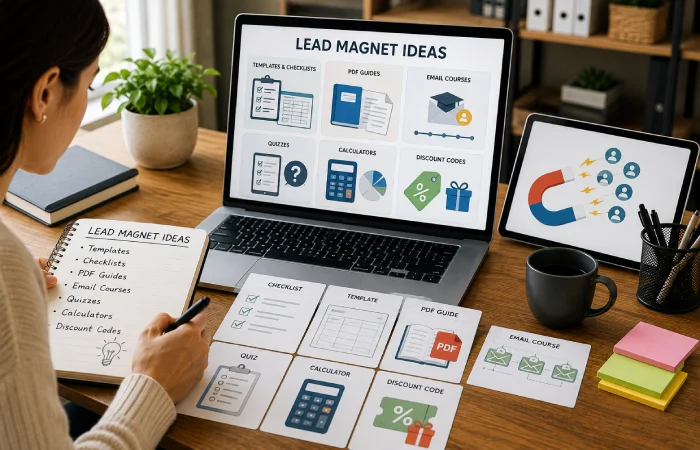
A lead magnet carries an email address by quickly solving one particular problem instead of offering great value for your contact info. An offer like “subscribe for an update” or an all-encompassing ebook won‘t convert. A lead magnet with a specific problem statement will convert significantly better as the visitors can quickly identify if it is relevant to them.
Formats that consistently convert, roughly ordered by typical conversion strength:
- Templates and checklists — a Notion template, spreadsheet, or checklist that solves an immediate, tangible task tends to convert best because the value is obvious before download.
- Short PDF guides — work well when they solve a named, specific problem rather than covering a broad topic.
- Free email courses — five to seven emails that build the highest-quality list, since subscribers who complete a course have already shown real interest.
- Quizzes and calculators — interactive formats that convert well because the visitor gets a personalized result in exchange for the email.
- Discount codes — standard for e-commerce, where the exchange is straightforward and the audience already has purchase intent.
What consistently underperforms: a generic ebook with a title like “The Ultimate Guide to X,” a broad template without a named use case, or any offer whose promised value isn’t clear within a few seconds of landing on the page.
Email opt-in form best practices

An opt-in form works when it makes the exchange clear and asks for the least information possible — name and email, not a full qualification form, at the point of signup.
- State exactly what the subscriber will get and how often — vague language like “stay updated” doesn’t meet consent standards in stricter jurisdictions and converts worse regardless.
- Leave the box unticked by default ticked consent boxes are not valid consent under the GDPR and are a common, and easily preventable, compliance fail.
- Make a careful choice of single vs. Double opt-in double opt-in results in a smaller but more engaged subscriber list and helps recording confirmation; single opt-in results in a rapidly growing subscriber list, but will also increased spam complaints.
- Limit form fields to two or three — each additional required field measurably lowers conversion.
Compliance isn’t optional context here. The Federal Trade Commission’s CAN-SPAM compliance guide sets requirements around accurate sender information, a clear opt-out mechanism, and prompt handling of unsubscribe requests, with penalties that scale per violating email — rules that apply to every commercial email a business sends, not just cold outreach.
Landing page for email signups

A dedicated landing page consistently outperforms a generic signup box precisely because it removes distraction — no navigation, one offer, one call to action, built specifically for the traffic sent to it. Landerlab’s 2026 analysis of landing page conversion benchmarks, drawing on WordStream and GetResponse datasets, found that opt-in-focused landing pages convert at meaningfully higher rates than pop-ups and embedded forms, particularly when the traffic source is email or a targeted campaign rather than broad paid social.
- One offer, one action — a page trying to capture an email while also selling a product tends to do both poorly.
- Headline answers “what’s in it for me” within seconds — vague headlines cost conversions before a visitor even reaches the form.
- Minimal form fields — the same two-or-three-field rule from opt-in forms applies here, since a landing page’s whole job is reducing friction to that one action.
- Fast load time — a page that takes more than a couple of seconds to load loses visitors before they see the offer at all.
Grow email list fast

The most rapid sustainable scaling occurs just by stacking all your many entry points around one solid lead magnet rather than running after one single trick.
- Promote the landing page directly in social bios, email signatures, and at the end of every piece of content, rather than relying on a footer form to be found.
- Add content upgrades to your highest-traffic existing pages — a bonus resource tied to that specific page’s topic converts better than a generic sitewide offer.
- Use an exit-intent form as a second chance for visitors who were about to leave without converting, without interrupting the main reading experience.
- Run the lead magnet through a partner or guest post audience to reach people who don’t yet know the brand.
What doesn’t count as building a list: buying or renting an email list. Purchased contacts haven’t consented to hear from a specific sender, which means higher spam complaint rates, damaged sender reputation, and direct exposure to CAN-SPAM and GDPR violations — the fast option here isn’t actually faster once deliverability problems start.
Email list building tools
Most list-building setups require three types of tool, and flocking to a single solution too early is a typical early error.
- Email service provider (ESP) send, manage lists, automation, check out if has signup forms and A/B testing built-in before considering adding another tool for those.
- Landing page builder a part of the ESP or independent applications; the key is simplicity and quickly created, clutter-free template, designer capabilities are not expected.
- Popup or on-site form tool — for exit-intent and content-upgrade forms specifically; many ESPs include this natively, which is worth checking before paying for a separate subscription.
For a new business, an ESP with-native forms, and a landing page builder will get you set up end to end without trying to stitch together 3 separate subscriptions.
FAQ
How long does it take to build an email list from scratch?
Most businesses will start to see significant traction in that three- to-sixmonth window, once they‘ve established a working lead magnet, a landing page, and begun to market themselves online consistently. The timeline depends heavily on existing traffic; a site with steady visitors will build a list faster than one starting from zero traffic as well as zero subscribers.
What’s the best lead magnet for a small business?
The best lead magnet solves one specific, named problem for the business’s exact audience — a template, checklist, or short guide tends to outperform a broad ebook. What is the right format is more the question of what your reader needs right away than producing a list of ideals.
Is single opt-in or double opt-in better?
Double Opt-in results in a smaller, more engaged list, as well as an audit trail of consent–which is more important in a heavily regulated market, or if your business sends out large volumes. Single opt-in results in a larger list, but one that is statistically more at risk of spam complaints, and one that will likely have a lower average level of engagement. Which is better depends on the relative importance of list size versus list quality for your business.
Can I buy an email list to get started faster?
No — purchased or rented lists haven’t given consent to hear from a specific sender, which creates higher spam complaint rates, damages sender reputation, and creates direct compliance exposure under CAN-SPAM and GDPR. A smaller list built through genuine opt-in consistently outperforms a larger purchased one on actual engagement and deliverability.
Ship one lead magnet this week
Pick the single most common question a customer asks before buying, turn it into a one-page checklist or short guide, and put it behind a dedicated landing page with a two-field form. That’s a smaller scope than most “how to build a list” guides suggest starting with, and it’s enough to start collecting real, consenting subscribers while the rest of the setup — additional lead magnets, a full tool stack — gets built around it.

I’m Thomas — Editor & Admin of incmarketingplace, Blogger, and Senior SEO Analyst. writer at Inc Marketing Place, sharing insights on SEO, branding, content marketing, and online business growth. I focuses on creating practical and easy-to-understand content for marketers, entrepreneurs, and growing businesses