
Email Marketing Mastery: The Complete Guide for 2026
Last Updated: July 30, 2026
Nobody that I know ever was excited about e-mail marketing when it was first introduced. It sounds boring. It sounds old. It sounds like something your dad’s company did in 2009 to announce a sale on office furniture.
And then you look at what it actually returns.
$36 to $42 back for every single dollar spent. That’s the average in 2026. Not the best-case number from a case study cherry-picked by an email platform trying to sell you a subscription. The average. Paid search returns $2. Social advertising returns $2.80. Display ads — the banners everyone ignores — return $1.35. Email beats all of them. Combined. And it isn’t particularly close.
So why do so many businesses treat it like an afterthought? Usually because nobody set it up properly in the first place, and a bad early experience left a bad impression. Or because the team is stretched thin and “send a newsletter” keeps getting bumped for something more urgent. Or honestly — and this is the most common one — because nobody sat down and built an actual strategy around it.
That’s what this guide is for. We’re covering strategy, best practices, what it looks like for small businesses specifically (with some real talk about the India context that most guides skip entirely), why the benefits matter beyond the ROI headline, and what good email actually looks like in the wild. Each section is an introduction with enough in it to be genuinely useful — and a link to the full deep-dive if that’s the piece you need most.
Email Marketing Strategy
Here’s the thing about email marketing strategy that most articles don’t say clearly enough: most businesses don’t have one. They have a list and a platform and a vague intention to “send emails more regularly.” That’s not a strategy. That’s a wish.
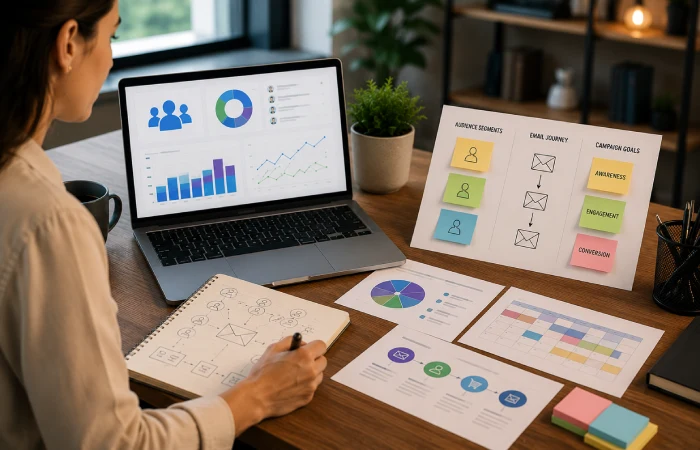
A real strategy answers a handful of specific questions before anyone writes a single word of copy. Who exactly are you sending to — and are different segments of that list in different places in their relationship with you? What do you actually want each send to accomplish, and is that outcome measurable? How does this email fit into the sequence of communications around it? What happens after someone clicks?
In 2026, 361.6 billion emails will find their way into inboxes every day. And it‘s not the emails with the most clever copy, or even the most beautiful design, that are remembered. It‘s the emails that seem important to the reader right now. That relevance doesn’t happen by accident. It comes from knowing your subscriber well enough to send them the right thing at the right time — and that knowledge comes from strategy, not from gut feel.
Automated sends have a conversion rate 2361 percent higher than standard broadcast send for some reason I keep going back to that given how huge it is that it just seems. interesting. But the mechanism behind it is completely logical. Automated emails go out when someone does something — signs up, makes a purchase, abandons a cart, hasn’t opened anything in 90 days. The trigger is a behavior signal. The email responds to that signal while it’s still warm. Of course it converts better. The subscriber is right there, in that moment, engaged with whatever they just did.
AI personalization is the 2026 update to all of this. Subject lines generated or optimized by AI outperform human-written ones by 26 percent on average open rates. Per-send revenue lifts 17 to 26 percent when content personalization is AI-assisted. This isn’t about replacing the human judgment in your email program — it’s about using tools that are genuinely better than humans at certain narrow tasks, like predicting which subject line phrasing will get a specific subscriber to open.
One thing worth saying specifically for Indian businesses reading this: evening send times significantly outperform morning sends for Indian subscriber bases, particularly on mobile. Festival campaign timing around Diwali, Eid, and regional celebrations drives open and conversion rates well above standard promotional benchmarks. These aren’t details you’ll find in the American email marketing playbooks that dominate Google search results. They matter.
A strategy is just a set of decisions made in advance so you’re not making them under pressure the day a campaign needs to go out. Make those decisions now.
Email Marketing Best Practices
I want to begin here with something that most best practices lists neglect: nothing counts if your email doesn‘t hit the inbox. Deliverability is the bedrock on which all the rest rests, and in 2026 it‘s become a lot more difficult.
Gmail and Yahoo keep auditing and tightening selector specification since 2024 when they refresh their sender criteria. If your domain doesn’t have SPF, DKIM, and DMARC properly configured, your emails are going to spam — or getting blocked outright — regardless of how good the subject line is or how beautifully the template renders. This is a technical setup that most people avoid because it sounds complicated. It’s not that complicated. Do it first. Do it before anything else.
Okay. Assuming your emails are actually arriving. Subject lines, because they‘re the only variable with the greatest likelihood of influencing someone to either open or ignore. The average open rate for the industry in 2026 is 26.6 percent. Your subject line is what puts you above or below that number. What works: specific, short (under 50 characters so it doesn’t get cut on mobile), and honest about what’s inside. What does: specific, punchy(50 characters max so it doesn‘t get truncated on mobile) and truthfull about what‘s inside. What doesn‘t: created false urgency, illusive teasers, empty subject line. That last one is particularly damaging — it trains subscribers to stop trusting your subject lines.
Send frequency is the conversation nobody wants to have because there’s no comfortable universal answer. Sending five to eight times a month shows the highest ROI for most consumer categories — around $48 per dollar at that cadence. More than that and unsubscribes start climbing. Less than that and subscribers forget you exist between sends. The honest answer is: test it with your specific list, watch the unsubscribe rate, and adjust.
Sixty percent of emails get opened on a mobile device. Single column layouts. Text large enough to read without zooming. CTA buttons big enough to tap without frustrating the person holding the phone. These aren’t design preferences. They’re the difference between a readable email and one that gets closed in two seconds because it requires lateral scrolling.
List hygiene is the best practice with the least glamour and the most consistent impact. Lists decay at roughly 22 percent per year naturally — people abandon addresses, change jobs, lose interest. Keeping inactive subscribers on your list doesn’t hurt your feelings. It hurts your deliverability scores, your open rates, and your sender reputation. Clean it. Quarterly at minimum.
Get the email there. Get it opened. Make it readable on a phone. Keep the list healthy. Everything else is refinement on top of those four things.
Email Marketing for Small Business

Small businesses talk themselves out of email marketing for a few reasons that don’t hold up particularly well under scrutiny. I think you don‘t have a long enough list. I think you don‘t have time to do it properly. I think you tried it once, but it didn‘t really work.
The list size thing first. You don’t need thousands of subscribers to start seeing real returns from email. A list of 200 genuinely interested people who signed up because they wanted to hear from you will outperform a purchased list of 20,000 people who’ve never heard of your business. The number matters less than the quality and the relevance. Start with whoever you have.
The time thing is real but it’s also been overstated historically. In 2026, even very small teams can build and automate welcome sequences, re-engagement campaigns, and basic promotional flows with minimal ongoing effort once they’re set up. The platforms that make this accessible — Mailerlite, Mailercloud, Mailchimp — all have free tiers. Mailercloud’s free plan covers 1,000 contacts with no time limit. Mailchimp’s free plan covers 500. You can start with zero budget.
Here‘s an actual example of the math in action. Let‘s say a salon with 800 email subscribers pushes out a March email promotion. It fills 40 extra appointments at $60 each. That’s $2,400 in revenue from a single email campaign — enough to pay for a full year of email marketing tools from one send. The ROI on that isn’t impressive. It’s almost embarrassing compared to what the same $50 in social ads would have produced.
Now the India-specific version of this, because most email marketing content is written exclusively from a US perspective and it leaves a gap. Indian small business owners have a lower budget to run their email programs, run multi-language, multi-audience programs catering to customers who are very mobile-first and are getting savvy with promotional material. What work: value-led content rather than discounter material, timing calendar aligned with the real-world calendar festivals, mobile-optimized templates adapted for 4G and 5G network environments. What doesn‘t: Downloading US/UK email playbook verbatim without customizing the approach to how the Indian subscriber reads and reacts to content.
81 percent of small businesses use email as their primary customer acquisition channel. 80 percent use it for retention. It’s not a secondary tool. It’s the main one. Treat it that way.
Start with what you have. A small real list beats a large uninterested one every time. And in 2026, the tools to do this properly are free.
Email Marketing Benefits
The ROI number gets cited so often that it starts to feel abstract. So let me try to make the benefits concrete instead of just statistical.
You own the list. That’s the first benefit and it’s the one that matters most in 2026. Your Instagram following, your Facebook page likes, your LinkedIn connections — none of those are yours. They exist on platforms that can change their algorithm tomorrow, deprioritize your content next week, or get acquired and shut down in three years. Your email list lives in a spreadsheet you control. Nobody can take it away. Nobody can charge you more to reach the people on it. In an environment where organic social reach has compressed to near-zero for most brands, that ownership is genuinely valuable.
Email drives conversion rates of 4.24 percent. Social media sits at 0.59 percent. That’s not a small gap — it’s a seven-times difference. And the mechanism behind it is permission. Every person on your email list opted in. They said, explicitly or implicitly, “yes, you can contact me.” That consent changes the dynamic of the communication entirely. You’re not interrupting them the way a social ad does. You’re showing up in a channel they’ve invited you into.
Email gets you 40 times more customers than Facebook and Twitter combined. Math version: 1,000 social media followers watching your organic post at a conversion rate of 0.59 percent equals roughly 6 customers. 1,000 email subscribers at a conversion rate of 4.24 percent gets you 42. Same audience size. Seven times the outcome. The difference is the permission and the intent behind the channel.
Measurability is a benefit that doesn’t sound exciting until you’ve tried to justify a marketing budget without it. You have data for every send. Which subject lines have resulted in revenue, what is being opened, what is being clicked what has being converted. Can test a subject line and have results in 48 hours. Try doing that with a podcast sponsorship or an outdoor billboard.
Personalization at scale is the 2026 advantage that separates email from almost every other channel. Three custom versions of the same campaign to a first-time subscriber, a customer who has made three purchases, or someone who hasn‘t responded to the last six emails all from a single campaign all feel very targeted. No other marketing touch point provides that much relevancy for that expense.
Owned audience. Highest ROI. Measurable results. Personalization at scale. The benefits stack in ways other channels can’t match — and they compound over time as your list grows.
Email Marketing Examples
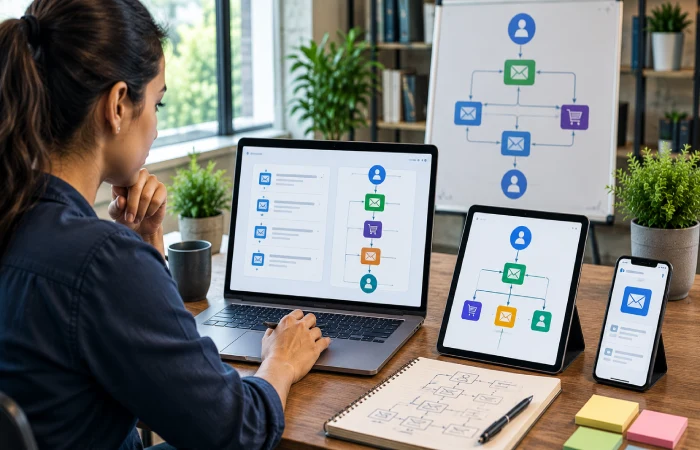
Studying email examples is one of the most useful things you can do to improve your own program. Not to copy them — to understand the decisions behind them. Everything about a successful email serves a purpose. That‘s when you begin to see how everything on an email is there for a reason.
Welcome emails first, because they’re the most universally important and the most consistently underbuilt. The solution to that is the welcome email and it‘s your single most effective way to establish the tone of the relationship, provide something immediately useful, and tell them what to expect moving forward. A welcome email that provides a strong value proposition and a specific next step right out of the gate will way outperform a generic “thank you for subscribing” email arriving six hours later. Craft a three part email series. It’s more work upfront. It pays back every single time.
All winning promotional emails have one thing in common that 99 percent of brands overlook: they stay relevant to the recipient. One off 20% off everything email sent to your full list on the same day is always going to underperform one targeted offer sent to a segment of your list who viewed a product category, purchased a product type before or haven‘t opened your emails in a while. Segmentation isn’t just a best practice. For promotional emails specifically, it’s the difference between a campaign that moves the needle and one that generates a wave of unsubscribes.
Re-engagement emails are the category most businesses ignore until the problem is already severe. Yet when subscribers go dark no opens, no clicks, 90+ days of inactive they continue to send to them gradually ruining their deliverability and not gaining anything. A three-email re-engagement series is nearly free to implement, and has been known to regain 10 to 15 percent of dead accounts. Those who don‘t re-engage are already deleted. Both outcomes are good. The recovered subscribers are now active again. The removed ones stop hurting your sender reputation.
Abandoned cart emails are probably the single highest-ROI automation available to any business that sells products online. Someone was in your store. They found something they wanted. Something stopped them — price, distraction, uncertainty, a phone call. A well-timed email showing them exactly what they left behind, with a clear path back to purchase and maybe a small incentive, recovers a meaningful percentage of that revenue automatically. Automated campaigns converting at 2,361 percent above traditional sends — abandoned cart sequences are where you see that number most clearly in practice.
Don’t study email examples for design inspiration. Study them for the strategic decisions they reveal. That’s where the real learning is.
Frequently Asked Questions
What actually is email marketing?
It’s the practice of sending targeted, permission-based emails to people who’ve agreed to hear from you — to build relationships, promote what you offer, and drive outcomes you can actually measure. The “permission” part is what makes it different from spam and what makes it work. Subscribers chose to be there. That changes how they receive what you send.
Is email marketing genuinely still worth it in 2026?
The numbers say yes, pretty decisively. $36 to $42 return per dollar spent. Conversion rates seven times higher than social media. 99 percent of email users check their inbox daily. Automated campaigns converting at 2,361 percent above traditional sends. The channel has actually gotten stronger as social media organic reach has shrunk — which is somewhat ironic given how many times email has been declared dead.
I’m a small business. Where do I even start?
Four things. A list — whoever you already have, even if it’s small. A platform — Mailerlite and Mailercloud both have free tiers covering 1,000 contacts. A reason for people to subscribe — a discount, something useful, early access to something. And a welcome email that goes out automatically the moment someone signs up. That’s it. That’s the starting point. Everything else gets built on top of those four things once you have the habit.
What’s a realistic open rate to aim for?
The industry average for 2026 is 26.6 percent for all sectors. Anything above 30 percent is strong. Below 15 percent means something is wrong — usually deliverability issues, a stale list, or subject lines that aren’t landing. Worth mentioning: since Apple introduced Mail Privacy Protection, which has been in place since 2021, tracking the open rate for iOS users is no longer accurate so I believe that the click-through rate is the most reliable indicator of engagement.
How many emails should I send per month?
Five to eight per month shows the highest ROI for most consumer categories. For B2B, one to two per week tends to work. For a small business just getting started, once a week is the right cadence — regular enough to build the habit and stay in the subscriber’s mind, infrequent enough that you’re not burning the list. The “right” frequency for your audience is discovered by watching your unsubscribe rate and adjusting, not by speculating.
Which platform should I use?
Depends on what you need. For beginners on a zero budget: Mailerlite or Mailercloud — both have strong free tiers with automation included. For e-commerce: Klaviyo is where the serious revenue tracking happens. For B2B with a CRM: HubSpot or Active Campaign. For Indian small businesses watching costs: Mailerlite’s free tier covers 1,000 contacts with no time limit. To be honest though, the platform isn‘t as important as simply starting on one. Don‘t let the nervousness of choosing a platform stop you.
What’s the difference between a regular email campaign and automation?
A regular campaign is something you write, schedule, and send manually — a newsletter, a promotion, an announcement. Automation is triggered by behavior — someone subscribes, someone buys, someone hasn’t opened anything in 60 days, someone abandons a cart. The trigger fires the email automatically, without anyone pressing send. Automated emails convert much better than manual at 50 times because they go out right when the subscriber responds. In 2026, if you have no automation enabled, you are leaving the most profitable part of email untouched.
Is email marketing different for businesses in India?
Same mechanics, different context. Indian subscribers are even more mobile-first than US subscribers. Evening and weekend send times consistently outperform morning sends. Festival-season campaigns — Diwali, Eid, Holi, regional celebrations — drive significantly higher open and conversion rates when they’re actually relevant to the celebration rather than just using it as an excuse for a sale. And for businesses serving Hindi or regional-language audiences, local language email content outperforms English-only by a meaningful margin in certain sectors. Most email marketing guides are written entirely from a US perspective. This one isn’t.
Final Thoughts
I keep coming back to that ROI number — $36 to $42 per dollar spent — not because it’s the most important thing about email marketing, but because it’s the thing that tends to shift how seriously businesses take it. And most businesses, honestly, don’t take it seriously enough.
376 billion emails go out every single day. By end of 2026 that number hits 392 billion. Your subscribers are in that inbox every morning. The question is whether your email is the one they open, read, and act on — or whether it’s the one that goes straight to delete without a second thought.
The answer to that question lives in your strategy, your execution, your willingness to test things and adjust based on what you learn. None of the five sections in this guide are complicated. They’re all doable. They just require actually doing them, consistently, over time.
Start with the section that maps to whatever’s most broken in your current setup. Fix that. Then move to the next one. Email marketing doesn’t reward perfection. It rewards consistency.

Creative marketing enthusiast sharing practical insights on digital growth, branding, and online strategies. Passionate about helping businesses succeed with simple, effective, and result-driven marketing solutions.