

How to Create Successful Email Marketing Campaigns in 2026

Last Updated: September 18, 2026
Most email marketing campaigns fail for a boring reason: they’re built as one-off blasts instead of a system tied to where a subscriber actually is in their relationship with a brand. A welcome campaign, a drip sequence, and a re-engagement flow all do different jobs and need different triggers, timing, and content — treating them the same way wastes the list you worked to build. TThe campaign types you should be running in 2026, real life examples of each, and how to build out a drip sequence, welcome series and re-engagement campaign into your overall email marketing strategy.
An email marketing campaign means a series of targeted emails sent to a segmented subscribers list for one specific purpose, for example: subscriber welcome series, a drip sequence nurture campaign or be re-activated campaign.
Types of email marketing campaigns
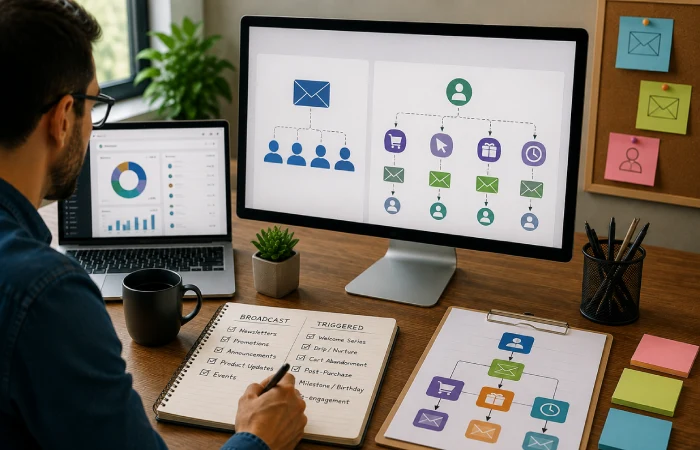
Every email marketing campaign falls into one of two structural categories: broadcast campaigns, sent once to a segment at a scheduled time, and triggered campaigns, sent automatically in response to a subscriber’s action or inactivity. Most working email programs run several of each.
The broadcast category covers newsletters, promotional sends, and announcements — content planned and scheduled by a person, going out to a list or segment at once. The triggered category covers welcome series, drip/nurture sequences, cart-abandonment emails, post-purchase follow-ups, milestone or birthday emails, and re-engagement campaigns — each one fired by a specific subscriber behavior rather than a calendar date.
Whichever type you run, US-facing sends fall under the CAN-SPAM Act, enforced by the FTC. Two requirements catch teams off guard: any opt-out mechanism you offer has to keep working for at least 30 days after a send, and you must honor an opt-out request within 10 business days — after that, you can’t sell or transfer that address to anyone except a vendor helping you stay compliant.
Email campaign examples
The clearest pattern across brands doing this well in 2026 is that each campaign has exactly one job. Duolingo’s streak-reminder emails exist to protect a habit, not to sell a subscription — the gamified badges and streak counts are built around behavioral triggers, not a calendar. Spotify’s annual “Year in Review” send works because it’s personalized with the recipient’s own listening data rather than generic year-end copy, which is a large part of why it gets shared outside the inbox entirely. On the transactional-adjacent side, cart-abandonment and post-purchase flows consistently outperform broadcast sends because they’re timed to a moment of high intent rather than a fixed schedule — automated, triggered emails generated 37% of all email-attributed sales from just 2% of total send volume in 2024, according to Omnisend platform data.
The common thread: campaigns built around a specific trigger and a single objective outperform generic sends built around a send date.
Drip email campaign strategy
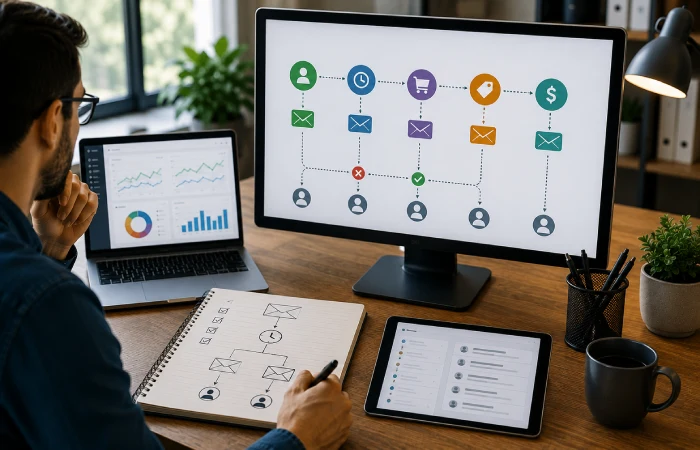
A drip campaign is a set of sentences that are already written and are initiated either by a trigger or fixed period of time “drip” refers to the flow and not to the content, so a drip campaign can be a welcome sequence, lead nurture flow or onboarding sequence, depending on the trigger.
Constructing one involves five moves: choose a single goal for the sequence (not “engagement” something concrete, measurable, such as “trial-to-paid conversion”); identify a trigger event to launch the sequence; construct each email as one job rather than reselling the same pitch; set up the automation with defined exit conditions to quit broadcasting when the user has responded; and monitor it constantly rather than setting and forgetting. Early sequence emails present a problem and earn attention; middle sequence emails present proof and resolve objections; late sequence emails make a call to action or back away if there has been little response.
There‘s a significant difference in the performance between well-constructed and poorly-constructed drips. The best in terms of open rate (28-35%) and click-through rate (6-9%) occurred with the highest quartile of net partners marketing converted performance studies in 2026 while the worst quartile averaged close to 12% opens and 1.4% clicks. This difference was found by analyzing template quality and segmentation discipline rather than total volume send.
Welcome email campaign
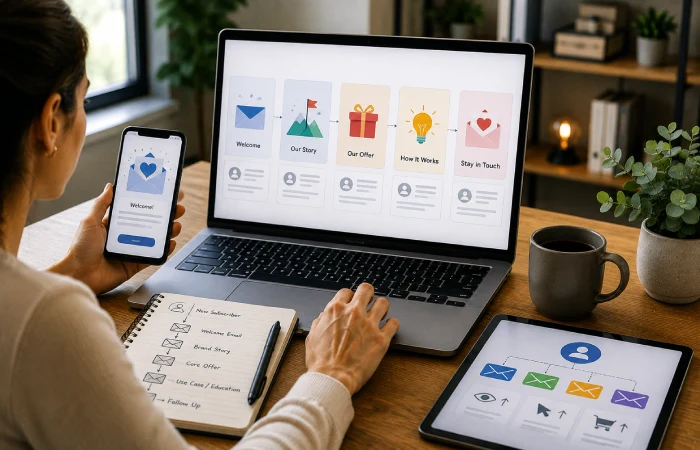
A welcome campaign is the sequence a new subscriber receives immediately after opting in, and it’s consistently the best-performing automated flow in most email programs — a single welcome email already outperforms a broadcast send, and a short series (typically three to five emails) outperforms a single welcome email, generating meaningfully more orders across the sequence than one message alone.
Reported welcome-email open rates vary enormously across sources — anywhere from the mid-30s to the low 80s percent — and that spread isn’t really a disagreement about performance. It’s largely a measurement artifact: Apple’s Mail Privacy Protection pre-fetches message content behind a proxy the moment an email lands, which registers as an “open” on the sender’s side whether or not the recipient ever actually reads it, according to ClickMinded’s 2026 newsletter benchmark analysis. A list that has the high percentage of Apple Mail users will automatically give high open rates, so a 60%+ open rates doesn‘t always represent “real” open rate you need click-through and conversion data.
Structurally, a welcome series is most effective when designed around five different goals over about two weeks: welcome and set expectations, brand story, core offer, a use-case or education email, and a light re-engagement nudge if the earlier emails didn‘t get a click. Teams on a tight resource budget can begin with three (welcome, offer, follow-up) and add later.
Re-engagement email campaign
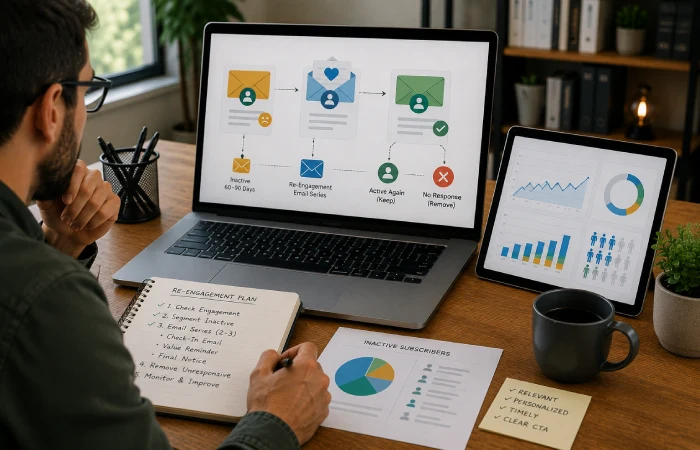
Re-engagement (or win-back) campaign: Keeps records who have fallen off the wagon. Usually after a period of time that a subscriber has not opened, or clicked (generally 60-90 days depending on frequency of normal send, is all I can get) within the time period you have defined.
The sequence tends to build up over two-three emails: Tactfully ask if they still want you in the first one, then have a more compelling reason to respond if they haven‘t, then a simple “we‘ll delete you” message with a simple, easy way to opt-in. Segmenting by history (recently lapsed versus long dormant, previous customer versus never purchased before) is more important in this part of an email program than almost anywhere else: Send a generic win-back blast to a list that hasn‘t been active in a year, and the response rate will be very different from than one sent to people who have only been stale for a few weeks.
Performance benchmarks vary by how “win-back” is measured: Mailchimp’s Re-engagement Report puts average recovery at 14% of inactive subscribers with a 29% open rate when success means any renewed engagement, while purchase-based recovery rates (someone actually buying again) run lower, typically in the low single digits. If a re-engagement email gets no response after the full sequence, remove that subscriber — sending to a chronically unengaged segment drags down deliverability for every other campaign on the list.
FAQ
What is an email marketing campaign?
An email marketing campaign is a coordinated set of one or more emails, sent to a defined segment of a subscriber list, built around a single measurable goal — welcoming a new subscriber, nurturing a lead, or winning back a lapsed one, among others. Campaigns are distinct from one-off transactional emails like receipts, which exist to confirm an action rather than drive a marketing outcome.
What’s the difference between a drip campaign and a regular email campaign?
A regular (broadcast) campaign is planed by a human and blast to a segment at a certain time, a drip campaign is programmed and set to fire on a trigger or interval a user signs up, makes a purchase, or becomes stale. A welcome series or re-engagement flow are both examples of drip campaigns; “drip” refers to the automation pacing, not the subject.
How often should you send marketing emails?
There’s no universal number — frequency should match what a segment has actually engaged with, not a fixed company-wide calendar. A newsletter-style list might support weekly sends, while a promotional list needs closer attention to unsubscribe and complaint rates as a signal to pull back before frequency starts hurting deliverability.
What’s a good open rate for an email campaign?
Depending on the industry, the average open rate for a broadcast campaign is almost always in the 20%–35% range. Triggered campaigns, such as Welcome and Cart-abandonment, perform a lot higher, as they are sent during a highly relevant moment. Any open rate above 45% for non-triggered mails is likely due to privacy-proxy pre-fetching, and should be considered along with click and conversion figures in order to assess the true effectiveness of a campaign.
How long should you wait before removing an inactive subscriber?
The vast majority of programs will cut people off if they haven‘t opened a mail or clicked a link for 60 to 90 days, start a two- to three-piece re-engagement drip once they reach that point, and then delete everyone who hasn‘t engaged by the end of that campaign. Sending in a consistently disengaged segment will is not just inefficient, it will poison sender reputation and inbox placement for every other campaign for the entire list.

I’m Thomas — Editor & Admin of incmarketingplace, Blogger, and Senior SEO Analyst. writer at Inc Marketing Place, sharing insights on SEO, branding, content marketing, and online business growth. I focuses on creating practical and easy-to-understand content for marketers, entrepreneurs, and growing businesses