

Digital Marketing Agency vs Consultant Cost Comparison Guide

Last Updated: September 18, 2026
So somebody asked me last month — why’d one agency quote $4,500 a month and another quote $14,000, for what sounded like the same exact scope? Fair question. And the honest answer? Pricing in this space is just genuinely messy. Not because anyone’s scamming you, necessarily. It’s that agencies and consultants don’t even price things the same way, so comparing them feels like comparing rent to a mortgage.
This guide fixes that, hopefully. Real 2026 numbers, agency and consultant, side by side, so you’re not guessing. And look — this isn’t really about which number is smaller. It’s about which structure actually fits the thing you’re trying to do.
Quick gut check before the numbers. Need ongoing execution, multiple channels running at once, content and ads and social and email all moving together? Agency. Usually. Need someone sharp to think through one specific, painful problem? Consultant. Usually. Keep that in your head. The cheaper option on paper is not automatically the smarter one.
Average Agency Pricing

Agency pricing is all over the map and honestly there’s a reason for that — you’re not just buying the work, you’re buying the team behind it. The account manager. The tools. The overhead of, you know, running an agency.
Clutch pulled 2026 data from more than 100,000 digital marketing agencies. The range: $5,000-$50,000 per month. Wide. Most small and mid-size businesses land well under that ceiling though — realistically somewhere between $2,500 and $15,000 depending on what you’re asking for.
What Actually Moves the Price
Boutique shops — two to fifteen people, usually — start around $1,500 to $3,000 a month if you’re only doing one channel. SEO only, say, or just social. Mid-market agencies running multi-channel campaigns? $7,500-$15,000. Enterprise-tier, full-service teams, and you‘re talking $15,000 -$30,000+.
Hourly billing exists too, less common for ongoing retainer work but it’s out there. Clutch’s numbers show $25 to $49 an hour on the low end. More experienced shops charge $100+, especially when it’s strategy work and not just execution.
Here’s the thing nobody likes saying out loud. The senior strategist who sold you on the contract? Often not who’s actually touching your account day to day. The bottom line for juniors: anywhere from $3,000-$7000 a month. Mid-level: $7,000-$15,000. Senior strategists and agency principals-the folks you actually pictured: $15,000-$30,000+. Ask who’s on your account. By name. Before you sign anything.
- Boutique single-channel work: $1,500–$3,000/month
- Mid-market multi-channel campaigns: $7,500–$15,000/month
- Enterprise full-service teams: $15,000–$30,000+/month
- Month-to-month contracts often run 15-25% higher than 6-12 month commitments
📖 Read More: Digital Marketing Agency vs Consultant
Typical Consultant Fees

Consultants price differently. No office, no account management layer sitting between you and the work — which can mean better value. Can also mean more risk, since it’s one person and not a team.
Hourly rates, generally, fall somewhere between $75 and $300 in 2026. Newer consultants — one to three years in, mostly tactical stuff — closer to $50 to $125. Experienced ones doing actual strategy work, $150 to $300. And then niche specialists, fractional CMOs, the senior folks with real revenue numbers behind them? $300 to $500+ an hour. Not unusual.
Retainer or Project — Which One Shows Up More
Most consultants doing long-term work move to a retainer instead of pure hourly billing. Typically $1,500 to $8,000 a month for small-to-mid businesses. Fractional CMO arrangements — a handful of hours a week, high-level guidance — sometimes price at $3,000 to $8,000 a month even though the actual hours are pretty light. You’re paying for judgment, not time.
Project work shows up for defined scopes. An audit. A launch plan. A funnel rebuild. Usually $2,000 for something focused, up to $50,000+ for comprehensive strategy work — though honestly most small business projects land well under $10,000.
One thing worth knowing, if you’re the one setting your own rate and not hiring someone else’s: $75 an hour sounds fine until you realize independent consultants only bill maybe 1,000 to 1,500 hours a year, Professional services research from the U.S. Small Business Administration also highlights the impact of overhead costs, self-employment taxes, and non-billable work on independent service providers, which helps explain why consultant hourly rates often appear higher than their actual take-home earnings (U.S. Small Business Administration guidance). out of roughly 2,000 working hours. Self-employment tax eats another 15.3% on top. It’s not just hourly rate times hours worked. Never is.
- Entry-level consultants: $50–$125/hour
- Experienced strategic consultants: $150–$300/hour
- Monthly retainers: $1,500–$8,000/month for most small-to-mid businesses
- Project-based audits and strategy work: $2,000–$50,000+ depending on scope
📖 Read More: Digital Marketing Consulting Cost
ROI Comparison
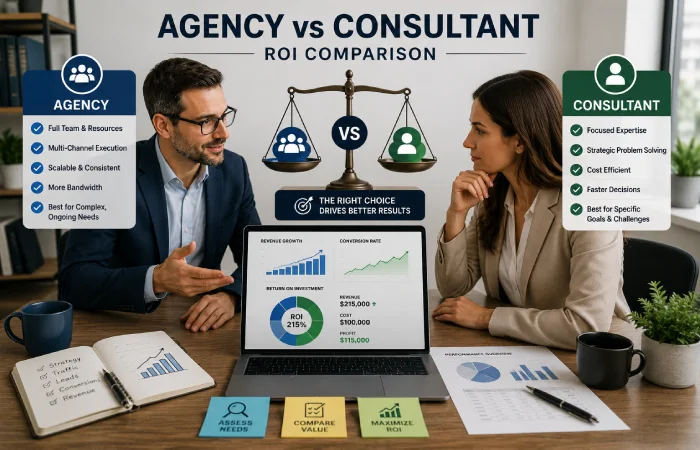
Cost and value aren’t the same thing. Obvious when you say it like that. But most cost comparisons stop right at the sticker price anyway, which is sort of the whole problem. This focus on outcomes over spend aligns with the Google Analytics measurement framework, which emphasizes tracking business objectives, conversions, and customer outcomes rather than evaluating marketing efforts solely by cost or activity metrics (Google Analytics measurement strategy). A $3,000-a-month consultant who actually fixes a broken funnel can be worth more — way more — than a $10,000 agency running campaigns that haven’t moved the needle in a year.
There’s a concept some pricing guides call the mistake tax. What you pay to fix bad work. The revenue you lose while things are broken. The hours you burn just managing systems that don’t talk to each other. Hire cheap, hire twice — and now you’ve paid for both the bad work and the good work that replaced it.
Where Agencies Tend to Win
Complexity, basically. Multiple channels moving together — SEO, paid, email, social, all reported in one place — that’s an agency’s home turf. More bandwidth. More specialized people per channel. Hard for one consultant to match that breadth alone, even a really good one.
Where Consultants Tend to Win
Focus. A consultant who’s spent ten years on nothing but B2B SaaS conversion funnels will usually out-think a generalist agency team juggling eleven other clients. And speed — no internal approval chain to slow things down. Agency wants to pivot strategy? Might take a week of sign-offs. Consultant decides something needs to change? Could happen that afternoon.
- Agencies generally win on multi-channel breadth and dedicated bandwidth
- Consultants generally win on focused expertise and decision speed
- The real cost is what you pay to fix mistakes — not just what’s on the invoice
📖 Read More: Digital Marketing Consultant Career Guide
Hidden Costs to Consider
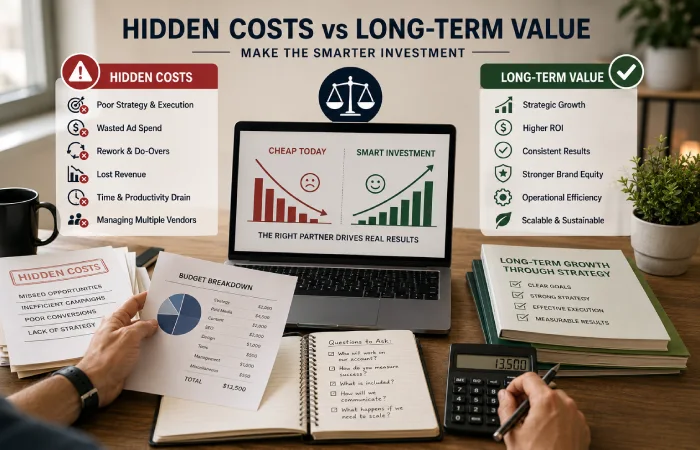
This is where most comparisons quietly fall apart, because the invoice total is never actually the whole story. Both sides — agency, consultant — carry costs you won’t see until you’re three months in.
On the Agency Side
Premium tools. HubSpot, Salesforce, whatever proprietary dashboard they built — often $200 to $2,000 a month on top of what you’re already paying. Bundled packages too. Agencies offer full service bundles because that‘s where they make the best margins. Not because your local plumber needs to add a viral TikTok strategy to his SEO retainer. And if your contract just says ‘ongoing optimization’ with no specifics? You’ve got zero leverage when the work slows down. Get the deliverables itemized. Always.
On the Consultant Side
Different problems here. One person means one point of failure — they get sick, go on vacation, land a bigger client, and your marketing just… stalls. Nobody’s backing them up. Tool access too — a lot of consultants expect you to provide and pay for the software stack yourself, ad accounts, CRM, analytics, rather than folding it into their fee. And since consultants often sell strategy rather than execution, you might still need a separate budget for whoever actually builds what they recommend.
- Ask for an itemized list of deliverables before signing any agency contract
- Clarify upfront whether software and tool costs are included or billed separately
- For consultants — ask what happens if they’re out for two weeks
- For agencies — ask exactly who’s working on your account, by name
Which Option Delivers Better Value?
No universal answer. Anyone who gives you one without asking what you actually need first is probably selling something. That said — patterns do hold up.
Need broad execution, multiple channels, ongoing, and nobody in-house managing it? Agency, usually wins on reliability. You’re paying for redundancy — matters a lot when someone’s out sick and the campaign still has to run.
Got one specific, well-defined problem? A stalled funnel. A launch that needs a real strategy. Senior thinking without hiring someone full-time? Consultant wins, usually, on value per dollar. No account management layer eating into what you’re paying for.
Here’s a pattern worth knowing — a lot of growing businesses use both. Just not at the same time. Bring in a consultant first, diagnose the problem, build the strategy. Then either execute in-house or hand it to an agency once direction’s actually clear. Strategy first, execution second. That order tends to prevent the most expensive mistake in this whole comparison: paying full agency rates for work that never had a real strategy behind it to begin with.
- Choose an agency for ongoing, multi-channel execution with built-in redundancy
- Choose a consultant for focused strategic problems or senior guidance without a full-time hire
- Consider sequencing both — consultant for strategy, agency or in-house for execution
Final Thoughts
Agency versus consultant cost isn’t really a competition with one winner sitting at the end. Agencies run $2,500 to $15,000+ a month, and what you get for that is breadth, bandwidth, redundancy. Consultants run $75 to $300 an hour, or $1,500 to $8,000 monthly on retainer — what you get is focus, speed, senior thinking, minus the overhead.
The number that should actually worry you isn’t either sticker price. It’s the cost of picking the wrong structure for what you need. A great consultant asked to do an agency’s job burns out trying to cover too much ground alone. A great agency hired to solve one narrow problem ends up billing you for a whole team you never needed.
Match the structure to the problem. First. Then look at the actual numbers above. Problem first, price second — that order is basically the whole difference between businesses that get real value from their marketing spend and the ones switching providers every six months, wondering why nothing sticks.
Frequently Asked Questions
Is it cheaper to hire an agency or a consultant?
On a pure hourly basis? Consultants usually come out cheaper — $75 to $300 an hour versus an agency’s blended rate, which has account management overhead baked in. But agencies typically bring more bandwidth and wider channel coverage for that money. Cheaper per hour doesn’t automatically mean cheaper for the result you actually need.
What’s a fair monthly retainer for a small business?
For agencies, $1,500 to $5,000 covers most small business needs if you’re doing one or two channels. For most consultants, that same $1,500-$5,000 range generally gets more senior strategic time since no account management layer.
Why do agency quotes vary so much for what sounds like the same work?
Team seniority, agency size, location, contract length, how many tools get bundled in. A boutique shop and an enterprise firm can quote five to ten times apart for what looks identical on paper. Usually it’s overhead and experience level driving that gap, not necessarily quality.
Do consultants charge less because they’re less qualified?
Not always. Rates well below that $75–$300 range can mean someone’s building a portfolio, working offshore, or leaning heavily on AI tools — worth asking about directly. But plenty of genuinely strong consultants price below agency rates simply because they don’t carry agency overhead in the first place.
What hidden costs should I ask about before signing either contract?
For agencies — tool fees, exactly who’s working your account, renewal pricing. For consultants — who covers things if they’re unavailable, whether execution’s included or billed separately, whether ad spend or software access needs to come from your end.
Can I switch from an agency to a consultant, or the other way, without starting from zero?
Usually, yeah — especially if whoever you’re leaving documented their strategy and reporting properly. Ask for full access to analytics, campaign history, and strategy docs before the relationship ends. Put it in writing. Offboarding terms matter more than people think.

I’m Thomas — Editor & Admin of incmarketingplace, Blogger, and Senior SEO Analyst. writer at Inc Marketing Place, sharing insights on SEO, branding, content marketing, and online business growth. I focuses on creating practical and easy-to-understand content for marketers, entrepreneurs, and growing businesses