50+ Email Subject Line Best Practices That Boost Open Rates

Last Updated: September 18, 2026
A perfectly written email is worthless if the subject line doesn’t earn the open. With the average professional facing over a hundred emails a day, most scanned for a second or two on a phone screen, the subject line is doing more filtering work than almost anything else in a campaign. This guide covers the length constraint every subject line has to work within, what actually makes a line catchy, how personalization really moves the needle, which words put deliverability at risk, and how to A/B test any of it, as part of a broader email marketing strategy rather than a one-off copywriting trick.
Best practices for email subject lines involves having short, concise, personalized, front-loaded subject lines with the presence of no spam words for maximum open rate.
Subject line character length
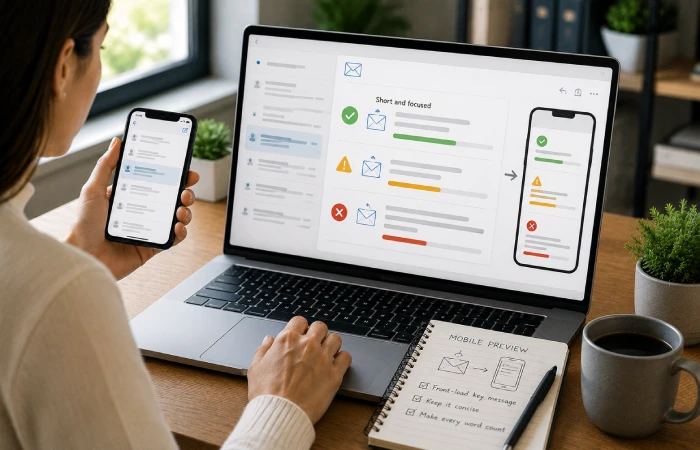
The numbers on length are truly inconsistent, and glossing over them does the reader a disservice. Most lists settle in the 30-50 character range, mostly because that‘s around what iPhone Mail previews in portrait mode and 55+% of consumer opens are in iPhone Mail. But not everyone is consistent: A GetResponse study mentioned by HubSpot found subject lines of 61-70 characters received the highest open-rate in its sample, but 41-50 was best for click-through rate.
The practical solution: always write for the first 30 characters when length is greater than 30. Front-load the specific detail — the benefit, the name, the number — and treat everything past that point as bonus context for readers who see the full line. A subject line that fails in its first 30 characters has already lost the mobile reader, no matter how strong the back half is.
Catchy email subject lines
A catchy subject line isn’t one stuffed with exclamation points — it’s one specific enough that the reader can tell immediately whether it’s relevant to them. Vague, generic lines no longer hold up against Gmail’s automatic categorization and increasingly selective inbox scanning.
- Ask a direct question tied to something the reader is likely already thinking about, rather than a generic teaser.
- Use a specific number instead of a vague quantity — “3 changes to your Q4 plan” beats “some updates for you.”
- Reference a real, current detail — a season, a recent action, a specific product — rather than evergreen filler language.
- Speak plainly rather than marketing speak, a subject line that sounds like it‘s from a person outperforms a subject line that sounds like an advertisement.
- Do NOT USE ALL CAPS and ”!!” all over the place that looks like spam no matter how good your offer is.
The test that trumps any formula: if I would delete the email as soon as I saw it with just the first 30 characters, the rest of the line has already been failed.
Personalized email subject lines
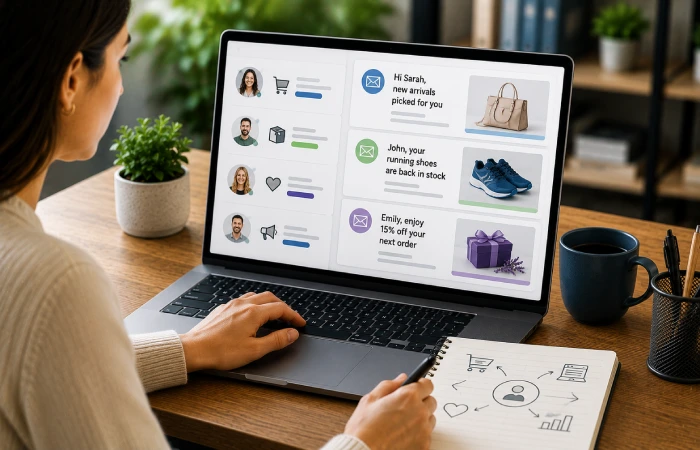
Personalization works however much of it is equally effective? While most best-practices content still treats personalization as a single tactic, it‘s actually a continuum. First-name personalization is now a given as it typically results in a lift in open rate of around 10 to 14% (again, a healthy bump but not revolutionary). Much larger lifts can be gained through behavior-based personalization based on previous purchases, browsing behavior, lifecycle stage and so on. For example, analysis by Digital Applied of AI-based subject line testing revealed dynamic personalization based on actual customer behavior produced a 26% open rate lift (roughly double that of first-name tokens).
The reason behavior-based personalization outperforms: specificity signals relevance faster than a name does. “Your running shoes are restocked” tells the reader the email contains something they already care about; “Sarah, check out our new arrivals” only tells them the email knows their name. For a business without behavioral data infrastructure yet, first-name personalization is still worth doing — it’s just the floor, not the ceiling.
Avoid spam trigger words
Spam filters won‘t block email for a single “bad” word – instead, they consider word choice in conjunction with sender reputation, document formatting, and previous engagement. But certain categories raise risk consistently enough to be worth avoiding by default, especially when combined.
- Exaggerated claims and money language — “100% free,” “earn cash fast,” “guaranteed winner” — the highest-risk category for any sender.
- Manufactured urgency — “act now,” “limited time,” “last chance” — fine occasionally, risky when it’s the default tone for every campaign.
- Health and pharma language — “miracle cure,” “no prescription needed” — scrutinized heavily due to regulatory concerns, relevant mainly to senders in that space.
- Multiple emojis or symbols — stacking attention-grabbing characters (🚀🔥💰) reads as a scam pattern to filters, even when the content is legitimate.
The mistake to avoid isn’t using any of these words ever — it’s stacking several of them in one subject line from a sender with weak engagement history. A well-established sender with strong open rates can use “free” without consequence; a new sender combining “free,” “act now,” and three emojis is asking for the spam folder.
A/B testing email subject lines

A/B testing consistently improves subject line performance, but most guides don’t tell a reader which variable to test first when time or list size only allows for one experiment at a time. Autobound’s synthesis of the Instantly 2026 Cold Email Benchmark Report and Belkins’ analysis of 5.5 million B2B emails found that A/B testing subject lines improves open rates by an average of 49%, with personalization level producing the largest measurable difference of any single variable tested.
A practical testing order, from highest to lowest typical impact:
- Personalization level — generic versus first name versus behavior-based; the largest lever available.
- Format — question versus statement versus direct call-to-action; consistently double-digit-point differences.
- Length — short versus long, once personalization and format are settled.
- Tone and emoji use — worth testing, but with smaller typical impact than the three above.
For a list under a few thousand subscribers, testing every variable at once dilutes the sample past the point of a reliable result — one variable per send, starting with personalization, gets a usable answer fastest.
FAQ
What is the ideal length for an email subject line?
Most data converges on 30 to 50 characters, largely because that’s what iPhone Mail displays before truncation, though results vary by dataset and some studies have found longer lines performing well on open rate specifically. The safer rule regardless of total length: front-load the specific detail into the first 30 characters.
Do personalized subject lines actually increase open rates?
Yes, but how much the lift is will depend on what kind of personalization. Personalized emails that use first names usually lift opens 10 to 14 percent. Personalized emails that use your customers real shopping behavior (their past purchases, how they interacted on your website, etc.) have been shown to be near a 26 percent lift.
What words trigger spam filters in email subject lines?
Certain words, like overblown money messages, created sense of urgency language, health/pharma terminology, and piled-on emoticons and symbols pose the greatest threats, particularly when combined. No single word on its own can offend a spam filter. There are also complicated calculations based on sender reputation and how engaged a user tends to be with prior messages.
How do you A/B test an email subject line?
Separate into randomized and comparable lists. Test one variable at a time, then send out to large enough sample to make the test statistically sound. Personalization level usually gives the largest statistically significant variation so this is generally the highest value item to test if you only have one test you can run per send out.
Test one subject line variable on your next send
Before rewriting an entire subject line library, pick the next scheduled campaign and run a single personalization test: generic subject line against one using real behavioral data, if that data is available, or first-name personalization if it isn’t. That one test, tracked against the 49% average lift A/B testing tends to produce, will tell you more about what actually moves your specific audience than any general best-practices list, including this one.

I’m Thomas — Editor & Admin of incmarketingplace, Blogger, and Senior SEO Analyst. writer at Inc Marketing Place, sharing insights on SEO, branding, content marketing, and online business growth. I focuses on creating practical and easy-to-understand content for marketers, entrepreneurs, and growing businesses