
The Content Marketing Funnel Explained: TOFU, MOFU, BOFU Guide

Last Updated: September 18, 2026
Most blogs default to writing whatever topic comes to mind that week, which is how a site ends up with forty awareness-stage posts and nothing for a prospect who’s already decided they need help. The content marketing funnel fixes that by giving every piece of content a job tied to where the reader actually is in their decision. This guide breaks down each stage, gives real content examples for each, and walks through mapping your existing content against it — all as part of a broader content marketing strategy rather than a standalone exercise.
A content marketing funnel is a framework that organizes content into awareness, consideration, and decision stages to guide a prospect from stranger to customer.
Content funnel stages
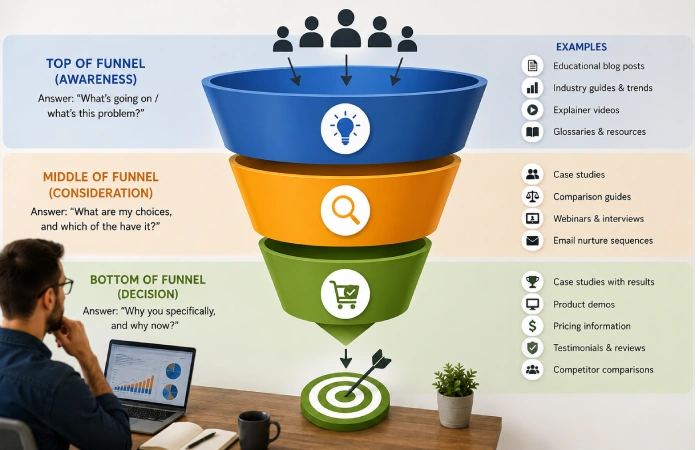
The funnel goes through three core stages to address three different questions the reader is silently asking. Top of the funnel (TOFU) content asks “what‘s going on / what‘s this problem?”. Middle of the funnel (MOFU) asks “what are my choices, and which of the have it?”. Bottom of the funnel (BOFU) asks “why you specifically, and why now?”.
The stages aren’t equally weighted in most content libraries. Companies tend to over-invest in TOFU because it’s the easiest to produce and measure — traffic and impressions are visible fast — and under-invest in BOFU because it requires product-specific detail that takes longer to write well. A useful gut check: pull up your last ten published posts and sort them by stage. If eight of them are TOFU, that’s not a content problem, it’s a funnel-balance problem.
Top of funnel content

TOFU content works by educating a reader who doesn’t know your brand yet, not by selling to them. The job is to be useful enough that the reader remembers you the next time they think about the problem. Semrush’s practical guide to the conversion funnel frames this stage as demonstrating an understanding of the reader’s pain points and expertise, before ever asking for anything in return.
That framing rules out certain formats by default. The “get a demo” CTA on a first time visitor blog post is pointless because they have no context yet for the benefit of a demo.
Formats that work well here:
- SEO-optimized educational blog posts answering broad “what is / how does X work” questions
- Industry statistics roundups and trend explainers
- Beginner-level guides or glossaries
- Short explainer videos or infographics
- Thought-leadership pieces that don’t mention your product
Common TOFU mistake: loading these posts with product mentions. Keep the CTA soft — a newsletter signup or a related read, not a sales ask.
Middle of funnel content examples

MOFU content picks up a reader who already knows they have a problem and is now comparing how to solve it. This is where most funnels quietly break, because the version of the reader who clicked your TOFU post isn’t the same person who’s ready to read a detailed comparison guide six weeks later — the content has to meet them at a different level of specificity.
Content types that consistently work at this stage:
- Case studies showing how a similar customer solved the same problem
- Comparison guides that evaluate categories of solutions, not just your product
- Webinars or expert interviews that go deeper than a blog post can
- Whitepapers or original research that builds authority
- Email nurture sequences that follow a lead magnet download
A detail worth getting right: MOFU content should still feel educational, not like a pitch deck. A comparison guide that only flatters your own product reads as biased and undermines the trust this stage exists to build.
Bottom of funnel content strategy
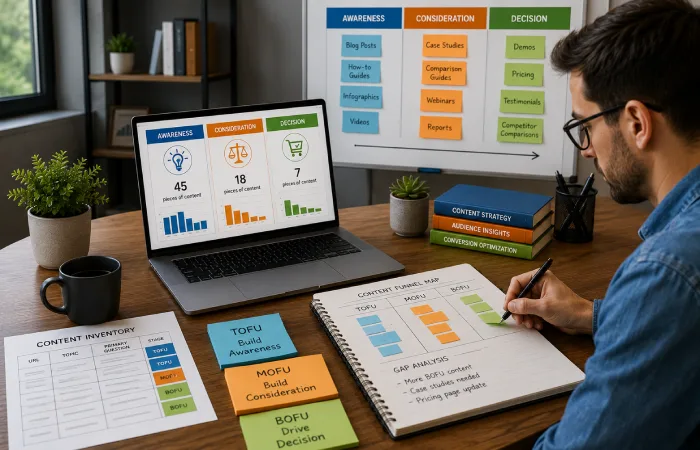
BOFU content targets a reader who’s evaluated their options and is deciding between a short list of specific vendors, including you. The job here shifts from education to reducing risk — answering the last objections standing between interest and a signed deal.
Reliable BOFU formats:
- Case studies with concrete, specific results (not vague success stories)
- Product demos or hands-on walkthroughs
- Pricing pages that answer cost questions directly instead of hiding behind “contact us”
- Customer testimonials and reviews
- Direct competitor comparison pages (“Us vs. [Competitor]”)
BOFU keywords tend to have lower search volume than TOFU keywords, but the searcher is far closer to a decision — phrases like “[competitor] alternative” or “[category] pricing” carry buying intent even though fewer people type them. A small number of well-targeted BOFU pages can outperform a much larger stack of TOFU posts on pure conversion count, even though they’ll never win on traffic volume alone.
How to map content to funnel
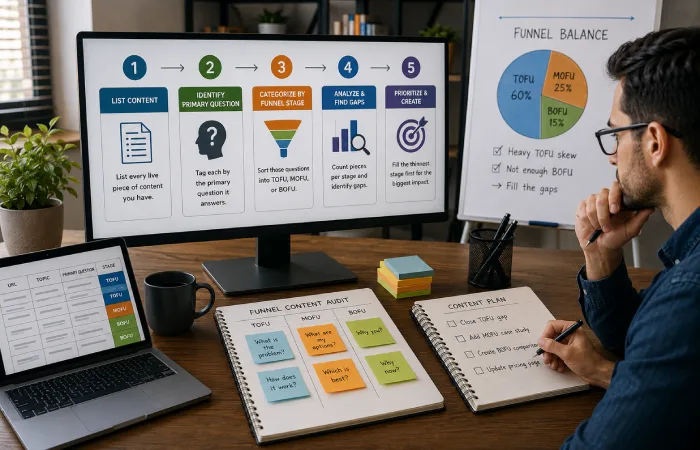
Content mapping goes wrong most often when it’s treated as a labeling exercise — taking content that already exists and slapping a stage tag on it after the fact. A better process starts from understanding how the audience actually thinks and what they need at each specific moment, then building or sorting content to match that, rather than working backward from what’s already been published.
A workable process for a small-to-mid content library:
- List every live piece of content you have, one row per URL.
- Tag each by primary reader question it answers — not by topic, by the question (“what is X” vs. “which X should I pick” vs. “why you over the alternative”).
- Sort those questions into TOFU, MOFU, or BOFU using the stage definitions above.
- Count pieces per stage. A heavy TOFU skew with almost no BOFU is the most common gap.
- Fill the thinnest stage first rather than adding more of whatever stage already has the most content — that’s where the fastest conversion lift usually sits.
Run this audit quarterly rather than once. Funnels change over time, especially when new content is automatically and ad hoc added. Even a controlled library, which was in balance six months ago, can subtly drift back to all-awareness without some kind of systematic oversight.
FAQ
What are the three stages of a content marketing funnel?
There are three levels, from top to bottom of funnel (TOFU), middle of funnel (MOFU), and bottom of funnel (BOFU) which also include terms such as awareness, consideration and decision. Some models include a fourth “advocacy” stage which occurs after the purchase, although their main funnel is these three:
What’s the difference between TOFU, MOFU, and BOFU content?
The purpose of TOFU content is to inform the reader who isn‘t familiar with your brand yet. TOFU content should not sell. MOFU content helps a reader who knows they have a problem compare specific solutions. BOFU content addresses a reader who’s down to a short list and needs a final reason to choose you.
How do you create content for each funnel stage?
Use the question the reader is really asking at that point as a starting point and match the format to that — ToFU is generally educational, MOFU is about comparisons and case study content, BOFU can be about pricing, demo or competitor comparison. Starting with the reader‘s question rather than the form list prevents the BOFU from feeling haphazard.
What content type works best at each stage?
No single format wins across all three stages. Blog posts and infographics tend to perform best at TOFU, case studies and webinars at MOFU, and product demos, pricing pages, and testimonials at BOFU — though the right choice always depends on how your specific audience prefers to evaluate a purchase.

I’m Thomas — Editor & Admin of incmarketingplace, Blogger, and Senior SEO Analyst. writer at Inc Marketing Place, sharing insights on SEO, branding, content marketing, and online business growth. I focuses on creating practical and easy-to-understand content for marketers, entrepreneurs, and growing businesses