
Content Marketing 101: The Complete Guide for 2026 (Strategy + Examples)

Last Updated: September 18, 2026
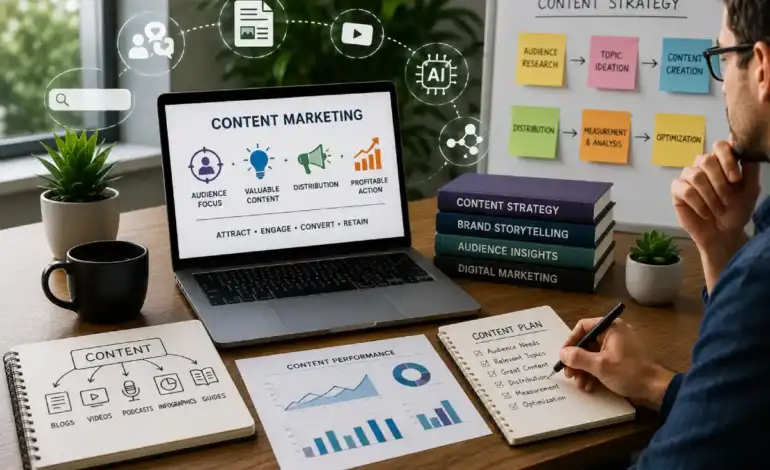
A. Content marketing- Defined in the textbook, content marketing is the production and dissemination of relevant, valuable content to attract a clearly defined audience and in turn, encourage profitable customer action, not just traffic, page views or Facebook likes. That‘s the textbook definition, and it has not changed. What has is the context: Where everyone is Discovering content, who is reading it first, and what “success” means to the CFO‘s dashboard.
It‘s if you typed “content marketing” into a search engine expecting to find a neatly packaged good definition and a step-by-step guide you‘ll get exactly that in this guide. However, you‘ll also find the one thing most every guide in this guide online completely misses missing: a truthful explanation of content marketing in 2026, when your target market includes being not only human beings but also AI platforms like ChatGPT, Gemini, and Perplexity who ultimately decide if your brand‘s mention even occurs in the first place.
Let’s start from the beginning.
What Is Content Marketing? (The Modern Definition)
Although the field of content marketing has some long roots in the past, the topical words under which it is currently applied have largely been marketed and popularized by Content Marketing Institute, one of the foundations set up by Joe Pulizzi in 2010. The Institute defines content marketing as: A strategic marketing approach focused on creating and distributing valuable, relevant content to attract and retain a clearly-defined audience and, ultimately, to drive profitable customer action.
The one that people seem to get hung up on the most, though, is content marketing vs advertising. While advertising says “Buy this,” content marketing says “Here‘s something you will find useful anyway” and then waits patiently for the relationship to develop until the point when the customer finally makes a purchase. Over time, content marketing has a compounding effect an effective content asset generates leads, solves customer questions and builds confidence years after it has gone live, unlike paid advertising which requires zeroing out the budget.
None of that means content marketing is soft or unmeasurable, by the way. It’s just measured differently than a click-through campaign — more on that later.
A Short History of Content Marketing: From Farmers’ Almanacs to AI Overviews
People assume content marketing is a product of the blogging era. It isn’t even close. Benjamin Franklin published Poor Richard’s Almanack in 1732, packing it with proverbs, weather predictions, and practical farming advice — all in service of selling his printing business. It worked well enough that it ran annually for 25 years.
A century and a half later, John Deere launched The Furrow in 1895, a magazine that taught farmers how to be more successful and profitable — not a catalog pushing tractors. It’s widely cited in content marketing case studies as reaching several million readers at its peak in the early 20th century, and remarkably, The Furrow is still published today, in multiple languages, more than 125 years later. That’s not a fluke; it’s proof that genuinely useful, non-salesy content has a shelf life that outlasts almost any ad campaign ever created.
Michelin followed a similar logic in 1900, publishing a free guide packed with maps, mechanic listings, and hotel recommendations — designed to get people driving more, so they’d wear through more tires. Jell-O did the same thing in 1904 promoting free recipe booklets from house to house. Within two years, sales had reached $1 million.
In 2010, Joe Pulizzi established the discipline with the founding of the Content Marketing Institute, named and creating a community around “content marketing”, and later holding an annual conference (Content Marketing World) that helped turn “content marketing” from a grab-bag tactic into a high-level corporate strategy.
And now we‘re in an unprecedented 4th act a decade ago no one saw coming: the generative retrieval era, where the very content you publish may never be “read” on your website; instead it will be paraphrased, quoted or interpreted by an AI model for a human before they ever get there. The barriers to entry that once separated real publishers from everyone else — printing presses, distribution networks, broadcast licenses — are gone. Every brand is a publisher now. The bar isn’t “can you publish,” it’s “is what you publish actually worth citing.”
Mapping Content to the B2B Buyer’s Journey

Probably the quickest way to blow your content budget is to publish into the wind without understanding exactly who is reading and how far along they are in the buyer‘s journey. B2B purchasing over the last decade has emerged as a predominantly self-service and digital journey research by Forrester, Gartner and others has identified that B2B buyers often research and shortlist vendors long before they are engaging a salesperson:
That means your content needs to do a lot of the selling before your sales team even gets on a call.
| Funnel Stage | Buyer Mindset | Best Content Formats | Core Metrics |
|---|---|---|---|
| Awareness (TOFU) | “I have a problem, but I don’t fully understand it yet.” | Educational blog posts, guides, original research, short-form video | Organic traffic, time on page, new-visitor rate |
| Solution Exploration (MOFU) | “I understand the problem. What are my options?” | Comparison guides, webinars, expert interviews, case studies | Content-to-lead conversion, email sign-ups, webinar attendance |
| Vendor Selection (BOFU) | “I’ve shortlisted vendors. Convince me you’re the right one.” | ROI calculators, pricing breakdowns, client testimonials, live demos | Demo requests, sales-qualified leads, pipeline created |
| Retention & Advocacy | “I bought it. Now help me get value from it.” | Onboarding guides, customer success content, community, case study features | Renewal rate, expansion revenue, referral volume |
The mistake most teams make is producing almost everything for the top of the funnel — it’s the easiest content to write and the easiest to justify — while starving the middle and bottom stages that are actually closest to revenue. If your blog is full of “101” articles but you have no comparison content or ROI tools, you’re generating awareness for competitors to close.
Content Shock Is Real: Why More Content Isn’t the Answer Anymore
In January 2014, marketing consultant Mark Schaefer introduced an idea that uncomfortable for many marketers: “Content Shock” Content Shock argues that there‘s a simple reality we all need to face. The amount of content being produced online was increasing dramatically. The amount of attention, on the other hand, was limited. At some point, the math stops working. You can’t out-publish an infinite market.
Twelve years later, that prediction looks less like a theory and more like a description of Tuesday. Generative AI tools have made it trivially easy to produce huge volumes of “content” — most of it generic, unoriginal, and functionally interchangeable with a thousand other AI-generated articles targeting the same keyword. Google has publicly stated it doesn’t penalize AI-assisted content simply for being AI-assisted, but it has also been explicit, through its Helpful Content system introduced in 2022 and folded into core ranking since, that content produced primarily to game search rankings — rather than to genuinely help a reader — gets demoted, sometimes site-wide.
This is where the distinction between a Content Creator and a Content Artist actually matters. In theory, a Content Artist is also an irreplaceable optimization, providing original data that no one else can provide, a perspective based on authentic experience, a degree of detailedness that a generalized AI summation cannot match because it was never given that information to work with to begin with.
Practically, that means:
- Publish original research, surveys, or proprietary data whenever you can — even small-sample internal data beats another rehash of someone else’s stats.
- Put a named, credentialed human byline on your content, not“Admin“or a facelessbrand voice.
- Say something that actually requires you to have done the thing you are writing about.
- Say something that requires you to have actually done the thing you’re writing about.
That last point is essentially Google’s own “Experience” pillar in its E-E-A-T framework — Experience, Expertise, Authoritativeness, and Trustworthiness — which Google formally added to its Search Quality Rater Guidelines in December 2022, specifically to reward content written by people who’ve actually lived the thing they’re describing.
SEO vs. GEO: Optimizing for Google and the AI Answer Engines

Here’s the part most “Content Marketing” guides still gloss over: search itself has split in two. There’s still traditional Google search, where you’re competing for a ranked position on a results page. And there’s now a parallel track — Generative Engine Optimization, or GEO — where you’re competing to be the source an AI model chooses to cite, quote, or summarize when it answers a question directly, sometimes without the user ever clicking a link at all.
We have seen industry studies in 2024 and 2025 (from Ahrefs, Advanced Web Rankings, Pew Research Center) reporting sizeable drops in organic click-through for queries showing an AI Overview or AI-generated summary, in percentage depending on the study and the query type, but always down, less clicks to your website when you rank high, as the answer is often given before people scroll down.
Here’s how the two disciplines actually differ in practice:
| Factor | Traditional SEO | Generative Engine Optimization (GEO) |
|---|---|---|
| Primary goal | Rank in the top 10 results | Get cited or quoted inside an AI-generated answer |
| Core metric | Organic traffic, rankings, CTR | Citation frequency, share of voice, brand mentions in AI responses |
| Content structure | Keyword-optimized headers, long-form pages | Extractable, standalone statements an AI can lift without context |
| Ideal opening | SEO-friendly intro paragraph | “Bottom Line Up Front” (BLUF) — a direct, quotable answer in the first few sentences |
| What gets rewarded | Backlinks, domain authority, on-page optimization | Named statistics, original data, expert quotes, clear attribution language |
| Distribution surface | Google, Bing | ChatGPT, Gemini, Perplexity, Claude, Grok, Google AI Overviews |
| Failure mode | Ranking on page 2 | Being invisible even while ranking well organically |
A few things worth building directly into your content strategy because of this shift:
Write in BLUF format. Open each major section with a clear, standalone answer before you explain the reasoning behind it. AI models tend to pull heavily from the earlier portion of a page’s text — so if your best insight is buried in paragraph twelve, it’s not getting cited.
Use explicit attribution language. Explicit citing those that beg for a sure source of the claim – “based on,” “one study out of X says,” “as professor so-and-so says”- act as syntax handles that improve the model‘s ability to lift and attribute your content rather than turn you into a paraphrasing, blendering, unrecognizable mess.
Feed it facts, not filler. AI retrieval systems, much like Google’s own quality systems, favor pages dense with verifiable statistics, named entities, and dates over pages padded with generic commentary. If a paragraph could apply to literally any brand in your industry, it’s not doing any citation-earning work.
Don’t ignore technical basics. Server-side rendering, clean crawl access via robots.txt, and genuinely fast page speed still matter — an AI crawler that can’t parse your page can’t cite it, no matter how good the writing is.
Where Does Your Brand Stand? Understanding AI Visibility Tiers
Not every brand starts this race from the same line, and it’s worth being honest about that instead of pretending a perfectly optimized blog post levels the field overnight.
Early research from AI visibility monitoring tools suggests brand recognition on AI platforms tends to fall into a rough three-tier pattern:
- Established global brands with heavy existing press coverage, Wikipedia presence, and years of backlinks tend to get mentioned by AI models even on broad, unbranded category questions (“best project management software,” for example) at a noticeably high rate.
- Established mid-market brands with decent digital footprints but less blanket media coverage get mentioned meaningfully less often on those same unbranded queries.
- Smaller, niche, or early-stage brands — even ones doing genuinely excellent work — are frequently invisible on unbranded category prompts entirely, simply because the underlying language model has little to no trustworthy signal connecting them to that category yet.
The practical takeaway isn’t discouraging, it’s clarifying: if you’re a smaller or newer brand, don’t expect a single pillar page to make ChatGPT start recommending you for generic category searches. What actually moves that needle is accumulating “brand mass” over time — earned media coverage, a presence on trusted third-party comparison sites, a Wikipedia entry if you qualify for one, and consistent mentions across the kind of sites AI models already trust.
That last point matters more than most marketers realize. AI models lean heavily on third-party validation rather than brand-owned content when forming their answers — comparison sites, review platforms, YouTube, established media outlets, and community discussion tend to carry far more weight in an AI’s citation decision than your own website copy does, no matter how well-optimized it is. Practically, that means “best-of” listicles and roundup articles on respected third-party sites are one of the highest-leverage placements you can pursue — a single mention on a widely-cited industry listicle can surface your brand across dozens of related AI queries, far more efficiently than another blog post on your own domain ever could.
Different AI platforms also behave differently enough that a single-platform strategy is genuinely risky. ChatGPT and Perplexity, for instance, source and refresh information on different schedules and from different types of sites — meaning strong visibility on one engine doesn’t guarantee anything on another. Treat this the way you’d treat SEO across Google versus Bing a decade ago: same underlying discipline, different tuning per platform.
Proving ROI: A Practical Framework for Content Attribution

If there’s one line that sums up where content marketing measurement has landed, it’s this: your CFO doesn’t care about pageviews. Multiple industry surveys over the past few years have found that a striking minority of marketers — often cited around one in five — can confidently connect their content output to actual revenue. That gap is exactly why content budgets get cut first when things get tight; nobody upstream can prove they shouldn’t be.
Fixing that doesn’t require a complicated martech stack. It requires scoring content across three dimensions instead of one:
1. Engagement Depth — not just pageviews, but scroll depth, time-on-page milestones, and internal link clicks that indicate someone actually consumed the content rather than bouncing off it. These are easy to set up as custom events in GA4.
2. Conversion Influence — multi-touch attribution that recognizes the role of content in conversion even if it wasn‘t the last touch prior to a form fill. Single-touch last-click attribution frequently underestimates top- and mid-funnel content influence.
3. Revenue Impact — connecting content-influenced leads to your CRM’s deal pipeline, so you can report not just “this page got traffic” but “this page touched $X in closed-won revenue this quarter.”
Score each piece of content on a simple weighted scale across those three categories, and you get something far more useful than a traffic report: a ranked list of which content is actually paying for itself, and which is just taking up shelf space. It also gives you the ammunition to make the case for continued investment — or to justify cutting the pieces that never move past stage one.
Building a Content Marketing Strategy: The Practical Steps
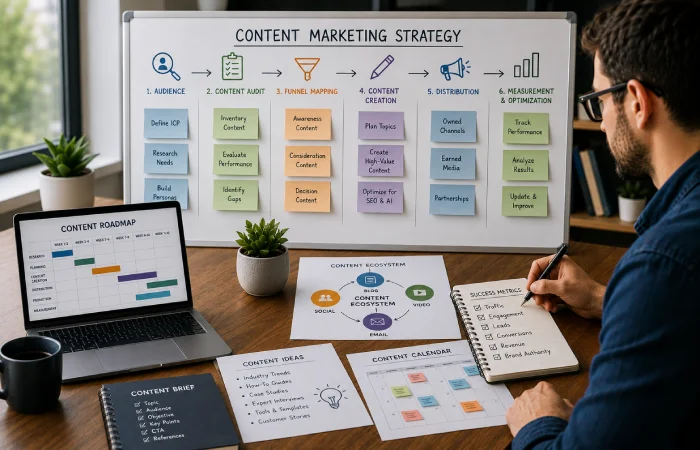
Pulling everything above into an actual working process, here’s the sequence we’d recommend to a team starting from scratch:
- Determine who your audience is and what their real problems are before you determine your content calendar. The persona file no-one looks at is useless; knowing what the three questions your best customers ask before buying are is priceless.
- Audit what you already have. Most companies are sitting on more usable content — old case studies, sales deck insights, support ticket themes — than they realize. Don’t start from zero.
- Map the content to the funnel stages (see table above the beginning of this guide for a template) and determine where your gaps are. The common problem for most teams is that they overly invest in content for awareness and underspend in the vendor-selection stages of the funnel.
- Write for humans first, structure for machines second. Don‘t feed your document to machines first, humans first. Push data structure to one side: if the insight is right, then format it using BLUF openings, stand-out headers and named data points so that readers and AI systems can mine the information.
- Publish consistently, not constantly. Consistency builds trust and topical authority; sheer volume just accelerates content shock.
- Measure across all three attribution dimensions — engagement, conversion, and revenue — from day one, so you’re never stuck retroactively trying to prove value six months in.
- Update and maintain cornerstone content. Search behavior, citation trends and even artificial intelligence (AI) training data all change over time so content that is not kept up to date will eventually lose top rankings and citations to more current competition.
None of these steps are hard to do individually. It is the combination of all seven together, regularly across several quarters rather than weeks, that produces teams that build real content authority versus those that just publish hundreds of blog posts.
Frequently Asked Questions
What is the difference between SEO and GEO?
The first is Search Engine Optimization, which is about getting the content ranked on a search engine SERP and getting click-throughs. The second is Google is Doing SEO, getting the content optimized, timely and “perceivably authoritative” enough to be copied-and-pasted directly into an AI answer output from ChatGPT, Gemini, Perplexity, etc., so in this case you may never have a click-through. They overlap in value (quality, structure, authority) but require different tactical execution.
Does AI-generated content still rank on Google?
Yes — Google has announced that it does not punish use of artificial intelligence tools unless the content was created to manipulate rankings rather than provide some help to the reader, especially when posted on a scale without much human editing or insight.
How do I measure content marketing ROI?
Go beyond pageviews and time-on-site alone. Measure how deeply visitors engage (scroll thresholds, return visits), how content influences conversions (multi-touch attribution in the buyer‘s journey), and how content impacts revenue (content influenced deals in your CRM pipeline). All three, in tandem, provide you with a defensible answer when your executives ask what content actually has value.
How do I demonstrate E-E-A-T and real experience in my content?
Use named authors with visible credentials and real bylines, not anonymous or generic “team” attribution. Include firsthand details — specific outcomes, numbers, or observations — that could only come from someone who has actually done the work being described, rather than summarized information available anywhere else.
What is Content Shock, and how do you overcome it?
Content Shock – coined by Mark Schaefer in 2014, refers to the situation where the amount of content we can access is outrunning our ability to eat it. The way past it isn’t publishing more — it’s publishing content built on original data, genuine expertise, and a point of view that can’t be replicated by a generic AI summary of existing information.
Ready to Build a Content Strategy That Actually Moves Revenue?
Most content marketing advice stops at “publish consistently and you’ll see results eventually.” That’s not good enough anymore — not with content shock crowding every feed, and not with AI search engines deciding what gets seen before a human ever does.
At IncMarketingPlace, we build content strategies around all three layers covered in this guide: funnel-mapped content that actually matches buyer intent, structure that earns visibility across both Google and AI answer engines, and attribution frameworks that let you prove — in dollars, not pageviews — that your content budget is working. If you’re ready to stop guessing and start measuring, get in touch with our team to talk through where your content strategy stands today.

I’m Thomas — Editor & Admin of incmarketingplace, Blogger, and Senior SEO Analyst. writer at Inc Marketing Place, sharing insights on SEO, branding, content marketing, and online business growth. I focuses on creating practical and easy-to-understand content for marketers, entrepreneurs, and growing businesses