
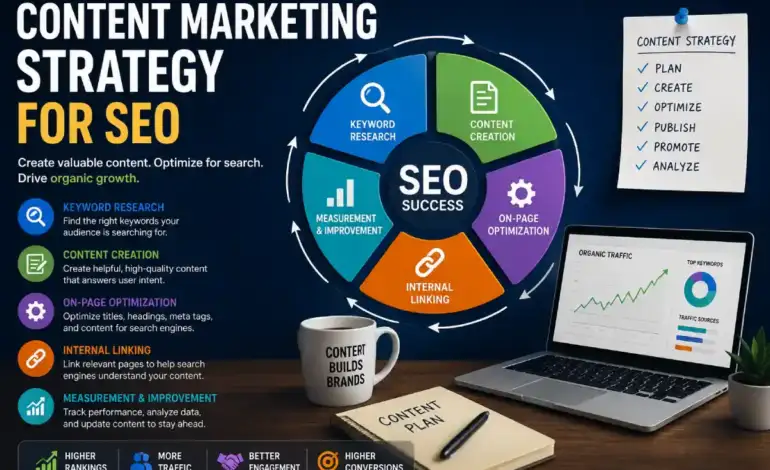
content marketing strategy for seo: A Complete Guide

Last Updated: September 18, 2026
SEO and content marketing go hand-in-hand, as two elements within the same strategy. You want SEO to help you appear to people searching and in search engines, but then you want content to make people stay, engage, build trust, and engage further. A content marketing strategy for SEO is the intentional execution and optimization for the creation, publishing, and promotion of content in pursuit of organic search visibility.
The more the brands themselves can think about what the end users really want from them and how much they can provide, the more they will be able to produce solid content as opposed to keywords being searched the most times per month. SEO content is generally best when it does not sound like a Google document but instead one for the person seeking to obtain information.
What Is a Content Marketing Strategy for SEO?

SEO Content Marketing Strategy: An SEO content marketing strategy is an organized framework for leveraging content that provides value to search visibility and attracts ideal audiences for the business through search engines.
It normally involves several connected activities:
- Understanding the target audience
- Researching keywords and search intent
- Selecting relevant content topics
- Creating useful and original content
- Optimizing pages for search engines
- Building internal links
- Promoting important content
- Measuring organic performance
- Updating older content when necessary
The important word here is strategy. Publishing hundreds of random blog posts is not necessarily content marketing. A strategy gives every important piece of content a purpose.
A shoe company could write an article about selecting running shoes as a beginner. It could also have one about trail running shoes, as well as an article about when to replace running shoes. Both cover different stages in the customer’s journey, yet give an easy opportunity to showcase products.
Why Content Marketing Matters for SEO

Search engines are there to connect people with what they want. If the content perfectly answers the query that spurred the search, then the probability that it’ll rank in a decent position increases significantly. SEO good isn’t just stuffing keywords into writing, for example.
The Seo content of today requires knowledge of search intent, topical relevancy, high-quality content, the authority you exhibit, UX, and your unique selling proposition to be impactful.
Think of the query ‘how to start strength training at home’. Is a one thousand five hundred words of paper regurgitating ‘start strength training at home’ fifty times better than a succinct, action-ready answer about exercise movements, equipment, what’s next for beginners, safety considerations, and an easy weekly schedule? Good Seo content answers the query behind the search engine keyword. Just do that.
Content Marketing vs. SEO Content
Content marketing and SEO content aren’t the same, though there is overlap. The general practice of producing and distributing valuable content to attract, inform, engage, and retain a target audience. SEO content is content written with the explicit goal of gaining rankings in organic search.
A content marketing strategy might include many different pieces of content like blog posts, videos, email newsletters, social posts, guides, case studies, podcasts, and so on.
Organic search would just be one of distribution channel of many.
| Content Marketing | SEO Content |
| Focuses on audience relationships | Focuses heavily on organic search visibility |
| Can use many distribution channels | Primarily targets search-driven discovery. |
| May target existing customers and prospects | Often targets people actively searching. |
| Includes many content formats | Commonly includes web pages, guides, and articles. |
| Builds brand awareness and trust | Builds visibility, relevance, and organic traffic |
The best businesses do not force themselves to choose between the two. They use content marketing to build the brand and SEO to make useful content easier to discover.
Start With Your Audience, Not Keywords
Keyword research is important, but it should not be the first thing you think about.
Start by understanding the people you want to reach.
Ask questions such as:
- What problems are they trying to solve?
- What information do they need before making a decision?
- What questions do customers repeatedly ask?
- What mistakes are beginners likely to make?
- What concerns might prevent someone from buying?
- What terminology does the audience naturally use?
- What information is missing from existing resources?
This process helps you create content that has a reason to exist.
A keyword tells you what people type into a search box. Audience research helps you understand why they typed it.
That “why” is often where the most valuable content ideas come from.
Understand Search Intent
Search intent refers to the reason behind a person’s search query.
Someone searching for “best office chair” is probably in a different stage of the buying journey from someone searching for “how to fix an office chair that leans.”
Common types of search intent include:
Informational Intent
The user wants to learn something.
Examples include:
- What is content marketing?
- How does SEO work?
- What causes dry skin?
Educational blog posts and detailed guides can work well for these searches.
Navigational Intent
The user is trying to find a particular website, brand, or page.
Examples include:
- Google Search Console
- Nike running shoes
- LinkedIn login
Commercial Investigation
The user is researching options before making a decision.
Examples include:
- Best laptops for students
- WordPress vs Wix
- Best email marketing tools
Comparison articles, reviews, buying guides, and detailed explainers can be useful here.
Transactional Intent
The user is ready to take an action, such as purchasing or signing up.
Examples include:
- Buy running shoes online
- Email marketing software pricing
- Book a hotel in Hyderabad
Understanding intent prevents you from creating content that technically targets a keyword but fails to satisfy the person searching for it.
Build Topic Clusters Instead of Random Articles
How to Structure Your SEO Content with Topic Clusters. The most powerful way to structure your SEO content strategy is with topic clusters. A topic cluster starts with a high-level pillar page topic, and smaller, detailed topic pages support the pillar content.
For example:
Pillar topic: Content Marketing
Supporting topics could include:
- Content marketing strategy
- Content marketing funnel
- Content calendar
- Content promotion
- Content writing
- Content distribution
- Content marketing metrics
- SEO content strategy
These pages can be connected through internal links.
This structure helps readers move naturally from one subject to another. It also gives search engines clearer signals about the main topics your website covers.
A website that consistently demonstrates useful knowledge around a subject can develop stronger topical relevance than a website publishing unrelated articles simply because individual keywords appear attractive.
Create Content That Deserves to Rank
SEO optimization cannot rescue content that provides little value.
Before publishing an article, ask a simple question:
If I were the reader, would this page genuinely help me?
Strong content usually does several things well.
It Answers the Main Question Quickly
Readers should not have to fight through a long introduction before finding the information they came for.
It Adds Useful Detail
Don’t try to extend the article just so it can reach a number of words. Explain the significance, give practical solutions, and answer obvious questions.
It Is Easy to Read
Making a long article readable requires the use of short paragraphs, descriptive headings, bullet points, examples, tables, and natural transitions.
It Offers Something Original
Original examples, observations, experiences, comparisons, data, expert commentary, or practical explanations can make content more valuable than a generic rewrite of existing pages.
It Builds Trust
Where appropriate, explain sources, demonstrate expertise, identify limitations, and avoid making claims that cannot be supported.
Keyword Research Still Matters
Keywords remain useful because they provide insight into the language people use when searching.
However, keyword research should be treated as audience research, not merely a checklist.
Look for:
- Primary keywords
- Long-tail keywords
- Related questions
- Synonyms and variations
- Comparison terms
- Problem-based searches
- Beginner queries
- Commercial keywords
- Location-based searches when relevant
Long-tail searches can be particularly useful for content planning because they often reveal a more specific need.
For example, “SEO” is extremely broad.
“Content marketing strategy for small business SEO” is much more specific and gives you a clearer picture of what the searcher may want.
Optimize the Important On-Page Elements
Once the content is useful, optimize it naturally.
Important on-page elements include:
- Page title
- Main heading
- Subheadings
- URL
- Introduction
- Body content
- Image alt text where appropriate
- Internal links
- Meta description
- Structured data when relevant
The objective isn’t stuffing keywords in every nook and corner. Aim for extremely clear communication on your subject, using only natural English. For instance, if your keyword topic becomes a content marketing strategy for SEO, you can continue to speak about keyword research, search intent, topic clustering, internal linking, content optimization, and analysis and get all that achieved without sounding repetitive.
Internal Linking: The Quiet Power of SEO
Internal linking means linking from one page on your website to another relevant page on the same website.
It is one of the simplest ways to strengthen a content strategy.
Suppose you have a comprehensive article about content marketing. Within that article, you might naturally link to separate pages about keyword research, content calendars, SEO audits, and content distribution.
Internal links help readers discover related information without returning to the search results.
They can also help search engines discover pages and understand relationships between different pieces of content.
The key is relevance. A link should be useful to the reader rather than inserted simply to increase the number of internal links.
Content Refreshing Is Part of the Strategy
Publishing content is not the end of the process.
Some articles become outdated. Statistics change. Search behavior evolves. Competitors publish better resources. New questions appear.
That is why content refreshing should be part of an ongoing SEO strategy.
Review older content periodically and look for:
- Outdated facts
- Broken links
- Missing information
- Weak sections
- Old examples
- Poor search intent alignment
- New related questions
- Opportunities for better internal linking
Sometimes updating an existing strong page can be more valuable than publishing another article on a completely new topic.
Measure the Performance of Your Content
A content strategy needs measurable goals.
Useful SEO content metrics can include:
- Organic traffic
- Search impressions
- Click-through rate
- Keyword visibility
- Organic conversions
- Engagement signals
- Leads generated
- Revenue influenced by content
- Backlinks earned
Traffic is useful, but it should not be the only goal.
An article with 20,000 views and no tangible business outcome is essentially worthless compared to an article that gets 2,000 targeted visitors and generates qualified leads. The right way to measure success is based on the goal of your content.
Common Content Marketing Mistakes to Avoid
A good strategy is also about knowing what not to do.
Writing Only for Search Engines
If your article sounds robotic or repetitive, readers will notice. Write naturally first and optimize thoughtfully afterward.
Chasing Every Trending Keyword
Not every popular subject is of concern to your potential audience, though. Traffic that is not of concern to them has seldom generated value for business.
Publishing Too Much, Too Quickly
More doesn’t mean better SEO- Just 10 outstanding pieces of content are better than 50 sub-par content.
Ignoring Older Content
A website can gradually become filled with outdated pages if old content is never reviewed.
Forgetting the Conversion Journey
You might attract readers of educational content who then go on to purchase products. Provide appropriate users with a natural continuation- another guide, product page, consultancy, or newsletter.
Content Marketing Strategy vs. Traditional SEO Strategy
| Factor | Content Marketing Strategy | Traditional SEO-Focused Approach |
| Main focus | Audience and valuable content | Search visibility |
| Primary goal | Build relationships and attract relevant audiences | Improve organic rankings |
| Content role | Central part of the strategy | Sometimes treated as a supporting element |
| Keyword use | Guides topic discovery | Often strongly keyword-focused |
| Long-term value | Brand authority, trust, traffic, leads | Rankings, visibility, organic traffic |
| Best approach | Combine content, SEO, promotion, and measurement | Combine technical and on-page optimization |
Neither approach needs to operate independently. Modern SEO works particularly well when technical optimization and useful content support each other.
The Future of SEO Content
Search is getting a lot more conversational and a lot more varied. More and more searchers are jumping across platforms, devices and different search experiences to find out what they’re looking for. And the result of this is that genuine usefulness is more essential, not less.
For this reason, your content marketing should be about building knowledge, not just stuffing keywords.
Consider the website that you yourself would put your faith in. Probably not the website stuffed to the brim with the same few keywords repeated over and over. Most likely it’s the website with an ability to break down complex subject matter into simple concepts that’s clear in its answers, packed with examples, and simple to navigate to the information you seek next.
That is the standard worth aiming for.
Final Thoughts
A successful content marketing strategy for SEO is not a shortcut to rankings. It is a long-term system for understanding an audience, answering its questions, building topical authority, and creating useful resources that deserve attention.
The most important shift is simple: stop thinking of content as something you publish and start thinking of it as something you build.
Every article should have a purpose. Keyword should connect to a real search need. Internal link should help the reader. Update should make the resource more useful.

I’m Thomas — Editor & Admin of incmarketingplace, Blogger, and Senior SEO Analyst. writer at Inc Marketing Place, sharing insights on SEO, branding, content marketing, and online business growth. I focuses on creating practical and easy-to-understand content for marketers, entrepreneurs, and growing businesses