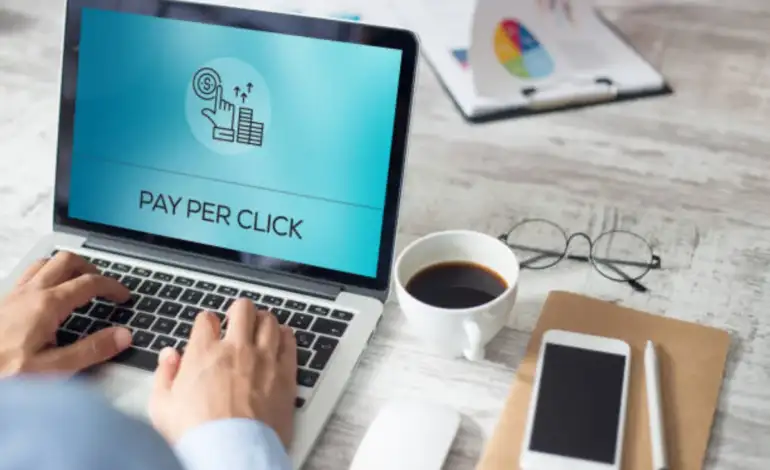
PPC Advertising Explained: The Complete Guide to Pay-Per-Click Marketing in 2026

Last Updated: September 18, 2026
Heads up — this isn’t a surface-level overview. If you want the full story on PPC advertising what exactly it is, how the auction happens under the hood, and how to create campaigns that don‘t bleed money then you‘ve come to the right place..
Get to the point: PPC advertising (or Pay-Per-Click as it is commonly known), is a topic that sounds simple until you are staring at a Google AdWords dashboard wondering how you spent $300 and only got three conversions. This part is very simple: you only pay when someone clicks on your ad. No click, no charge.
But here’s what most guides won’t tell you: the click is the easy part. What happens before the click — the keyword strategy, the bidding, the Quality Score — and after the click — the landing page, the offer, the conversion path — is where campaigns live or die.
This guide covers all of it. Whether you are launching your first Google Ads campaign in a startup office in Bengaluru or you‘re scaling paid media for a business in Chicago, the fundamentals are exactly the same. And that‘s what we will walk you through.
What Is PPC Advertising?
One-line definition: PPC advertising is a digital ad model where you pay only when a user clicks your ad — not when they see it. Every click has a cost. Every cost should have a purpose.
It has been around since early 2000‘s. But it was popularized by Google AdWords, the now Google Ads. And it is what revolutionized how companies buy attention on the web. Before PPC, you paid upfront for ad space and hoped people noticed. With PPC, you only pay when they actually engage.
That shift matters more than it sounds. It means a small bakery in Pune and a global retailer can both advertise on Google — and both pay only for real interest, not empty impressions.
The Main Types of PPC Ads
PPC isn’t just Google search results. It spans multiple formats across the web:
- Search Ads Text ads that show up at the top of Google or Bing results when someone performs a keyword search. These are very intent focused and usually convert well.
- Display Ads- These are visual banner ads that are shown on websites that are part of Google‘s Display Network. They are effective for brand building and remarketing.
- Shopping Ads are product-focused ads on show images, prices, stores, which are essential for e-commerce.
- Video Ads Advertisements which play before a You Tube video clip or within a You Tube video clip. Great for stories and product presentations.
- Social Media Ads (Facebook, LinkedIn, Twitter/X, Instagram sponsored content). These are technically PPC when paid using the cost-per-click bidding.
- Remarketing Ads – ads targeted at people who have already visited your website.. Often the highest-ROI PPC format available.
PPC Terms Worth Knowing From Day One
| Term | Plain English Meaning |
| CPC | Cost Per Click — what you pay each time someone clicks |
| CTR | Click-Through Rate — % of people who see your ad and actually click it |
| Quality Score | Google’s 1–10 rating of your ad’s relevance. Higher = cheaper clicks |
| Ad Rank | Your position in results: Bid x Quality Score. Relevance beats budget |
| Impression | Every time your ad is shown — whether anyone clicks or not |
| ROAS | Return on Ad Spend — revenue generated per dollar spent on ads |
| Conversion | The action you want — a purchase, a call, a form submission |
Where PPC Ads Actually Run in 2026
Google Ads is the obvious one — it reaches over 90% of internet users globally. Google Ads remains the dominant search advertising platform globally, reaching billions of users across Search, YouTube, Gmail, and the Display Network according to Google’s official advertising platform documentation (Google Ads overview). But the PPC ecosystem is wider than that:
- Google Ads — Dominates search advertising. Non-negotiable for most businesses.
- Meta Ads (Facebook + Instagram) – No equal in targeting audience by interest and behaviour.
- Microsoft Advertising (Bing) – Frequently ignored, but CPCs range between 20-30% cheaper than Google and appears to attract a older, savvy demographic.
- LinkedIn Ads — Expensive CPCs but unbeatable for B2B reach
- Amazon Ads — Critical for product-based businesses; buyers are already in purchase mode
- India-specific platforms — InMobi, JioAds, Hotstar Ads are growing fast as mobile internet penetration deepens
Quick takeaway: PPC is not just one thing it‘s a family of ad formats available across search, social, video and display advertising. The channel where you should place your ads depends solely on where your customers actually are.
How Does Pay-Per-Click Advertising Work?
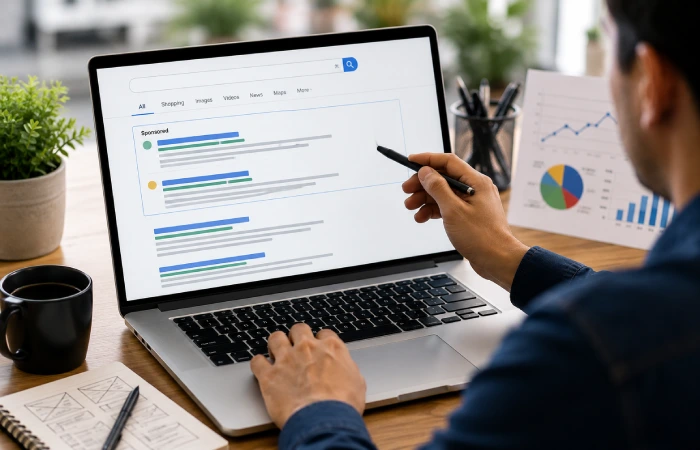
Every time you type a search query into Google in just 200 milliseconds this amazing process is happening an automated auction takes place, a winner is chosen, and an ad appears. You never see any of it. It happens before the page loads.
Here’s what that auction actually looks like from the inside:
The PPC Auction — Step by Step
- User types a query: ‘best running shoes under $100’
- Google scans all advertisers bidding on related keywords
- How is Ad Rank calculate? Ad Rank is calculated for each advertiser: Ad Rank= Max Bid x Quality Score.
- Ads are ordered by Ad Rank, and the highest positions are allocated
- User sees the ads. If they click, the advertiser is charged
The price you actually pay isn’t your maximum bid — it’s just enough to beat the Ad Rank of the advertiser below you. This is called second-price auction logic. Which means bidding smart, not bidding high, is the real game.
Quality Score: The Factor Most Advertisers Ignore
Quality Score is Google’s way of rewarding relevance. It’s scored 1-10 and it directly affects both your ad position and your cost per click. Google itself explains that Quality Score is influenced by expected click-through rate, ad relevance, and landing page experience, all of which directly impact auction performance and advertising costs Google Ads Quality Score documentation. A Quality Score of 8 on a $1 bid can outperform a Quality Score of 3 on a $3 bid.
Three things determine it:
- Expected Click-Through Rate — how likely users are to click your ad compared to competitors
- Ad Relevance — how closely your ad matches the intent behind the search keyword
- Landing Page Experience Is the page you land on the same as suggested in the ad?
The vast majority of advertisers are fixated on Bidding Strategy and completely neglect Quality Score. This is an expensive complacency that silently costs thousands in be inflated CPCs.
Real-World PPC Cost Benchmarks (USA vs India, 2025-2026)
What does a click actually cost? It depends heavily on industry and location. Here’s what the data shows:
| Industry | Avg CPC (USA) | Avg CPC (India) |
| Legal Services | $6–$8 per click | ₹40–₹80 per click |
| Financial Services | $3–$6 per click | ₹30–₹60 per click |
| E-Commerce | $0.50–$1.50 per click | ₹5–₹20 per click |
| SaaS / Software | $2–$5 per click | ₹20–₹50 per click |
| Healthcare | $2–$4 per click | ₹15–₹40 per click |
| Education | $1–$3 per click | ₹10–₹30 per click |
India insight: CPCs in India run 60–80% lower than equivalent US campaigns. For those marketing to Indian audiences or running multi-lingual campaigns, this is one of the most affordable paid options in the paid advertising space at the moment.
PPC Marketing Strategy: Building Campaigns That Don’t Waste Money

Running PPC without a strategy is really expensive. Nearly all of those “I tried Google Ads but it didn‘t work” businesses made one of two mistakes: either picking the wrong keywords or sending traffic to a page that wasn‘t optimized to convert. Sometimes both.
Here’s how to build a PPC strategy that actually holds up:
Step 1 — Know Exactly What You Want the Campaign to Do
Before touching a single keyword, define the outcome. Sounds obvious. Most people skip it.
- Brand Awareness: you want impressions and reach, not necessarily clicks
- Lead Generation: you want form fills, phone calls, demo requests
- E-Commerce Sales: you want purchases — Shopping ads or high-intent search terms
- App Downloads: you want installs — use App campaigns inside Google Ads
Each goal also has a totally different campaign structure, bidding method, and whichever success metric you‘re using. Combining them is how you get campaigns that seem alive but aren‘t.
Step 2 — Keyword Research for PPC (Different From SEO)
PPC keyword research is not about finding high search volume keywords. It’ about finding the keywords that real buyers are actually using when they‘re ready to buy. This are usually more specific than obvious keywords longer and less competitive.
- Use Google Keyword Planner or Semrush or Ahrefs to plan the type of keyword you‘d like to target.
- Prioritize exact-match and phrase-match to control where your budget goes
- Create a list of the negatives from day one. ‘free’, ‘diy’, ‘jobs’, ‘tutorial’ are common budget-killers.
Long-tail keywords (3-5 words) that almost always costs less and converts better than short competitive keywords.
Step 3 — Structure the Campaign Properly
Google Ads has a strict hierarchy. Observe it, and you‘ll keep your campaigns manageable and your Quality Scores high:
- Account → Campaign → Ad Group → Keywords → Ads → Landing Page
- One product or service = one campaign. Don’t mix them.
- Keep ad groups tightly themed — 3-10 closely related keywords per group
- Run at least 3 ads per ad group so you can test what actually resonates
Step 4 — Write Ad Copy That Earns the Click
Your ad is in competition with the page full of all other ads and organic results around it. Your ad gets about 2 seconds to grab your attention. Here’s what works:
- Place the keyword at the beginning of the headline it gives you away immediately.
- Give data and details wherever possible. For example: 3-Day Shipping, From 29/mo, 50 Off Today’
- Be clear about what you want your CTA to be and make it specific: Get a Free Quote, Book a Demo, Shop Now.
- Utilize ad extension that is sitelinks, callouts, structured snippets. They add the real estate and relevancy for free.
Step 5 — Fix Your Landing Pages First
This is the part most advertisers skip, and it’s the most important. Clicks don’t pay your bills — conversions do. A weak landing page will destroy even a brilliant ad campaign.
- Message match is non-negotiable: if your ad says ‘20% Off Running Shoes’, then the headline on the landing page had also better say the same.
- Load speed is very important optimize to get under 3 seconds, particularly on mobile.
- One page, one goal, one CTA. Remove every element that doesn’t support the conversion
- In India, 60%+ of your PPC traffic will come from mobiles. If your page is not optimised for mobile then almost all of you ad spend is wasted.
Step 6 — Track Conversions Before You Spend a Rupee or Dollar
No tracking = no optimization. It’s that simple. Set up:
- Google Ads Conversion Tracking — tracks what happens after the click
- Google Analytics 4 — gives full-funnel behaviour data. Google recommends combining Google Ads conversion tracking with Google Analytics 4 to understand the complete customer journey, attribution paths, and post-click behavior [Google Analytics measurement guidance].
- Google Tag Manager — manages your tracking tags without needing a developer for every change
PPC Mistakes That Silently Kill Campaigns
- Skipping negative keywords — this alone can drain 20-30% of your budget on irrelevant clicks
- Using broad match without supervision — it gives Google too much control over where your ads show
- Sending everyone to the homepage — it’s almost never optimized for conversion
- Ignoring Quality Score — low relevance = high costs, regardless of how much you bid
- Setting it and forgetting it — PPC campaigns need at least weekly review to perform well
The companies that see strong PPC results not spending more they‘re spending wiser. Strategy, structure & ongoing optimization out performs big spend every time.
Benefits of PPC Advertising for Business
There’s a reason PPC is a $190+ billion industry. It works. But not in the vague, theoretical sense — it works in specific, measurable ways that make it one of the most compelling marketing tools available to businesses of any size.
Let’s break down what PPC actually gives you that other channels don’t:
Speed — Genuinely Immediate Results
SEO takes months. Word-of-mouth simply takes time. A well-optimised PPC campaign can go live and start driving clicks within a matter of hours. For product launches, flash sales and venturing into new markets, that latency is really invaluable.
Targeting Precision That’s Hard to Match
PPC lets you get specific in ways that no other channel can replicate at scale. You can target by:
- Keywords — reach people actively searching for exactly what you sell
- Location — down to a specific city, postcode, or radius from a pin on a map
- Device — want to reach mobile users in Hyderabad between 7-9pm? You can do that.
- Demographics — age, gender, household income, parental status
- Audience behaviour — in-market audiences, remarketing lists, customer match
Total Budget Control
You set a daily cap. When it’s hit, the ads stop. There’s no surprise invoice at the end of the month. You can start with 500 rupees a day or $5,000 a day — and adjust, pause, or stop any time. That level of financial control is something most advertising channels simply don’t offer.
Measurability — Every Rupee/Dollar Accounted For
This is where PPC truly shines. You see exactly what you have spent, how many people have clicked, what they have done at your website and have they converted. Compared with a billboard or a radio advertisement where it is difficult to track ROI?
Brand Visibility Even Without the Click
Users who see your PPC ad but don’t click still process your brand name. Paid search advertising sparks branded organic search queries by about 89%. Your PPC campaign is bringing recognition to your brand well before anyone even clicks.
Works at Every Stage of Business
A bootstrapped startup in Noida and a publicly traded company in New York can both run PPC campaigns. The platforms don’t discriminate based on company size. What matters is strategy, not budget.
| Real Strengths of PPC | Honest Limitations |
| Traffic starts immediately | Traffic stops the moment budget stops |
| Laser-precise targeting | Needs active, ongoing management |
| Fully measurable ROI | Competitive keywords get expensive fast |
| Works for any business size | Learning curve — beginner mistakes cost real money |
| Complements SEO well | Ad fatigue if creative isn’t refreshed regularly |
PPC is at its best when you require rapid turnaround, highly targeted, accountable performance. PPC is its weakest when random or novice placement is done, then just left to sit.
PPC vs SEO: An Honest Comparison
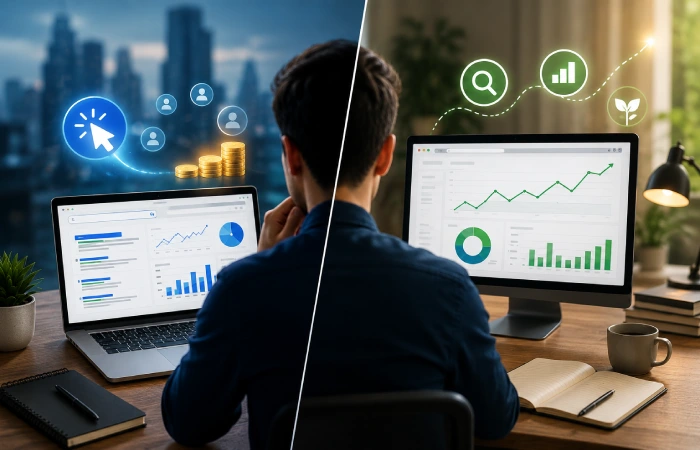
This question comes up constantly, and it usually gets answered badly. People frame it as a competition. It’s not. PPC and SEO are different tools that solve different problems — and the best marketing programmes use both.
That said, if budget is limited and you need to prioritise, here’s what actually matters:
| Factor | PPC | SEO |
| Speed to results | Hours — sometimes days | Months — often 6-12+ |
| Cost model | Pay per click, ongoing | Time + content investment |
| Traffic type | Stops when budget stops | Compounds and persists |
| Targeting control | Extremely precise | Keyword-dependent |
| User trust | Lower — users see ‘Ad’ label | Higher — organic feels earned |
| Scalability | Budget-gated | Scales without proportional cost |
| Best for | New sites, promos, testing | Long-term authority building |
Situations Where PPC Makes More Sense
- You just launched a website and have zero organic presence
- You’re running a time-sensitive offer or seasonal campaign
- You need to test messaging, offers, or audiences quickly before committing to SEO content
- Your target keywords have ‘buy’, ‘hire’, ‘near me’ — high commercial intent terms that convert well
Situations Where SEO Makes More Sense
- You’re creating educational content designed to build long-term authority
- CPCs in your industry are so high that paid search ROI doesn’t make mathematical sense
- You’re playing a long game and want traffic that doesn’t vanish with a budget cut
- Your audience researches extensively before buying — they trust organic results more
The Real Answer: Use Both, in the Right Order
New site? Start with PPC to get traffic and test what converts. Use that conversion data to inform your SEO keyword strategy. As your organic rankings grow, gradually shift budget allocation. Mature business? Run PPC on competitive terms & other new campaigns, get SEO traffic for information & brand keywords.
Businesses appearing in the paid and organic results for the same keyword? That‘s not luck. They‘re actually doing both on purpose.
Quick reality check: There is no best channel. The best answer for you depends on your time horizon, your budget, your competition and, to be honest, how much patience you‘ve got.
PPC Advertising in 2026: What AI Is Changing

It’d be dishonest to write a 2026 PPC guide without talking about AI — because the platforms themselves are now deeply AI-driven. Google’s automation has moved from optional to essentially unavoidable in most campaign types.
Here’s what’s actually happening and what it means for advertisers:
- Performance Max campaigns now run across all Google channels — Search, Display, YouTube, Shopping, Gmail — using AI to allocate budget in real time. You provide assets and goals; the algorithm figures out the rest.
- Smart Bidding uses machine learning to optimize on every auction based on hundreds of signals in real time. Target CPA and Target ROAS bidding strategies have overtaken manual bidding in most mature accounts.
- Responsive Search Ads allow Google to run tests with different combinations of the headlines and descriptions. They will appear whichever is the most effective.
- Predictive audience targeting identifies users likely to convert before they search — based on behaviour patterns across Google’s ecosystem.
The catch: AI-powered PPC still needs human strategy. The algorithm optimises toward whatever goal you set. If you set the wrong goal, or feed it weak creative assets, it will optimise very efficiently toward the wrong outcome. Garbage in, garbage out — just faster.
PPC Advertising: Common Myths vs Reality
| What People Assume | What’s Actually True |
| ‘PPC is only for companies with big budgets’ | You can run effective campaigns from $5-10/day. Budget size matters less than targeting quality. |
| ‘If you run PPC ads, you’ll get sales immediately’ | PPC sends traffic. Conversions depend on your landing page, offer, and how well your funnel is built. |
| ‘The highest bidder always wins the ad spot’ | Ad Rank combines bid AND Quality Score. A relevant $1 bid can beat an irrelevant $5 bid. |
| ‘PPC and SEO are competing strategies’ | They serve different purposes and timeframes. The best programmes use both. |
| ‘Once your campaigns are live, they manage themselves’ | PPC needs regular review — weekly at minimum. Neglected campaigns waste money quickly. |
| ‘PPC doesn’t work for small or local businesses’ | PPC is actually ideal for local businesses — geographic targeting means you pay only for local clicks. |
Final Thoughts: PPC Advertising Rewards the Strategic and Punishes the Careless
Let‘s be honest about PPC in 2026: it is quite easy to get started and costly to do it correctly. All you need is a Google Ads account and a credit card to input. Achieving a true ROI on this spend takes strategy, structure and dedication.
The businesses that genuinely win with PPC — whether they’re in Seattle or Surat — share a few common traits. They have clarity about what they want the campaign to achieve. They put a lot of emphasis on relevance of keywords and managing the negative keywords. They don‘t see the landing pages as an add-on, they see it as part of the campaign. And they base their decisions on data, not gut feel.
PPC advertising is essentially a conversation with someone who is already looking for what you have. They have entered a keyword. They have intent. Turning up with the right message, at the right time that is easy for them to say yes.
That’s the whole game. Strategy, relevance, and follow-through.
Would you like to explore a topic in more depth? Each of the anchor sections links to one of the cluster articles below which contains all the information, examples and step-by-step instructions you need. Use those links.
Frequently Asked Questions
Q1: What exactly is PPC advertising, in plain terms?
It‘s kind of like digital advertising model where we only pay when the ad is clicked not for impressions. This is the place where your ads will appear on google, Bing, Facebook or sites around the web. And you only get charged per click, the ‘per click’ aspect is differentiated from traditional display campaigns.
Q2: How much should I budget for PPC advertising each month?
In US, Small businesses will generally spend anything from $500-5,000/month alone on Google adwords. In case of India, if you run a good campaign, you will be spending INR 10,000-50,000/month depending on the industry and the platform. The more competitive your keywords are the higher you CPC will be – which means you‘ll need a larger budget to generate any real volume.
Q3: Is PPC worth it for small businesses?
Often, yes — especially for local businesses or those in niches where SEO would take too long to show results. The critical factor is tight keyword targeting. Small budgets spread across broad keywords rarely work. Small budgets focused on specific, high-intent terms frequently do.
Q4: What’s a good click-through rate for PPC ads?
Average CTR for search ads is in the 2-5% range in all industries. For display it is much lower, sometimes under 1%. Strong CTR on search is over 5%. It‘s important to also take your conversion rate into account when looking at CTR. You want a high conversion rate that follows a high CTR, a high CTR with low conversion is a poor lead.
Q5: Can PPC advertising work on a tight budget?
Yes but only if you get very targeted. Small budgets will need exact-match keywords,hardcore geo-targeting, and a carefully designed landing page. And in India especially, the low CPCs mean PPC is affordable for anybody with less than Rs 500/day to play with, if they go for absolute precision targeting.
Q6: What’s the difference between PPC and CPC?
PPC stands for Pay-Per-Click, which is the advertising system. CPC stands for Cost-Per-Click which is what you as an advertiser are charged per click. Once you have set up a PPC campaign, you keep an eye on CPC as one of your key performance indicators (KPI s). Consider PPC as the system and CPC as one of the dials you look at inside it.
Q7: How quickly do PPC ads show results?
Ads go live within hours of launching. But ‘results’ is more nuanced — you’ll see traffic immediately, but meaningful optimisation data usually takes 2-4 weeks to accumulate. Most campaigns hit their stride somewhere between 30 and 90 days, once the algorithm has enough conversion data to optimise against.

I’m Thomas — Editor & Admin of incmarketingplace, Blogger, and Senior SEO Analyst. writer at Inc Marketing Place, sharing insights on SEO, branding, content marketing, and online business growth. I focuses on creating practical and easy-to-understand content for marketers, entrepreneurs, and growing businesses