
SEO Content Planning Strategy for Long-Term Organic Growth

Last Updated: September 18, 2026
I‘d like to begin with a question that isn‘t asked often: you published 50 blog posts last year and yet your organic traffic didn‘t change much, what should‘ve happened?
It probably wasn’t the writing quality. It probably wasn’t even the keyword targeting. Nine times out of ten, the issue is that those 50 posts had no real relationship to each other. They were individual shots in the dark rather than pieces of a connected system. And Google, especially after the March 2026 Core Update, is not rewarding disconnected content anymore — it’s rewarding sites that demonstrably know a topic inside and out.
That’s what a proper SEO content planning strategy actually fixes. Not how often you publish. How coherently you publish. This one explains the five building blocks: learning what content planning really means, building a calendar that actually accomplishes something, leveraging topic clusters to create expertise, discovering the right keywords before you begin planning anything, and measuring what‘s working so you‘re not flying blind.
What Is SEO Content Planning?
Ask ten marketers to define SEO content planning and you’ll get ten different answers. Most of them will describe something that’s really just editorial scheduling — deciding what to write and when to post it. That’s not a plan. That’s a publishing routine.
A real SEO content planning strategy is a system for building search visibility deliberately. It starts with the question ‘what topics do we want to own?’ — not ‘what should we write about this week?’ Those sound similar. They’re not. One leads to a random pile of posts. The other leads to a site that Google understands as an authority on something specific.
The clearest way I’ve seen it put: a content calendar tells you when. A content strategy tells you why. Both matter, but the second one has to come first. If you’re filling calendar slots without a strategic map underneath, you’re just creating content debt — pieces that don’t build on each other, don’t reinforce each other’s rankings, and don’t compound in value over time.
Why 2026 Changed the Rules Again
Google’s March 2026 Core Update shifted topical authority from a ranking signal to a primary ranking factor. Sites with deep, interlinked coverage of specific subjects climbed. Sites with scattered posts on loosely related topics dropped — sometimes significantly. SearchAtlas reviewed over 400 SEO campaigns and found that sites prioritizing topical coverage first see ranking improvements up to three times faster than those chasing backlinks first. Their practical benchmark was 25 to 30 high-quality, interlinked articles within one content cluster before focusing on link acquisition.
What that means practically: you can’t just publish and hope. You need a map. Google’s own guidance on creating helpful, people-first content emphasizes demonstrating expertise, depth, and satisfying user needs rather than publishing isolated content pieces. See Google’s helpful content guidance for the principles that increasingly influence long-term search visibility.
- Content planning = deciding what to create and in what connected sequence, not just when to post
- Topical authority is now a direct ranking factor — scattered publishing actively hurts sites
- A content strategy answers ‘why this piece exists’ — the calendar just schedules it
How to Build a Content Calendar

The way most people build content calendars is backwards. They open a spreadsheet, pick publishing dates, brainstorm topics to fill them, and start writing. I get why — it feels productive. But what you end up with is a calendar that serves your schedule, not your search strategy.
The right order is: pick the topic cluster you’re building first, map the specific pieces that would make you the most comprehensive resource on that topic, then assign those pieces to your calendar. Now the calendar serves the strategy instead of the other way around.
Practically speaking — if you’re building authority around ‘SEO content planning,’ your calendar shouldn’t have random marketing posts interspersed between your SEO articles. It should have a logical sequence: the pillar overview, then the content calendar guide, then topic clusters, then keyword research for content planning, then tracking. Each piece reinforces the others. Each piece gets internal links from the others. Google reads the whole cluster, not just individual pages.
What a Properly Built Calendar Includes
Most content calendars track title, author, publish date, and status. That’s fine, but it misses the pieces that actually make the calendar strategic.
- A topic cluster field — which cluster does this piece belong to?
- A search intent label — informational, commercial, transactional, or navigational
- A refresh queue column — not just new posts, but existing pieces due for an update
- Internal link assignments — where this piece links to and which pieces should link to it
- Keyword target — the primary term this piece is written around
That last column trips people up. You shouldn’t be figuring out your keyword target when you sit down to write. It should already be decided at the planning stage, before the piece is ever assigned.
📖 Read More: Digital Marketing Consultant
Topic Clusters and Content Silos
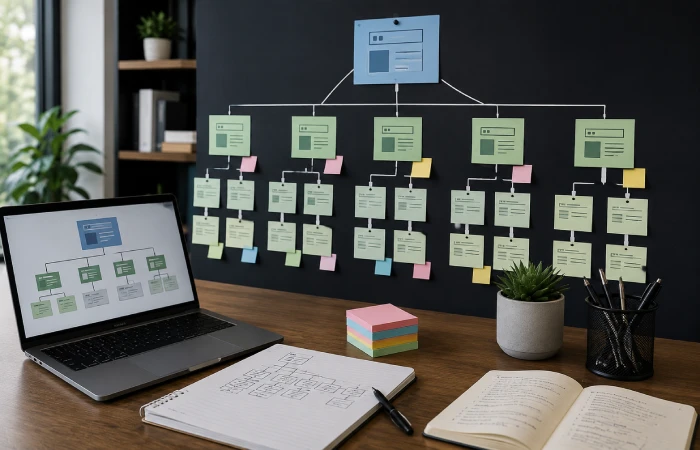
Topic clusters are the architecture behind why certain sites seem to rank for everything in their niche while equally-sized competitors rank for almost nothing. It’s not domain authority. It’s structure.
The model is simple enough: one pillar page covers a broad subject at a high level. A set of cluster pages — usually five to fifteen, depending on the topic — covers specific subtopics in depth. Every cluster page links back to the pillar. The pillar links out to every cluster page. The cluster pages cross-link to each other where it’s relevant and natural.
What this creates, in Google’s eyes, is a coherent body of knowledge. Not a site that mentioned a topic once, but a site that covers it from multiple angles, at multiple depths, with consistent internal signals pointing inward. That’s what topical authority looks like in practice — and it’s what gets you into AI Overviews and featured snippets consistently rather than occasionally.
Content Silos — The Stricter Version
A content silo takes the cluster concept and tightens it. In a true silo, internal links only flow between pages in the same topic category. A page about SEO content planning links to other SEO content pages, never to a page about social media marketing or email strategy. The idea is to concentrate topical signals within each subject area rather than diluting them across the site.
Whether you go full silo or loose cluster depends on your site’s size and how clearly distinct your topic areas are. For most content sites, a loose cluster approach — strong internal linking within topic groups, occasional cross-topic links where genuinely relevant — works fine and is a lot easier to maintain.
The thing most people miss: you don’t have to build the whole cluster before you start. Publish the pillar page first. Add cluster pieces one by one. The authority accumulates as you go — you don’t need to wait until it’s complete to see results.
- Pillar page: broad overview, links out to all supporting cluster articles
- Cluster pages: deep on one specific subtopic, link back to pillar and cross-link within cluster
- Silos restrict cross-topic linking to keep authority concentrated — useful for larger sites
- Start publishing the cluster before it’s complete — rankings build as pieces are added
Keyword Research for Content Planning

Here’s an unpopular opinion: keyword research is not a pre-writing step. It’s a planning input that should happen before you decide what to write at all — not after you’ve already picked your topics.
The order most people use: pick a topic, then look for keywords to target. The order that actually works: do the keyword research first, identify which questions your audience is actually asking, then build your content plan around those questions. Sounds like a small shift. In practice it completely changes what you end up writing.
When you start from keyword data, you find things you wouldn’t have thought of. Questions your audience cares about that you’d never instinctively include. Subtopics that have search volume you’d have skipped. Terms competitors are ranking for that you haven’t touched. The keyword research doesn’t just inform the content — it shapes the whole cluster map.
What to Actually Focus On
Volume gets all the attention. It shouldn’t. A keyword with 200 monthly searches and clear commercial intent will drive more actual business than one with 8,000 searches where everyone is just browsing. Before you put a keyword in your content plan, answer this: what does the person searching this actually want? If your content can give them that, it belongs. If you’re just reaching for the volume, it probably doesn’t.
Keyword gaps are where real opportunity hides. If you’ve never run a gap analysis before, Semrush provides a detailed explanation of how a keyword gap analysis uncovers terms competitors rank for that your site has yet to target, making it one of the fastest ways to identify content opportunities. Pull a gap report in Semrush or Ahrefs — your domain versus two or three direct competitors — and you’ll typically find dozens of relevant terms they’re ranking for that your site hasn’t touched. Those gaps are low-hanging fruit. Your competitors have already proven the traffic exists. You just need to write the piece.
Long-tail terms still matter, especially early on. If your site is new or doesn’t have much authority yet, targeting lower-competition, more specific phrases gets you ranking traffic faster. That early traffic isn’t just numbers — it builds signals that make the harder keywords easier to crack later.
- Do keyword research before picking topics, not after — it changes what you write
- Search intent beats volume — know what the searcher actually needs before you target a term
- Run a competitor keyword gap analysis before finalizing your quarterly content plan
- Long-tail terms build early momentum for newer sites while harder terms are still out of reach
📖 Read More: Keyword Research for Content Planning — Step-by-Step Guide [internal link]
Tracking Content Performance

Most content teams check traffic once a month, see that it went up or down, and move on. That’s not performance tracking. That’s checking a scoreboard without understanding the game.
Real performance tracking tells you why a piece is or isn’t working — and more importantly, what to do about it. Without that layer, you’re just publishing into the void and hoping the numbers eventually look better.
The Metrics That Actually Tell You Something
Google Search Console is your first stop, not GA4. GSC shows you impressions, clicks, and average position for every piece of content — and the combination of those three numbers tells a specific story. High impressions, low CTR? Your title and meta description aren’t compelling people to click. Good rankings but low traffic? You’re probably targeting keywords with less real volume than the tool suggested. Solid CTR but poor engagement once they land? The content isn’t delivering on what the title promised.
Ranking position trends matter more than snapshots. A page sitting at position 14 today means almost nothing by itself. A page that moved from 22 to 14 over the past 60 days means everything — it’s working, it just needs time and maybe a few tweaks to break into page one. A page stuck at 22 for four months is a different conversation entirely.
Content decay is the thing nobody wants to deal with but everyone eventually has to. Posts that ranked well in 2023 or 2024 have often slipped quietly down the rankings. Competitors published better versions. Information went stale. Google’s understanding of the topic evolved. Building a quarterly refresh cycle into your content calendar — not just for new posts but for your existing library — is one of the highest-ROI activities in SEO. A piece that already has authority is almost always faster to recover than a new piece is to rank.
A Simple Tracking Framework
| Metric | Where to Find It | What It Means | When to Act |
| Impressions + CTR | Google Search Console | Is your title getting clicks? | CTR under 2% — rewrite title and meta |
| Average position trend | GSC / Semrush | Is the piece climbing or stalling? | No movement in 90 days — refresh content |
| Organic traffic (90-day) | GA4 | Is the piece actually driving visits? | Declining 3 months straight — audit and update |
| Time on page | GA4 | Are people reading or bouncing? | Under 60 seconds — improve depth or structure |
| Internal link clicks | GA4 | Are readers exploring the cluster? | Near zero — reposition or add more links |
- Check GSC before GA4 — impression and CTR data is where most quick wins hide
- Track trends over 90-day windows, not week-by-week fluctuations
- Schedule a quarterly content audit — refreshing old posts beats publishing new ones for ROI
📖 Read More: Content Marketing Strategy for SEO
Final Thoughts
There’s a version of content marketing where you publish three times a week forever and wonder why organic traffic plateaus at some modest number that never really grows. A lot of companies are living that version right now.
The fix isn’t publishing more. It’s planning smarter. Building cluster by cluster, making sure every piece has a reason to exist beyond ‘we needed content this week,’ and tracking closely enough to know when something is working versus when it’s just sitting there.
Pick one cluster. Build the pillar. Add the supporting pieces. Link them together properly. Give it 90 days. That’s the whole SEO content planning strategy — not complicated, just consistently applied. The sites compounding organic growth right now are not doing something magical. They’re doing this, over and over, for every topic they want to own.
Frequently Asked Questions
What exactly is SEO content planning?
It’s the process of deciding what content to create, in what connected sequence, around which topics — specifically to build organic search visibility over time. The key word is ‘connected.’ Content planning without a structural architecture is just a publishing schedule, and a publishing schedule alone doesn’t build topical authority.
How is a content calendar different from a content strategy?
A content calendar is a schedule — when things go live, who’s writing them, what stage they’re in. A content strategy is the decision-making layer underneath — which topics to pursue, why, in what order, and with what search intent. The calendar executes the strategy. Without the strategy, the calendar is just organized busywork.
How many articles does a topic cluster need before it starts working?
Research from SearchAtlas puts the practical threshold at 25 to 30 high-quality, interlinked articles per cluster before investing heavily in link building. In practice you’ll see movement earlier — especially for lower-competition terms — but the real compounding effect tends to kick in around that number. Start publishing, don’t wait until the cluster is ‘complete.’
How often should I update my content plan?
At minimum, quarterly. More often if you’re in a competitive space or if Google has had a major update recently. The plan should change based on what’s actually ranking, where your keyword gaps are widening, and what competitors are publishing. A content plan you set in January and never revisit is probably working against you by April.
What tools do I actually need for SEO content planning?
Start simple: Google Search Console (free, non-negotiable), one keyword research tool — Semrush or Ahrefs both work — and something to organize your calendar like Notion or Airtable. Surfer SEO or Clearscope help with content optimization once you’re writing. You don’t need all of them on day one. Search Console plus one keyword tool covers 80% of what you need to plan effectively.
What should I do if my content isn’t ranking after 90 days?
First, check Search Console for impressions. If the piece is getting impressions but no clicks, the issue is your title or meta description. If it’s getting almost no impressions, Google isn’t associating the page with your target keyword — check your on-page optimization and internal linking. If it’s ranking around positions 15-25, a focused refresh (deeper content, better structure, updated information) often moves it to page one faster than a new piece would.

I’m Thomas — Editor & Admin of incmarketingplace, Blogger, and Senior SEO Analyst. writer at Inc Marketing Place, sharing insights on SEO, branding, content marketing, and online business growth. I focuses on creating practical and easy-to-understand content for marketers, entrepreneurs, and growing businesses