
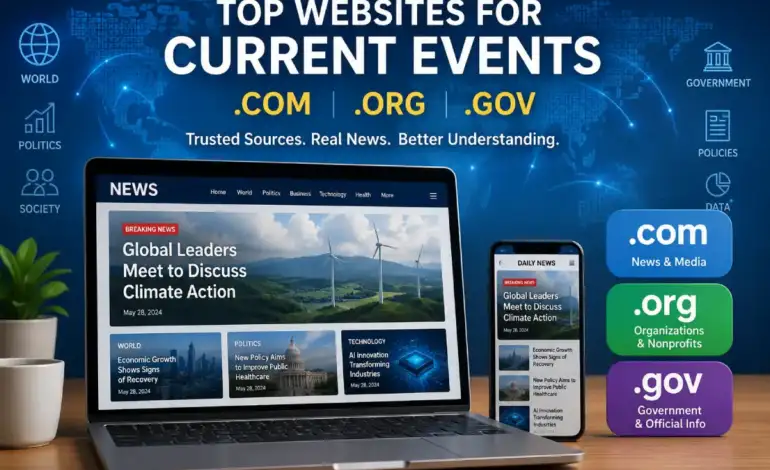
top websites for current events .com .org .gov: Details
Last Updated: August 27, 2026
Staying on top of the news sounds so straightforward until you click your mouse, only to find 20 headlines screaming for your attention. One site may have the absolute latest news of the moment, while another site specialises in politics, and then you might also find the government posting the primary source behind whatever the news of the day happened to be. Which…is why it’s so helpful to know the most popular sites for current events.
Of course, no one needs to get their news from just one website, but knowing that will help determine where each may be useful to visit.
Here are popular .com, .org, and .gov news sites. I will also review how to compare sources & develop your own news-consuming habit.
What Are Websites for Current Events?

News on the move. News on the Go. Current events websites are websites that disseminate information on present and recent events occurring in a variety of fields, including politics, economics, the arts, sciences, technology, education, international politics, public policy, and the community.
A website for current events can include the daily newspaper; in the past, a city would have only one small newspaper published daily.
The web allows any organization or individual in the world to do so without concern for whether such publication ever was profitable or a public service at all. Some current-events sites do all that; a government Web site would stick to what its job is (public law and statistics). For instance, USA.gov calls itself ‘the official guide to U.S. Government information and services’ and lists federal agencies, laws, regulations, elected representatives, government programs, and much else under various headings.
Why Use More Than One Current-Events Website?
A very easy error for any reader to commit is to accept a website as the “whole story.”
Each publication has differing editorial priorities. Some try to break the earliest story. Others provide more time and effort on analysis and reporting—investigative efforts.
For official agencies, a third mission: providing public access to material relevant to their official duties.
Using several authoritative sources allows a better opportunity to discern three things:
- What happened
- How the event is being interpreted
- What the official record says
For example, if Congress passes an important piece of legislation, a news website may explain the political consequences, while an official government source can provide the actual bill, legislative record, or related documents.
The U.S. Government Publishing Office’s GovInfo service provides access to materials including congressional bills, the Congressional Record, Federal Register information, presidential documents, hearings, and government reports.
Best Websites for Current Events: Quick Comparison
| Website | Type | Best For | Main Strength |
| Reuters | .com | Breaking and international news | Fast, straightforward reporting |
| BBC News | .com | World events | Broad international coverage |
| AP News | .com | U.S. and breaking news | Direct news reporting |
| NPR | .org | U.S. and public-interest news | Context and audio coverage |
| ProPublica | .org | Investigative reporting | Long-form investigations |
| The Guardian | .com | World, politics and culture | Broad editorial coverage |
| USA.gov | .gov | Official U.S. information | Government services and information |
| GovInfo | .gov | Laws, bills and government documents | Primary government records |
| SupremeCourt.gov | .gov | Supreme Court developments | Court opinions and official information |
| Congress.gov | .gov | Legislation | Bills and legislative information |
The most useful source depends on what you are trying to learn. A reader looking for a quick overview of an international event may prefer Reuters or BBC News, while someone researching a federal regulation should go directly to an official government source.
Reuters: A Strong Choice for Fast, Straightforward News
Reuters is excellent when you just need a quick overview of what’s going on, without having to sift through tons of opinion. The site covers international news, politics, business, markets, tech, and most other major news categories. As an initial source for immediate news, Reuters is fine.
Read the initial report, then read somewhere else if you need some context, historical review, opinions, or deeper explanation.
It’s good for current breaking stories to get at the facts before moving to the analyses.
BBC News: Useful for International Current Events
BBC News. It is useful to readers keen to keep abreast of international events.
However, breadth is where it truly shines. A major international event could be followed by regional issues, politics, science, tech and climate change, culture and sport.
When events happen outside your own area, and they only receive a tiny amount of coverage from domestic media outlets, it can be very handy to tune into coverage being broadcast outside your borders. The true benefit of working at a large international broadcaster is perspective provided by geography. The manner of depiction of a similar event can be compared to the way that other organization(s), operating in the other media space, depicts it.
AP News: A Practical Source for Breaking Stories
Here is one of the most well-known AP breaking and mainstream reports. AP, in particular, is useful if you’re looking for an account of an event with relatively little commentary. Many other news organizations incorporate the AP into their reports.
So it’s a great place to start when you want basic information on a main news event.
AP reports can be an efficient jumping-off point before you settle down with some longer articles if you’re an academic, a novice researcher, or just have some downtime on your hands.
NPR: Current Events With More Context
NPR is a non-profit media organization that provides U.S. Politics, world news, public interest issues, culture, technology, and science news coverage. One thing that might recommend NPR for people to read or listen to is its combination of print and audio offerings.
It may serve people well when you want to know not only who, what, when, and where, but also why an issue is relevant for everyday citizens.
For students who are trying to keep abreast of developing events, its contextual approach may simplify complex topics.
ProPublica: Useful for Investigative Current Events
Not all current-events stories are breaking-news events. Often, the most useful coverage takes weeks, months, or even years to reveal itself. Organizations like ProPublica, for instance, are dedicated to investigative coverage and public-interest journalism.
That makes this kind of reporting especially useful when examining issues that relate to government actions and public institutions; corporate and public conduct; and societal issues.
If break-news reports show what happened, investigative reporting can reveal what may have been happening below.
The Guardian: A Broad Source for Global Topics
The Guardian discusses news in politics, international relations, business, science, culture, technology and beyond.
There are times when this would be a useful publication to have and read, as it provides reporting as well as wider commentary and interpretation.
The reader, as with all newspapers (and indeed all types of media and text), should be aware that reporting, analysis, editorials, and opinion are of differing kinds. The reader does not need to shy away from opinion if that is a useful way to develop some knowledge or perspective on something; they should just know that this is what the article is currently providing, as opposed to a report of facts.
USA.gov: When You Need Official Government Information
Government Websites: Unlike traditional news sites, USA.gov can be a helpful go-to for finding information on U.S. Agencies, laws, regulations, services, elected officials, and government programs. The site can also offer information regarding the different branches of government.
This can be an especially valuable tool when current events and news related to government policy are involved.
If a new rule has been created and approved by a federal agency as reported in a news story, then the agency’s website, the Federal Register, can have the text of the new regulation. This is an important difference – if you do not, then your sources often will not be primary, but secondary.
GovInfo: A Valuable Source for Government Documents
GovInfo is a database maintained by the U.S. Government Publishing Office that contains a vast repository of official government documents. Its collections cover areas such as the congressional record and materials (hearings, reports, bills) presented before Congress; Federal Register contents; presidential documents; and other federal documents.
For anyone looking to learn more about current issues, GovInfo may be an invaluable resource.
GovInfo provides readers with a means to read not just the headline, but also the government’s documents on the topic, including an extremely useful resource for students writing research papers, journalists attempting to verify accounts, or any individual wishing to see a government measure properly documented.
SupremeCourt.gov: Follow Major Judicial Developments
Here’s when they are especially crucial. Most crucial resource: Visit the court itself. The U.S. Supreme Court’s website is among the top destinations if a breaking story is about the court.
Opinions, orders, case documents, the docket, a calendar, oral argument resources-all are on the website.
While a news account may provide a summary of a decision in a matter of several paragraphs, getting the official text of the opinion is an ideal step if you want the real document. It is not always simple for the casual reader to get through, but even just looking for the official title of a case and decision date can help you understand that a news account is correctly pinpointing the matter.
Congress.gov: Follow Legislation and Congressional Activity
For current events involving Congress, Congress.gov is another valuable resource.
It can help readers investigate legislation rather than relying solely on headlines about a bill.
This distinction is important because a bill being introduced is not the same thing as a bill becoming law.
Current-events readers should pay attention to words such as introduced, passed, amended, sent to the other chamber, signed, enacted, or vetoed. These terms describe different stages of the legislative process.
.com vs .org vs .gov: What Is the Difference?
The suffix of a domain name can give a hint, but the domain itself is never a confirmation of the validity of a webpage.
A .com domain implies that a site belongs to a commercial organization. The largest news sites employ .com domains.
A .org domain usually implies that a site belongs to an organisation, nonprofit institution, or association; however, it is no guarantee of the site being nonprofit or impartial.
A .gov domain means that it belongs to the United States government. These can be a very important resource for authentic government documents or data and for official government-linked data.
The takeaway is actually very easy:
The domain tells you something about the person who posted it, but nothing whatsoever about whether the material is good. The reader must still examine who posted a document, what evidence is shown to support a claim, when it was originally posted, and whether it is being supported by other more knowledgeable authors.
How to Choose the Right Website for Current Events
Choosing a current-events website becomes easier when you start with the question you actually want answered.
For Breaking News
Use sources such as Reuters, AP News, and BBC News when you need a quick overview of a developing story.
For International Events
BBC News, Reuters, and other major international news organizations can provide broad geographic coverage.
For U.S. Government Developments
Start with USA.gov and the relevant federal agency.
For Laws and Regulations
Look at official government documents, including GovInfo and the Federal Register.
For Supreme Court Decisions
Check SupremeCourt.gov for the official court material.
For Congressional Activity
Use Congress.gov to investigate legislation and congressional records.
For Investigative Reporting
Explore organizations such as ProPublica when you want deeper reporting rather than immediate headlines.
How to Check Whether a Current-Events Story Is Reliable
Good news consumption is not about believing everything or doubting everything.
It is about learning how to verify.
First, check the publication date. A perfectly accurate article from six months ago may no longer describe the current situation.
Next, look for the source. If an article says a government agency announced something, visit the agency’s website when possible.
Then compare the story with at least one independent source.
Finally, separate facts from interpretation.
For example:
“The government announced a new policy.”
That is a factual claim that can potentially be checked against an official announcement.
But:
“The new policy will completely transform the country.”
That is an interpretation or prediction and requires a different standard of evaluation.
Learning this distinction is one of the most valuable current-events skills a reader can develop.
A Simple Current-Events Reading Routine
You do not need to spend hours reading every news website.
A simple routine can be more effective.
Start with one broad news source for the major headlines. Then choose one story that genuinely interests you. Read a second credible source to compare the basic facts. If the subject involves government action, look for the relevant official source.
For important topics, go one step further and find the primary document.
This creates a useful information chain:
Headline → News report → Independent source → Official document → Personal understanding
The goal is not to become overwhelmed by information. The goal is to become better at identifying which information deserves your attention.
Why Primary Sources Matter
Primary sources are especially valuable in current-events research because they take you closer to the original information.
Government announcements, court opinions, legislation, official statistics, public records, and original research papers are examples of primary materials.
GovInfo, for example, provides access to official publications from the legislative, executive, and judicial branches of the U.S. federal government.
Primary sources do not automatically make an issue easy to understand. Legal documents can be complicated, government reports can be lengthy, and official statements can lack the context found in journalism.
That is why the strongest approach is often to use both journalism and primary sources.
Journalists can explain the significance. Primary documents can show what was actually written.
Final Thoughts
The best websites for current events are not necessarily the ones with the largest number of headlines. The most useful sources are those that help you understand an event accurately and from multiple angles.
For quick news, Reuters, AP News, and BBC News are useful starting points. For public-interest and investigative reporting, NPR and ProPublica offer different strengths. For official U.S. information, USA.gov, GovInfo, Congress.gov, and SupremeCourt.gov can take you directly to government information and records.

Creative marketing enthusiast sharing practical insights on digital growth, branding, and online strategies. Passionate about helping businesses succeed with simple, effective, and result-driven marketing solutions.