
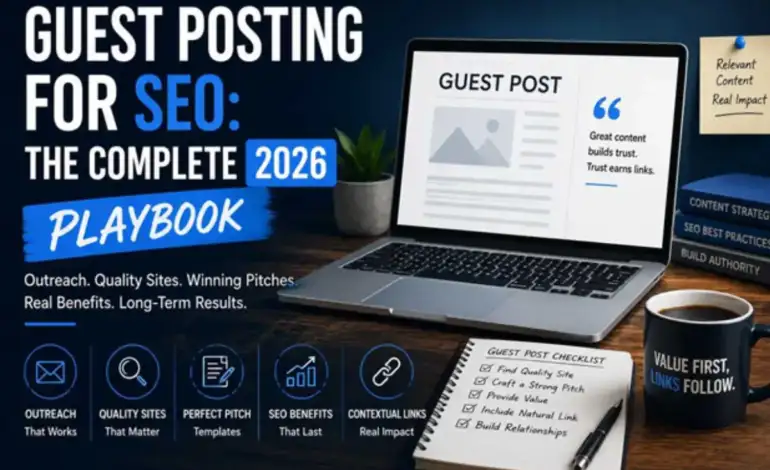
Guest Posting for SEO: The Complete 2026 Playbook
Last Updated: September 15, 2026
Guest blogging has been reportedly “dead” more than just about any other SEO strategy, and yet it still delivers genuine contextual links, referral traffic, and brand trust to the sites who are doing it right. The difference in 2026 isn’t whether guest posting works. It’s whether you’re treating it as genuine content creation or running an outdated link scheme — because Google’s spam systems, including SpamBrain and the Site Reputation Abuse policy introduced in March 2024, were built specifically to catch the latter. This playbook covers outreach, site selection, pitching, templates, and the actual benefits you should expect, without the recycled advice.
Guest Post Outreach
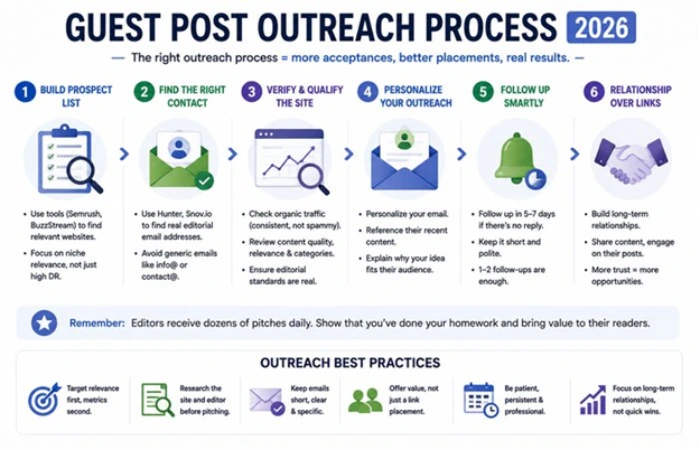
Outreach is where most campaigns quietly fail. Not because the emails go unanswered, but because the wrong sites get targeted in the first place.
A working outreach process looks like this: build a prospect list, verify contact details, check the site’s real traffic and editorial standards, then reach out with something specific. Skip the manual vetting and you’ll end up placing content on “link farms” — domains with a decent Domain Rating but almost no organic visitors. Those links do little for rankings and can flag your domain as part of a low-quality network.
Tools worth knowing:
- BuzzStream or Semrush for prospecting and backlink gap research
- Hunter or Snov.io for finding the right editorial contact, not a generic info@ address
- A verification tool (like Mailfloss) to keep your sender reputation clean — bounced emails hurt deliverability fast
Before pitching anyone, check for consistent organic traffic (not a traffic spike followed by a cliff, which usually signals a penalty), a relevant topic focus, and evidence that a real editor reviews submissions. A site with a “Write For Us” page listing prices is not an outreach target — it’s a link marketplace, and Google treats it accordingly.
Guest Blogging Sites
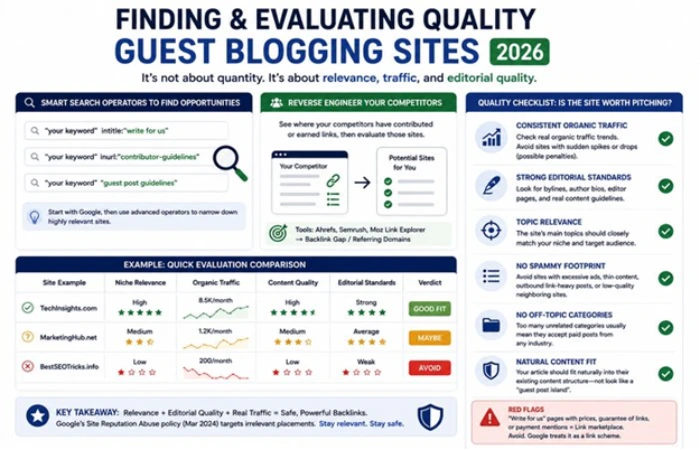
Finding legitimate guest blogging sites takes more effort than Googling “write for us + your niche,” though that’s still a reasonable starting point. Search operators help narrow the field:
- “your keyword” intitle:”write for us”
- “your keyword” inurl:”contributor-guidelines”
- “your keyword” “guest post guidelines”
A more effective method is Reverse Engineering where you see those publishers that already have guest posts or any mention from your competitors and put in an application for the same publisher to get featured. When you get the list then proceed with a filter.
- Does the site publish regularly (weekly or more), or has it gone quiet?
- Is there a real editorial voice, with bylines and author bios?
- Do off-topic categories exist that suggest the site accepts paid placements from unrelated industries?
- Would this content fit naturally into their existing site structure, or would it read as an isolated “guest post island”?
That last point matters more than most guides admit. Google’s Site Reputation Abuse policy specifically targets content published on a trusted domain purely to borrow its authority, with little connection to what the site normally covers. A finance blog suddenly publishing about payday loans, or a gardening site running crypto explainers, is exactly the pattern this policy was written to catch. Relevance isn’t a nice-to-have anymore — it’s compliance.
Guest Post Template
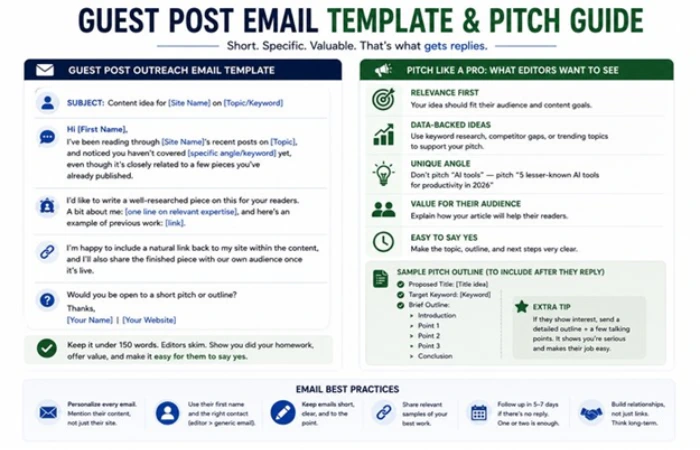
A short, specific email consistently outperforms a long, templated one. Here’s a structure that works without sounding automated:
Hi [First Name],
I‘ve been reading a selection of [Site Name]‘s recent posts on [Topic], and see you‘ve explored almost everything except for [specific angle/keyword] which is surprisingly relevant to a couple of pieces you have gone to the trouble of posting.
I would love to write a thoroughly researched article on this for your readers. Tell me about yourself: [one line on relevant expertise] and send me some links to your previous writing: [link].
I am happy to add a natural outgoing link to my website, and I‘ll be interested to see the piece once it‘s up on your site so I can also pass it to our readers.
Would you be open to a short pitch or outline?
No more than 150 words. Editors skim. A wall of text with three bolded value propositions reads as a mail-merge, not a message from someone who read their site.
Guest Post Pitch
The pitch is where most guest posting campaigns leave value on the table. A generic “I’d love to contribute a post” pitch competes with hundreds of identical emails in an editor’s inbox. A pitch backed by a specific content gap doesn’t.
The idea is simple: use a keyword research tool to compare the target site’s rankings against a direct competitor’s. If their competitor ranks for a topic they haven’t covered, that’s your pitch. Instead of asking for a favor, you’re offering a data-backed opportunity — “here’s a topic your competitor is winning traffic on that you currently aren’t.” That rephrasing shifts a whole new dynamic in the conversation, because you‘re no longer requesting placement, you‘re offering a quantifiable gain to their site.
It doesn‘t have to be complicated. Even an approximation of the monthly search volume for the missing keyword, will tend to make the pitch sound more tangible than hypothetical.
Guest Posting Benefits
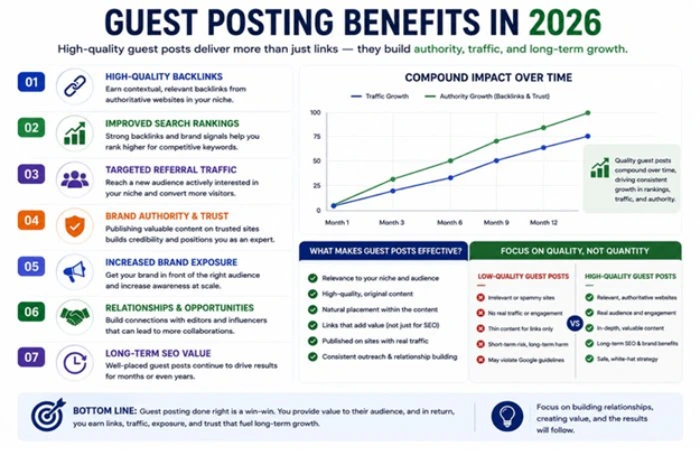
Guest posting still earns its place in a link-building strategy for a few concrete reasons:
- Contextual backlinks – links embedded within relevant, contextual information typically pass value for a longer period of time than links submitted to directories or footers.
- Referral traffic-a handroll on an active site can generate genuine visitors, not just link equity.
- Brand visibility and credibility – being present in respected, relevant publications demonstrates expertise to readers and, indirectly, to search engines assessing topical authority.
- Relationship building – one good placement frequently leads to additional work, syndication or potential paid opportunities.
- Diversified anchor text profile – as naturally written links tend to use contextual anchors much more often than coming all from exact-match phrases that would set off spam alarms. Best practice that most SEOs follow is no more than 30% of the anchor profile should be this kind of exact phrases.
None of this works if the content itself is thin. The benefit comes from the placement being earned through genuine value, not from the mechanics of the backlink alone.
Building a Strategy That Actually Holds Up
Guest posting in 2026 is all about quality, not quantity. Few, quality placements on sites that are truly relevant and active will beat a dozen poorly researched and rushed pitches to directories with low readership and they won‘t get you into hot water under Google‘s current spam safeguards. Think of outreach as establishing relationships; pitches as value propositions; each guest post as content you‘d want to be identified with. That‘s it. The rest is just execution.

Creative marketing enthusiast sharing practical insights on digital growth, branding, and online strategies. Passionate about helping businesses succeed with simple, effective, and result-driven marketing solutions.