
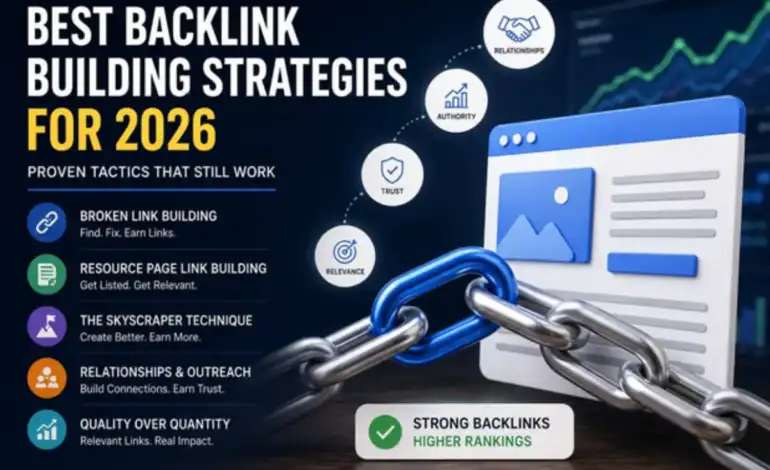
Best Backlink Building Strategies for 2026 (Proven Tactics)
Last Updated: September 15, 2026
Most backlink advice hasn’t caught up with 2026. Cold outreach templates still get forwarded around, “build more links” still gets repeated as a strategy on its own, and skyscraper campaigns still get recommended without anyone mentioning that reply rates have collapsed since Brian Dean popularized the tactic back in 2013. The tactics below still work, but not the way they worked five years ago, and not for the reasons most guides give.
Here’s what’s actually holding up in 2026, and what’s quietly stopped working.
How to Get Backlinks

No shortcuts here: you‘re going to have to earn these links by providing the recipient with a reason to actually link to you, instead of politely asking for one. And that reason generally will be something along the lines of: you fixed a broken element on someone‘s website, you created something that was worth citing say raw data, a useful utility, or a new, invaluable resource or you built a relationship with an editor before pitching them anything. The death of link building itself is not going to be automated, impersonal outreach at scale.
All of the tactics below (broken link building, resource page pitching, skyscraper) have one thing in common: they come from the position of first providing value to the recipient and not asking for something. That‘s a difficult thought to sit with before you hit “send” on your email, but it‘s worth it this realization affects your outreach email, not just your method.
High-Quality Backlinks

Not every link is worth the same, and domain authority alone is a bad filter for finding the good ones. A link from a site with real organic traffic, topical overlap with your page, and an editor who actually reads submissions will outperform ten links from directory-style domains, even when those domains show a higher DR score. Vet targets on actual traffic, 5,000+ monthly organic visitors is a reasonable floor, rather than a metric alone, and keep your anchor text natural: branded anchors should make up roughly 40-50% of your overall profile, with exact-match commercial anchors kept under 5% to avoid looking manipulated.
One thing worth knowing before you write off an opportunity: nofollow links aren’t dead weight anymore. Recent analysis from AirOps found nofollow and dofollow links now correlate almost identically with AI visibility, 0.509 versus 0.504, which means a nofollow mention from a trusted publication still does real work in 2026. It just doesn’t do that work through classic link equity anymore, so stop filtering opportunities by attribute alone.
The Skyscraper Technique

It‘s simple: identify existing content that already attracts links, create an enhanced version of it, and promote the upgraded piece to the sites linking to the existing content. It‘s not dead, but it‘s far more difficult than in 2013. According to tests carried out by SerpReach, the percentage of outreach campaigns resulting in a link has fallen from the benchmark 10-20% observed in 2013 to around 1-3% for most SEO practitioners today “because to be considered better, it now has to be genuinely new”.
AI can produce a very full appearing guide in a matter of minutes, so only the length alone is not worth anything these days, with editors being so good at bashing down padded stuff on sight; What still works is adding something the original piece doesn’t have: original data, a named expert’s take, an updated figure nobody else has published. Pair that with outreach that names the specific gap you filled, not a generic “we made something better” line, and the technique still converts, just at a fraction of its old volume.
Broken Link Building

This is one of the few white-hat tactics that gets easier every year, simply because the web keeps decaying faster than anyone maintains it. Pew Research found 23% of news webpages and 21% of government webpages contain at least one broken link, and 54% of Wikipedia articles have at least one dead reference in their citations. That’s a large, constantly renewing pool of opportunities that doesn’t require competing for attention against other pitches.
The process: identify a dead link in an existing page and then use the url in the Wayback Machine to accurately replicate exactly what the original page was about and how it was formatted in order to build a close surrogate rather than a blanket replacement if it‘s a listicle build a listicle, not a blog post. Sell it as a solution rather than a favor and identify which link exactly is broken and in what piece of content. Reply rates are significantly higher here than cold emails as you are providing a 100% real and visible problem for the site owner.
Resource Page Link Building
Many sites still have a “useful links” or “resources” page in your niche recommendations, guides, reports, references intended to be added to over time. Do a search of your topic plus “resources,” “useful links,” or “recommended tools,” to find these, then make sure the page actually appears to be kept up-to-date (fresh additions, not just dead links) before you send it.
The ask is simple, just identify why your resource belongs in the list and where it roughly belongs, rather than a bland “please add my link” email. It is a less active channel than it was in the past, as not all sites maintain these pages anymore, but those that do are typically curated by someone who actually cares about the list, meaning that the link gained is worth more than its raw DR score.
Conclusion
None of these five work as a one-time project. Skyscraper content requires fresh information to remain compelling as the standard of “better” continues to rise, broken link opportunities are re-created as the web continues to decay, and resource pages require regular re-vetting as they are either updated or abandoned. Approach link building as a maintenance process, not a campaign with a finished date. Select whichever approach best addresses a genuine, concrete problem for the recipient of the e-mail.
That’s what’s actually converting in 2026. Everything else, the generic templates, the pure volume plays, the padded skyscraper posts with nothing new inside them, is competing for space in a spam folder against people who did the work.

Creative marketing enthusiast sharing practical insights on digital growth, branding, and online strategies. Passionate about helping businesses succeed with simple, effective, and result-driven marketing solutions.