The Complete Guide to Authority Building in 2026

Last Updated: September 18, 2026
Here’s something nobody tells you when you start building a website: you can write the most helpful article in your entire niche, format it perfectly, answer every question your reader has — and it can still sit quietly on page three of Google, unseen.
Frustrating? Absolutely. But it makes sense once you understand what’s actually happening. Your website is what you say about yourself. Off-page SEO is what everyone else says about you. And in 2026, Google — along with AI answer engines like ChatGPT, Gemini, and Perplexity — trusts the second voice a lot more than the first.
Think of it like a new skincare brand launching in a crowded market. You can have gorgeous packaging and a killer formula, but if not a single dermatologist, beauty editor, or trusted influencer has ever mentioned your name, would you trust it as much as a brand three people you follow have already raved about? That’s off-page SEO in a nutshell — it’s reputation, built outside your own four walls.
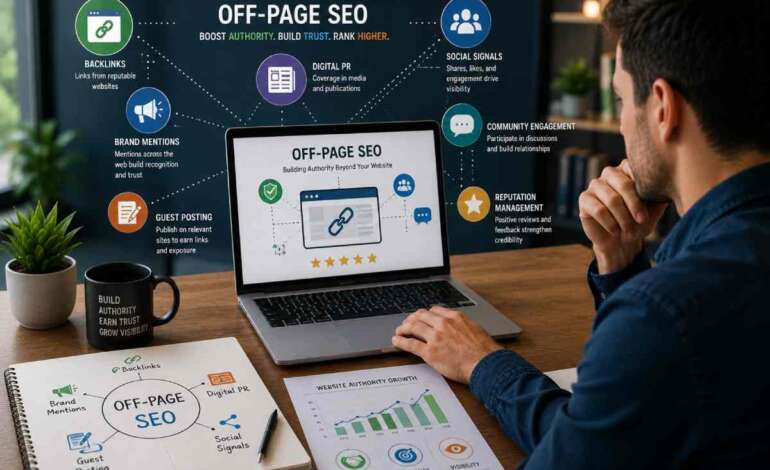
Off-page SEO is the practice of building trust and authority for your website through actions taken away from it — backlinks from other sites, mentions of your brand, guest content on relevant blogs, and the way people talk about and share you across the internet. Google reads all of this as a signal: is this brand actually respected, or just self-promoting?
This guide is your hub — a map of everything off-page SEO covers in 2026. Each section below gives you the real picture, plus a link to a full deep-dive if you want to go further into that specific technique.
Why Off-Page SEO Matters More Than Ever in 2026
Search has changed shape. It’s no longer just a list of ten blue links — it’s AI-generated overviews, chat-based answers, and voice search results that synthesize information from across the web. And here’s the part that matters to you: those AI systems lean heavily on the same trust signals off-page SEO has always been about. If your brand isn’t mentioned, linked to, or talked about anywhere credible, you’re not just missing out on rankings — you’re invisible to the tools millions of people now use to make decisions.
For a beauty and lifestyle brand targeting both the US and Indian markets, this matters double. Both audiences increasingly research through a mix of Google search, Instagram, and now AI chat tools before they buy anything — from a foundation shade match to a haircare routine. If your name doesn’t come up in that research trail, someone else’s does.
Key takeaways:
- Off-page SEO is now inseparable from AI visibility, not just Google rankings
- It builds the “trust layer” that content alone can’t create
- It typically takes 3–6 months of consistent effort to show real, compounding results — so start now, not later
Off-Page SEO Techniques: The Full Toolkit
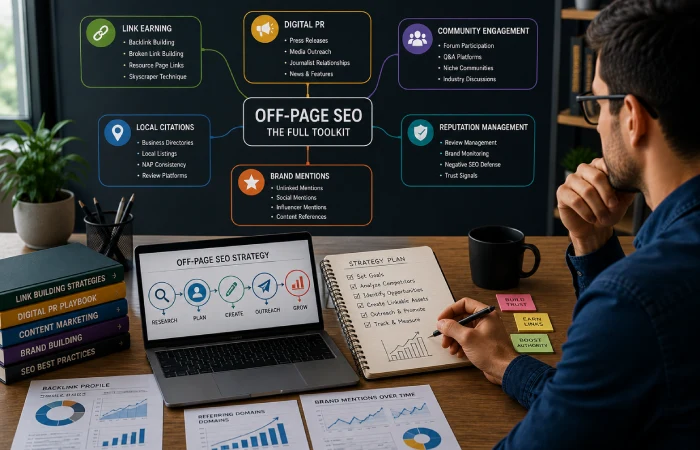
Off-page SEO isn’t one tactic — it’s a toolkit. The techniques that move the needle in 2026 fall into a few clear categories: link earning, digital PR, community engagement, local citations, and reputation management. Beginners often make the mistake of picking just one (usually backlinks) and ignoring the rest, which leaves their authority lopsided.
A stronger approach treats these techniques as a portfolio. Digital PR earns you a mention in a national beauty publication. That mention gets picked up and linked by three smaller blogs. Those links raise your domain’s trust. That trust makes your next guest post pitch easier to land. Each technique feeds the next.
Practical tip: start with whichever technique matches your current strengths. Have a founder with real expertise? Lead with expert commentary and podcast guesting. Have a great product but no press contacts yet? Start with structured brand-mention tracking and reply to relevant journalist queries.
Key takeaways:
- Treat techniques as a portfolio, not a single tactic
- Match your starting technique to your current strengths
- Let each technique feed the next — mentions lead to links, links lead to easier pitches
Mini summary: Off-page SEO isn’t a single tactic — it’s a system of techniques that reinforce each other over time.
Backlink Building Strategies That Still Work
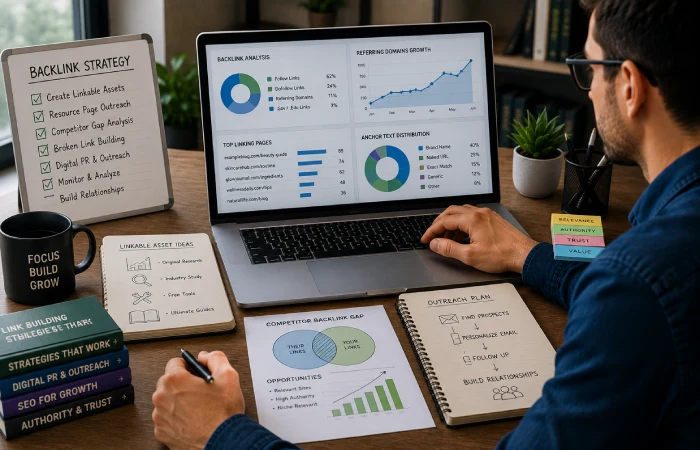
Backlinks remain the single strongest off-page ranking signal — but the rules for earning them have tightened considerably. In 2026, one link from a genuinely relevant, respected site in your niche outperforms dozens of links from low-quality directories or link farms. Google’s systems are simply too good now at spotting the difference.
The strategies that consistently work: building “linkable assets” (original research, free tools, comprehensive guides that people want to reference), targeted resource-page outreach, competitor backlink gap analysis (finding who links to your competitors but not you), and reclaiming broken links on relevant resource pages by offering your content as the replacement.
What doesn’t work anymore — and can actively hurt you — is buying links in bulk, joining private link networks, or chasing volume over relevance. If a link-building offer sounds too easy, it usually is a shortcut with a penalty attached.
Key takeaways:
- Quality and relevance beat volume every time
- Track new referring domains monthly and flag anything spammy
- Build content genuinely worth linking to, not just content worth publishing
Mini summary: In 2026, backlink strategy is less about chasing links and more about becoming genuinely link-worthy.
Brand Mentions: The Quiet SEO Signal
Here’s something a lot of brands miss: you don’t need a clickable link for a mention to help you. When a beauty blog says your skincare guide breaks something down well, without linking your name, Google can still register that as a trust signal — often called an “unlinked mention” or “implied link.”
These mentions matter because they’re harder to fake than backlinks. A journalist casually referencing your brand in a roundup, or a Reddit thread recommending your product by name, reads as organic credibility — the kind that’s genuinely difficult to manufacture.
Practical example: a digital marketing agency pitching insights for a “Top SEO Tools” roundup can earn a mention even without a direct link — and that mention, tracked and repeated across multiple sources, builds the same authority a backlink would over time.
Key takeaways:
- Track brand mentions with alerts, even unlinked ones
- Pitch journalists and bloggers proactively for roundups and expert quotes
- Every mention, linked or not, adds to your credibility footprint
Mini summary: Not every trust signal needs a hyperlink — being talked about is valuable on its own.
Guest Posting: Still One of the Most Reliable Tactics
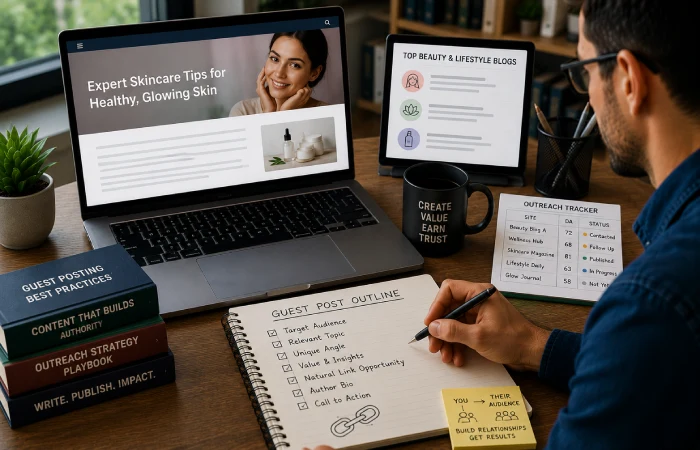
Guest posting means writing content for another website in exchange for visibility — usually a link back to your own site. Done right, it’s still one of the most sustainable off-page strategies available in 2026. Done lazily, it’s a fast way to waste time on rejected pitches or thin content nobody reads.
The formula that works: find sites in your niche with real traffic and a healthy domain reputation, pitch a specific and useful topic rather than a generic offer, and write something genuinely as good as (or better than) what you’d publish on your own blog. A weak guest post gets edited to death, rejected outright, or quietly removed months later — none of which help you.
Practical example: instead of pitching “can I write about skincare tips?” to a beauty editor, pitch a specific angle like ingredient myths dermatologists wish people would stop believing — specific, useful, and clearly filling a gap most sites haven’t covered yet.
Key takeaways:
- Research the site before pitching — generic pitches get ignored
- Write guest content that could stand on your own site
- Use natural, varied anchor text — avoid exact-match keyword stuffing
Mini summary: Guest posting rewards specificity and quality, not volume of pitches sent.
Social Signals and SEO: What Actually Matters
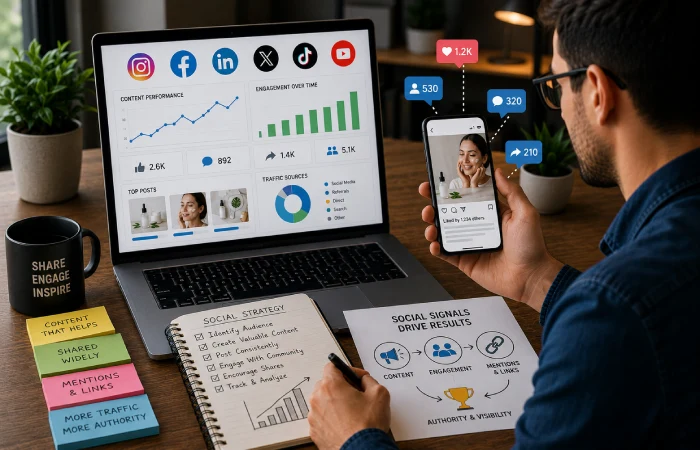
This is the one that causes the most confusion. Does a like or a share directly move your Google ranking? The honest answer: not directly, at least not confirmed by Google. But social signals still matter indirectly, and in 2026, arguably more than ever — because social platforms are now where content gets discovered, and discovery leads to links, mentions, and citations.
A blog post that gets shared widely on Instagram or Pinterest is more likely to be seen by a journalist or another blogger, who then links to it. Social visibility doesn’t rank you directly — it feeds the pipeline that does.
For a beauty and lifestyle brand, this is especially relevant. Pinterest and Instagram function almost like search engines within their own ecosystems, and strong social presence there increases the odds your content gets picked up, screenshotted, and referenced elsewhere on the web — including in AI-generated answers, which increasingly pull from socially popular content.
Key takeaways:
- Social signals don’t rank you directly, but they fuel visibility that does
- Focus on platforms where your audience actually researches (Pinterest and Instagram for beauty/lifestyle)
- Shareable, save-worthy content compounds your off-page authority over time
Mini summary: Treat social media as the discovery engine that feeds your backlinks and mentions, not a ranking factor on its own.
How Off-Page SEO Connects to E-E-A-T
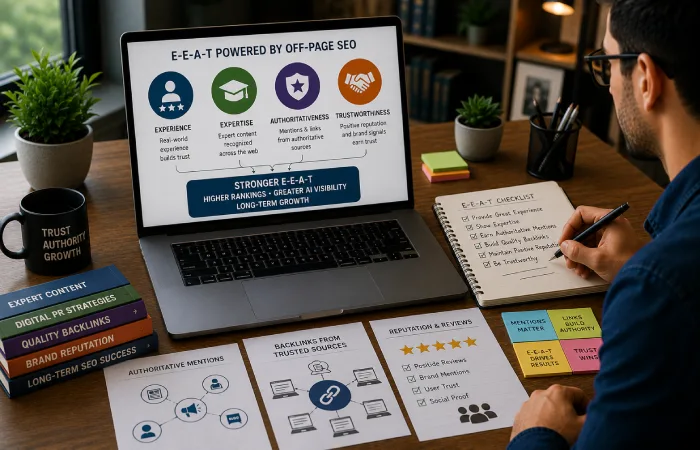
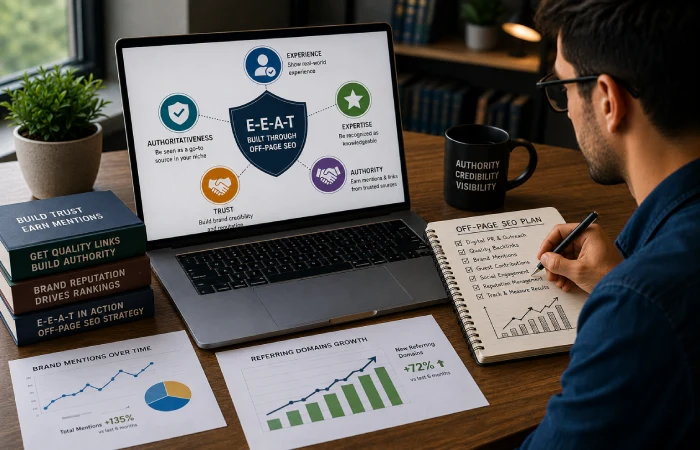
Google’s E-E-A-T framework — Experience, Expertise, Authoritativeness, Trustworthiness — sits at the heart of everything above. On-page content can claim expertise. Off-page SEO is how you prove it. A dermatologist quoted in your content is expertise. A dermatology publication linking to your guide is authoritativeness. A pattern of genuine mentions across trusted sites, sustained over time, is trust.
This is why off-page SEO can’t be rushed or faked convincingly — it’s designed to reflect what real people and real publications actually think of you.
Common Mistakes to Avoid
- Chasing link volume instead of relevance — a hundred weak links can do less than one strong one, and can invite penalties
- Ignoring brand mentions because they’re not “clickable” — unlinked mentions still build trust
- Sending generic guest post pitches — specific, gap-filling pitches get accepted far more often
- Expecting fast results — most off-page strategies need 3–6 months before rankings move meaningfully
- Treating social media as a vanity metric — it’s a discovery engine that feeds your other signals
Myth vs. Fact
| Myth | Fact |
| “Backlinks are dead in 2026” | Backlinks remain the strongest single ranking signal — but quality now heavily outweighs quantity |
| “Unlinked mentions don’t count for anything” | Google’s systems can register unlinked brand mentions as a trust signal |
| “Social shares directly boost rankings” | Not confirmed directly — but social visibility drives the links and mentions that do |
| “More guest posts always means better rankings” | Weak guest posts on irrelevant sites can do nothing, or even hurt credibility |
Future Trends to Watch
Off-page SEO in 2026 is increasingly shaped by how AI answer engines source their citations. Early data suggests professionals overwhelmingly believe backlinks and mentions influence whether a brand gets cited by tools like ChatGPT and Gemini — meaning the same off-page work that builds Google authority is now also building “AI visibility.” Expect this overlap to deepen: brands that invest in genuine digital PR and mentions today are positioning themselves for both search engines and AI answer engines tomorrow.
Conclusion
Off-page SEO isn’t a single checkbox — it’s the ongoing reputation-building work that tells Google, and now AI engines, that your brand deserves to be trusted and recommended. Backlinks, brand mentions, guest posting, and social signals all work together, each reinforcing the others over time. Start with the technique that matches your strengths today, track your progress monthly, and give it the 3–6 months it genuinely needs to compound. Off-page SEO rewards patience and consistency — and once it starts working, it keeps working long after you’ve stopped actively chasing it.
FAQs
What is off-page SEO in simple terms?
Off-page SEO is everything you do away from your own website — backlinks, brand mentions, guest posts, and social visibility — to build trust and authority that helps you rank higher.
Is off-page SEO more important than on-page SEO?
Neither works well alone. On-page SEO makes your content findable and relevant; off-page SEO makes it trusted. You need both for consistent rankings.
How long does off-page SEO take to show results?
Most strategies need 3–6 months of consistent effort before rankings move meaningfully. It’s a long-term investment, not a quick fix.
Do unlinked brand mentions actually help SEO?
Yes — search engines can treat unlinked mentions as a trust signal, especially when a brand is mentioned repeatedly across credible sources.
Does social media directly affect Google rankings?
Not directly and not confirmed by Google, but social visibility drives the discovery, shares, and links that do influence rankings.
Is guest posting still safe to do in 2026?
Yes, as long as it’s done on relevant, reputable sites with original, valuable content — not mass-produced posts purely for links.

I’m Thomas — Editor & Admin of incmarketingplace, Blogger, and Senior SEO Analyst. writer at Inc Marketing Place, sharing insights on SEO, branding, content marketing, and online business growth. I focuses on creating practical and easy-to-understand content for marketers, entrepreneurs, and growing businesses