

CRM & Marketing Automation Integration: 2026 Complete Guide

Last Updated: September 18, 2026
Most integration advice stops at “connect your CRM and your marketing automation tool” without saying how, or what the real tradeoffs are between the ways of doing it. This guide covers the two platforms that dominate this conversation — HubSpot and Salesforce — what integration actually buys a sales and marketing team, and which CRMs are worth considering if you’re not locked into either one, as part of a broader marketing automation strategy.
CRM and marketing automation integration is the process of connecting customer relationship management software with marketing automation tools so that customer data and campaign activity update automatically in both systems.
HubSpot CRM and marketing automation
All of hubspot‘s marketing automation and CRM data resides in the same shared database, and this is the root of most of what there‘s to like about it: no additional connector to set up, and no fear of the two applications falling out of sync. A marketing manager can define an automated email flow, and a sales rep can view the entire interaction history of a contact without either of them having to change anything about any integrations.
That single-database design also affects how fast you can actually get running. HubSpot implementations typically go live in 2–6 weeks, compared with 2–6 months for Salesforce Marketing Cloud, according to Amroar’s 2026 platform comparison — a real difference if a team needs automation running before a specific launch date rather than as an open-ended project. Tradeoff: Depth of customization, which is also the ceiling of simplicity in HubSpot, is where Salesforce tends to be more powerful for more finely tuned data models and approval flow.
Salesforce Marketing Cloud automation
Salesforce Marketing Cloud is not just “the marketing part of Salesforce” it‘s a standalone product separate from and priced (significantly) differently from Salesforce‘s CRM (Sales Cloud). As Resonate‘s 2026 comparison shows, Marketing Cloud pricing runs at just over $1250/month on top of whatever a business already is paying for Salesforce CRM licenses, which puts it just in reach of a company “already on Salesforce” having to make a real budget and integration decision to plug in marketing automation, not simply something it gets as part of the package.
What that investment buys is depth: Marketing Cloud handles complex, multi-channel customer journeys and gives technical teams fine-grained control over data and segmentation logic that HubSpot doesn’t match. The tradeoff is the same depth that makes it powerful also makes it harder to stand up — most organizations bring in a Salesforce-certified implementation partner rather than configuring it entirely in-house, which is part of why the typical rollout runs months rather than weeks.
CRM integration benefits
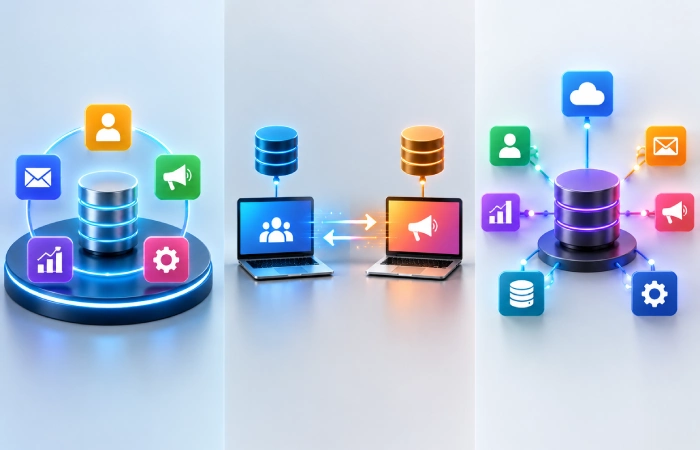
Connecting a CRM and a marketing automation platform gives both teams one shared version of the truth: marketing can see which campaigns actually led to closed deals, and sales can see every touchpoint a prospect had before a call, rather than each team working from a partial, siloed picture.
There are three concrete ways to build that connection, and picking the wrong one for your team’s complexity is the most common mistake, per Automarck’s 2026 integration guide: run both functions on a single unified platform (simplest, but locks you into one vendor’s capabilities), set up native point-to-point sync between two separate best-in-class tools (more flexibility, more configuration and potential data lag), or route both systems through a Customer Data Platform that acts as the master data store (most scalable for complex, multi-tool stacks, but the most implementation overhead). Whichever architecture a business chooses, the actual workflows built on top of it — including email automation workflows triggered by CRM data like lead score or deal stage — are only as reliable as the underlying sync.
Sales and marketing alignment with CRM

Integration’s biggest measurable payoff shows up in how fast a business grows once sales and marketing stop working from separate data. According to research by the Aberdeen Group and cited in Automarck‘s 2026 guide, firms whose sales and marketing teams are aligned see their revenues grow 24% faster over three years and their profits grow 27% faster than firms with non-aligned teams. That‘s a much more substantial margin than what most ROI studies about single tools imply, since it accounts for the added value of two teams, given the same information, rather than the capabilities of a single tool.
Practically, alignment is about reaching consensus on the shared definitions everyone will use before any data is reconciled: what constitutes a marketing qualified lead as opposed to a sales qualified lead, at what point any given contact touches off from marketing to sales, and who will own the follow-up timing when that hand-off occurs. If that alignment isn’t in place, integration just accelerate that same miscommunication in a shared dashboard.
Best CRM with marketing automation
In addition to HubSpot and Salesforce, many CRMs have marketing automation built into the product (rather than a separate product on top of it). ActiveCampaign, which always ranks among the best systems for teams who want sophisticated email automation and behavioral segmentation along with authentic CRM, is priced in the average range at around $15/month to start, and scales with the number of contacts in your database. Zoho CRM provides a truly robust automation layer at a fairly inexpensive price point, especially if you‘re already using other Zoho products. Keap (formerly Infusionsoft) is designed specifically for small business owners and solopreneurs who want a combined CRM and marketing automation system, simplified. Pipedrive is worth a specific note on this list: while it‘s a very good sales pipeline CRM, the automation would be an add-on in the same way Keap would be, so if your need is primarily for campaign automation, you‘d probably go to a different system.
| CRM | Best for | Native marketing automation depth |
|---|---|---|
| HubSpot | Teams wanting one platform, fast setup | Strong, unified with CRM by default |
| Salesforce | Enterprises needing deep customization | Strong, but a separate paid product (Marketing Cloud) |
| ActiveCampaign | Marketing-led teams wanting deep automation | Very strong, CRM is the secondary feature |
| Zoho CRM | Budget-conscious teams, especially on Zoho One | Solid, improved significantly in recent years |
| Keap | Small businesses and solopreneurs | Solid, built for simplicity over depth |
| Pipedrive | Sales-first teams | Limited — marketing automation is a bolt-on |
This comparison is based on published platform documentation and 2026 vendor-comparison research (Amroar, Resonate, Automarck, SynapseIndia, ThatMarketingBuddy), not independent hands-on testing of every listed platform.
FAQ
What is CRM and marketing automation integration?
CRM & marketing automation integration. CRM and marketing automation integration is the linking of customer relationship management software (CRM) with marketing automation technologies so that customer data and campaign activity remain synchronized across systems. It can refer to the merging of the two technologies into a single platform or the integration of two separate best-in-class solutions.
Does HubSpot have marketing automation built in?
Yes — HubSpot’s Marketing Hub and CRM share the same underlying database by default, so marketing automation, contact records, and deal data all live in one system without a separate integration to configure. This is a large part of why HubSpot implementations tend to go live faster than platforms requiring a separate marketing automation product.
Is Salesforce Marketing Cloud the same as Salesforce CRM?
No. Salesforce Marketing Cloud is a separate product from Salesforce’s core CRM (Sales Cloud), priced and licensed independently, typically starting around $1,250 a month. A business using Salesforce for sales still needs to separately purchase and integrate Marketing Cloud to get comparable marketing automation.
What are the benefits of integrating CRM with marketing automation?
The core benefit is a shared, accurate picture of every customer interaction across both teams — marketing can see which campaigns actually produced closed deals, and sales can see a prospect’s full engagement history before reaching out. Companies with genuinely aligned sales and marketing data report meaningfully faster revenue and profit growth than those running the two functions as separate silos.
Which CRM has the best marketing automation?
There’s no single best answer — it depends on whether marketing or sales is the primary driver. ActiveCampaign and HubSpot lead for marketing-first teams wanting automation built in from the start, Salesforce leads for enterprises needing deep customization and are willing to pay for a separate Marketing Cloud license, and Pipedrive is a poor fit specifically for marketing automation despite being a strong sales-pipeline tool.
Conclusion
First, you need to choose the one from three possible platform integration architectures that truly suits your team: a single unified platform if you want ease of use, native sync if your team is already comfortable with two of the tools, or a CDP if your team has outgrown the first two. While answering this question will save you a lot of pain, most CRM-marketing automation projects are rebuilt within the year because this question was never asked.

I’m Thomas — Editor & Admin of incmarketingplace, Blogger, and Senior SEO Analyst. writer at Inc Marketing Place, sharing insights on SEO, branding, content marketing, and online business growth. I focuses on creating practical and easy-to-understand content for marketers, entrepreneurs, and growing businesses