
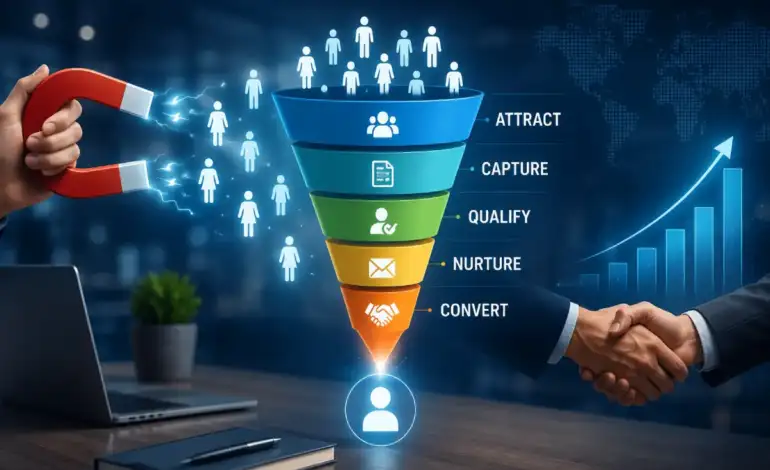
Lead Generation Guide 2026: Strategies, Tools & Best Practices

Last Updated: September 18, 2026
In short: Lead generation is bringing in potential buyers and requesting them to leave their personal detail for the sales process to begin. It is successful when the right message is in front of the right person at the right time and the details are gathered in a way the prospect is happy with followed-up quickly. It isn‘t when the details are gathered in a way the prospect is not comfortable with followed-up quickly. This guide covers the full system, from what a lead actually is to how you measure whether your program is paying for itself.
The reality is, most businesses do not have a “lead generation problem”. They have a specific, solvable problem deep in the middle of the process that converts a stranger into a salesperson making the call. The problem could be traffic. Maybe the leads are plentiful and completely wrong.
We’ve seen all three, usually in the same company at different points in its life.
The reason for this guide‘s length is that the topic is, so if you just want to get to the part that is not working then you can use the contents page to do this. If you don‘t know the topic then read it from start to finish as it explains the topic. All the information provided applies if you are marketing software solutions to large companies, roofing services to homeowners, or consulting to startup entrepreneurs. If B2B and B2C situations differ significantly, we highlight it.
What Is Lead Generation?
Leads generation is a way of building up a pool of potential customers by capturing their contact details (with their permission) so your marketing or sales team can then contact them at some point. The result is a lead this is generally an individual or a company who has an indication of interest in what you sell and is contactable.
That definition has three parts worth pausing on.
“Attracting.” Somebody has to discover that you are out there. It may be through a Google search, a LinkedIn entry, an advertisement, you buddy recommending you, a trade show booth, a cold email. The medium doesn‘t matter.
“Capturing contact information.” This is what separates lead generation from brand awareness. A person who reads your blog post and leaves is a visitor. A person who downloads your pricing guide and gives you their email is a lead. The exchange of information is the moment a lead is born.
“With consent.” In 2026 this isn’t optional. Buying a list of 10,000 emails and blasting them is not lead generation. It’s a compliance risk and a fast way to get your domain blacklisted. More on that later.
What counts as a lead?
Here’s where teams get into arguments. A lead is anyone who has raised a hand, but hands go up for very different reasons. Someone who subscribed to your newsletter is a lead. So is someone who requested a demo and asked about enterprise pricing. Treating them the same wastes everyone’s time.
That‘s why every serious lead generation program has defined what the lead stages are (we‘ll get to MQLs, SQLs and all of the below in a moment) and bought into consensus across marketing and sales. If you walk away with one thing from this section, walk away with this: document what a “qualified lead” means for your business, get sales to buy into it and review it every quarter. Half the friction between marketing and sales is gone when that piece of paper exists.
Why Lead Generation Matters More Than It Used To
Ten or fifteen years ago, a salesperson controlled most of the buying journey. The buyer called, the rep educated them, the rep steered them toward a decision.
That’s gone. What 6sense Buyer Experience Report (2023) says is that B2B buyers are approximately 70% of their buying process when first interacting with a vendor and they have a predetermined choice already. SoldTo. Com‘s analysis of B2B buying journey shows that only 17% of total buying time is spent meeting potential suppliers. During comparison shopping, that drops to 5 or 6%.
Think about what that means. Your prospect is doing most of their research without you, on your website, on review sites, in AI chat tools, in Slack communities, and by asking peers. If your lead generation is set up only to catch people at the very end, when they’re ready to talk to sales, you’ve already lost most of the deals you never knew were happening.
There’s a second shift: the way people search is changing. Gartner predicted early 2024 that regular search engine traffic could drop by 25% by 2026, as a few people shift some of their queries to AI chatbots and assistants. A Se mers and Datos study 2024 found that 58.5% of searches on Google in the US ended with no website click. Buyers are getting answers without visiting anyone. Being visible in those answers is now part of lead generation, not a separate thing.
And a third: the cost of getting it wrong went up. As of February 2024, Google and Yahoo. adopted bulk sender standards, which must be authenticated unless the sender is a huge business and the spam complaint rate is capped at 0.3%. Privacy legislation (GDPR in Europe, CCPA/CPRA in California, and a burgeoning line-up of US state statutes) pack serious punch if you collect data in a poorly considered way. The spray and pray method is no longer simply unproductive.
Put those together and the case is simple. The leading businesses are the ones that turn up early in the buyer‘s research, get permission to keep in touch, and are prepared when the buyer is. That is exactly what a strong lead generation system will do.
Types of Leads: MQL, SQL, PQL, and the Rest
Before you can find leads, you‘ll need a common language for them. These are the terms you‘ll find.
| Lead type | What it means | Typical trigger | Who owns it |
|---|---|---|---|
| Subscriber / contact | Gave you an email, minimal intent | Newsletter signup, blog subscription | Marketing |
| Marketing Qualified Lead (MQL) | Engaged enough that marketing thinks they’re worth attention | Downloaded a guide, attended a webinar, hit a score threshold | Marketing |
| Sales Accepted Lead (SAL) | Sales has looked at the MQL and agreed it’s worth working | Rep reviews and accepts | Sales |
| Sales Qualified Lead (SQL) | Sales has spoken to them and confirmed real fit and intent | Discovery call completed, budget/timing confirmed | Sales |
| Product Qualified Lead (PQL) | Used your product (free trial/freemium) in ways that predict purchase | Hit usage milestone, invited teammates, hit plan limits | Sales or growth |
| Service Qualified Lead | Existing customer signals they want more | Asks about upgrade, expansion, new service | Account management |
You’ll also hear hot, warm, and cold leads. These are looser terms for how close someone is to buying. A cold lead has never heard of you (a cold email recipient, for example). A warm lead knows you and has engaged. A hot lead is asking for a quote.
A few practical notes:
- Not every business needs every stage. A local plumbing company doesn’t need a SAL step. A SaaS company with a free trial absolutely needs PQLs.
- This is also where most of the leakage happens. The marketing team passes 200 MQLs to sales, the sales team runs down 40 of them and nobody knows what happened to the remaining 160. Find and define what the hand off process is now do this before you put any more dollars into the ads.
- PQLs outperform MQLs in product-led businesses, because your usage data provides more insight than a form submission. If you are selling software and not capturing product usage as a lead indicator, you are missing revenue.
How the Lead Generation Process Works
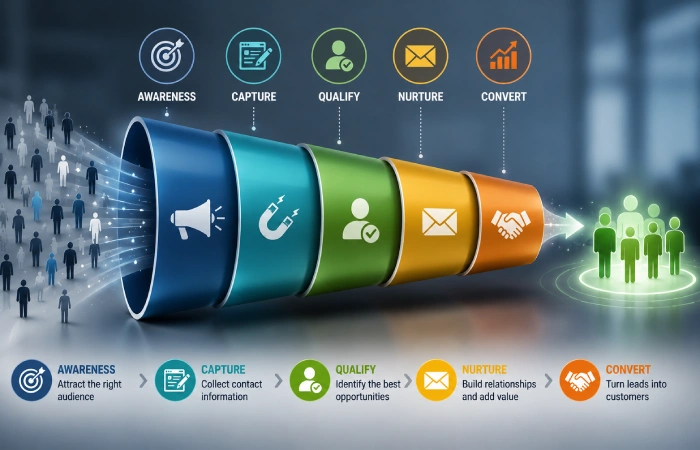
Strip away the tools and the jargon and lead generation is five steps. Every program, from a solo consultant to an enterprise sales org, goes through them.
Step 1: Attract
Make sure you are visible to the right people. This is your channels: search, content marketing, paid media, social media, outbound, events, referrals. The right is the important bit. Getting a flow of 1,0000 non-buyers is less desirable than attracting 100‘ers who could buy, as you‘ll waste time and money.]
Step 2: Capture
Turn attention into a contact record. This is the form, the chatbot, the calendar link, the gated download, the ‘can I have a demo’, the chat at the stand. The transaction must seem balanced: the contact leaves you with their details and in turn, they receive something they wanted.
Step 3: Qualify
Figure out if this lead is qualified and if this lead is ready. Some of this is automated (lead scoring, enrichment data). Some is a person-to-person conversation. The “next step” for each lead might be a sales call, a nurtures sequence, or a friendly “Not a good fit for us.”
Step 4: Nurture
Most leads aren‘t ready to buy when you get them. Nurture ensures you‘re still in front of them with relevant content and timely follow-up until they are. Enter email sequences, retargeting and occasional check-ins.
Step 5: Hand off and close
Once a lead qualifies and is viable, sales steps in. How smoothly that handoff goes (speed, vicinity, ownership) will surprise you in how much it influences your close rate.
The funnel view
You’ll often see this drawn as a funnel with three layers:
- Top of funnel (TOFU): Awareness. The person faces a problem, begins to learn about it. Content: blogs, how-to articles, videos, social media content.Ask: an email address at most.
- Middle of funnel (MOFU): Consideration. They have the information and are evaluating products / vendor. Contents: comparison guides, webinars, case studies, templates, calculators. Require: can provide more partiuclar (company, role) in return for more valuable contents.
- Bottom of funnel (BOFU): Decision. They select a vendor. Content includes product demos, free trial signups, pricing pages, consultation offers, ROI calculators. Ask: a conversation.
The funnel is a useful simplification, not a law. Real buyers loop back, skip stages, and involve other people. But it helps you avoid the most typical error: giving people a “book a demo” CTA when they just realized that they had a problem.
Inbound vs. Outbound Lead Generation
Inbound leads: The buyer finds you and contacts you Outbound: You find the buyer and contact them. The most healthy programs are a mix of both this is determined by the size of your deals, your sales cycle, and how mature your market is.
| Inbound | Outbound | |
|---|---|---|
| Who starts the conversation | The buyer | You |
| Main channels | SEO, content, social, webinars, referrals, review sites, AI search visibility | Cold email, cold calling, LinkedIn outreach, paid ads to cold audiences, events |
| Time to results | Slow to start (3–9 months for SEO), compounds over time | Fast to start (days), doesn’t compound |
| Cost curve | High upfront, lower per lead over time | Predictable, roughly linear cost per lead |
| Lead intent | Higher on average (they came looking) | Lower on average (you interrupted them) |
| Scalability | Limited by search demand and content capacity | Limited by list quality, deliverability, and headcount |
| Best for | Established categories with search demand, longer-term growth | New categories, enterprise deals, hitting near-term targets |
When to lean inbound
If people are searching for what you sell, inbound is almost always a better bet than outbound as a long-term medium-term investment. A good, well-ranked guide can generate leads for years after you publish it. Inbound leads tend to close more quickly because the buyer has already done their homework.
The catch is patience. If you need pipeline this quarter and you’re starting from zero, inbound alone won’t get you there.
When to lean outbound
Outbound makes sense in the following scenarios: when your ICP is a limited segment of viewers who can be specifically targeted (the 400 mid-sized logistics companies in your region, for example), when your deal size is worth the cost of a warm human outreach or when nobody is searching for your solution yet because they don‘t know it exists.
Outbound has gotten harder. Inboxes are crowded, spam filters are aggressive, and buyers are skeptical. The old way of pounding out a broad sound to a rented list is dead, and anyone still doing it will destroy their domain reputation. The one that works in 2026 is tighter, leaner, and some kind of signals (we get into this in the lead scoring section)
The honest answer: do both, sequenced
Starter with the one that reaches their customers earliest. Use the proceedsfrom that channel to develop the other channel, and have each one strengthen and support the other. Outbound prospects who ignore your email often Google you afterward. Inbound content gives your outbound team something worth sending.
B2B vs. B2C Lead Generation: What Actually Changes
The principles are identical. The mechanics are not.
| Factor | B2B | B2C |
|---|---|---|
| Who decides | A group. Gartner puts the typical buying group at 6–10 decision makers; Forrester’s 2024 buyer survey found an average of around 13 people involved in a purchase. | Usually one person, sometimes a household |
| Sales cycle | Weeks to a year or more | Minutes to weeks |
| Deal value | High, justifies human sales involvement | Lower, usually self-serve |
| What a lead looks like | Name, company, role, email, sometimes phone | Email or phone, maybe a first name |
| Primary channels | LinkedIn, search, webinars, outbound, events, review sites | Paid social, search, email, influencers, SMS, in-store |
| Qualification | Fit (company size, industry, role) plus intent | Almost entirely behavioral (what they browsed, clicked, added to cart) |
| Nurturing | Long, educational, multi-stakeholder | Short, promotional, behavior-triggered |
| Success metric | Pipeline value, SQLs, CAC payback | Conversion rate, revenue per email, ROAS |
The B2B complication nobody talks about enough: buying groups
If a dozen people influence a purchase and your lead generation only ever engages one of them, you’re exposed. Deals die because someone in finance, IT, or legal was never part of the conversation and vetoes the decision at the end. Sales teams call this the “invisible stakeholder” problem.
The fix is to think in accounts, not individual leads. When your CRM shows you‘ve had three people from the same company interacting in the last month that‘s a much more significant sign than one individual downloading three items. Structure your data so that you can actually see it: contacts associated with companies, roles categorized, engagement rolled up to account level.
It also means creating content your champion can forward. An engineering lead who loves your product still has to convince a CFO. Give them a one-page ROI summary, a security overview, and a short case study, and you’ve armed them to sell internally when you’re not in the room.
The B2C complication: volume and speed
B2C lead generation lives and dies on automation. You can‘t have a human follow up with 5000 people who abandoned a cart. The capture, the qualification, and the nurturing has to happen flawlessly drip campaigns, browsing and cart abandonment sequences, post purchase cross-sell offers, win back campaigns for dormant buyers. The mastery is in segmentation and timing, not conversation.
Lead Generation Channels: What Works and When
There is no silver bullet. There is only the channel that is right for your buyer, your budget and your timescales. Here‘s an honest breakdown of each.
Search engine optimization (SEO)
Your search rankings for the terms your buyers are googling when they are trying to find a solution you provide. This is the highest Return On Investment channel you can get from inbound marketing in the long term, but it takes the longest to produce results. Prioritize commercial intent keywords (e.g. ‘best [category] software’, ’[service] near me’, ’[product] prices’), because they will convert into a sale, then develop educational content targeted to individuals earlier along their purchase journey. For example, leading to pillar pages such as this one that are supported by dedicated cluster articles:
Content marketing
Blogs, directions, templates, utilities, calculators, research, video. Content is the lifeblood of everything else: what appears high in search, what you post on social, what you include in outbound campaigns, what helps nurture leads over time. The content your company misses is publishing the volume of content instead of the usefulness of. One truly useful benchmark report will outperform five dozen generic “tips” pieces.
Paid search (PPC)
Google Ads, Microsoft Ads. Fast and measurable, but expensive for competitive categories. Ideal for bottom-of-funnel terms where the buyer is ready to convert. The key to success isn‘t the ad it‘s the landing page. Placing paid traffic on your homepage is the most common way to sabotage your budget.
Paid social
LinkedIn, Meta, TikTok, X, Reddit. For B2B LinkedIn is the Fallback; it is really focused on targeting by job title, company size, industry etc and LinkedIn has consistently said that approximately 80% of B2B social media generated leads are from there. Also expensive. Meta and TikTok are king in the B2C space, but are also increasingly effective in B2B with a lower price point. Retargeting (serving ads to visitors) is almost always the most successful paid social tactic whatever the platform.
Email marketing
For leads you already have, nothing beats email on cost. Litmus finds it returns around $36.00 back for every $1.00 spent (based on 2020 figures and commonly quoted). Email is more of a nurturing than an acquisition channel but a good newsletter with genuine subscribers is a far more effective source of referrals and dormant lead reactivation than anything else.
Cold outreach (email and phone)
The main outbound channel. What is working today: thoughtfully researched, small lists; short emails (less than 125 words); a clear call to action (a trigger event, personal connection, something interesting I saw); a non-intimidating ask (“worth a quick look?”; not “can we chat for 30 minutes on Thursday?”); and a follow-up cadence of three or four touches in two weeks and then, on to the next.
What definitely doesn‘t work: mass sequences, fake personalization (“Wow, I saw you‘re VP of Marketing at Acme!”) and not managing deliverability. If you‘re sending cold at any non-trivial scale, you need SPF & DKIM & DMARC, a dedicated sending domain (never your primary), slowly warmed up inboxes, and daily volume kept reasonably low per mailbox. Google‘s opt-in spam complaint trigger line is 0.3% so stay below that, ideally 0.1%.
Webinars and events
Webinars operate at the mid-funnel stage and often have serious buyers behind them. If you can give almost an hour to something you‘re obviously interested in it. Live events (conferences, trade-shows and hosted dinners) are expensive per lead but they lead to the warmest relationships and have been the initiation point for many of our enterprise deals.
Referrals and partnerships
The most underinvested channel in nearly every business we look at. Referred is faster and free. Build a lightweight system: a simple “Customer satifaction“would suffice, wait for a high point (after a win), don‘t hassle people, send credit for co-operation. Train your partnership (agencies, complement vendors, partners, refets)every extension of your customer base.
Review sites and marketplaces
G2, Capterra, Clutch, Trustpilot, Google Business Profile and trade industry directories. You get found by the buyer who is conducting research about you without you. Claim and optimize your listings, hold reviews diligently and treat inbound prospects from this channels as high intent.
AI search and answer engines
The newest channel and the one changing fastest. When a buyer requests ChatGPT, Perplexity, Gemini or Google‘s AIOs, “what are the best options for X,” the machine blends together an answer from sources it trusts. And those sources are, today, called an optimizer like Generative Engine Optimization or Answer Engine Optimization.
The practical playbook is very much in line with good SEO: concise and to-the-point answers at the top of each section, organized content in tables, FAQs, numbered lists, etc., unique facts about your entity (business/web presence) listed across the web, and schema markup. The main new muscle is monitoring: track whether you’re mentioned for your target queries and how you’re described.
Choosing your channel mix
A workable starting point for most businesses:
- One primary inbound channel you commit to for at least 12 months (usually SEO plus content).
- One paid channel for near-term volume (paid search for B2C and local, LinkedIn or paid search for B2B).
- One relationship channel (referrals, partnerships, or outbound depending on deal size).
Add channels only after the first three are working. Spreading a small budget across seven channels is how you end up with no data on any of them.
Lead Magnets, Landing Pages, and Forms: The Conversion Mechanics
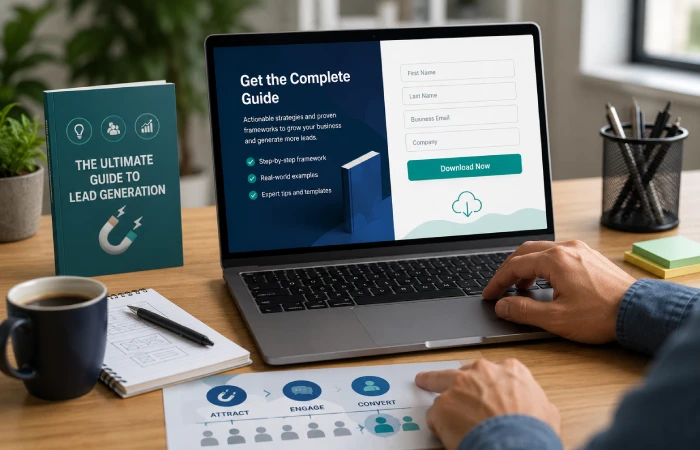
Traffic doesn’t equal leads. The conversion happens on a page, through a form, in exchange for something. Get these three things right and you can double your leads without a single extra visitor.
Lead magnets
A lead magnet is what you offer in exchange for contact details. The best ones are specific, immediately useful, and closely tied to what you sell. In rough order of effectiveness for most businesses:
- Tools and calculators (ROI calculators, cost estimators, audits). High perceived value, high intent.
- Templates and checklists. Practical, fast to consume, easy to make.
- Original research and benchmark reports. Great for authority and PR, harder to produce.
- Webinars and workshops. Strong for B2B mid-funnel.
- Free trials, freemium, and free consultations. Bottom-of-funnel; the “magnet” is the product itself.
- Ebooks and whitepapers. Still work, but expectations are high and generic ones get ignored.
- Discounts and giveaways. The B2C staple. Effective for volume, attracts bargain hunters.
Match the magnet to the funnel stage. A checklist for someone at the top of the funnel. A comparison guide for the middle. A trial or consultation at the bottom.
Landing pages
A landing page is a focused page with one job: convert. The average landing page conversion rate in various industry sectors is approximately 6.6%, as reported by the Conversion Benchmark Report 2024. However, varies significantly from industry to industry. A few things reliably move that number:
- One offer, one CTA, no navigation. Every exit link is a leak.
- Headline matches the ad or link that brought them there. Message mismatch kills conversions.
- Benefits above the fold, proof below. What they get, then why they should believe you (logos, testimonials, numbers).
- Speed. Every extra second of load time costs you.
- Mobile first. More than half your traffic is probably on a phone.
Forms
The form is where most friction lives. The rule of thumb: ask only for what you’ll use in the next step. If nobody’s going to call the lead, don’t require a phone number. Options that help:
- Progressive profiling: ask two fields the first time, two more the next time.
- Enrichment: collect the email and let a data tool fill in company, size, and industry automatically.
- Conditional fields: show the “how many employees” question only if they’ve said they’re B2B.
- Chatbots and calendar embeds as alternatives to forms for high-intent visitors who’d rather just book.
CTAs
Calls to action are small but they matter. Specific beats generic (“Get the pricing guide” beats “Submit”). Contrasts not only matter. The placement matters: one earlier in the presentation for those ready now; one later for those wanting more indication and one in the middle of long content.
Test one variable at a time. Headline, then form length, then CTA copy. Changing five things at once tells you nothing.
Capturing and Managing Leads: CRM, Speed, and Data Hygiene
You’ve captured a lead. Now what happens in the next hour matters more than most teams realize.
Speed to lead
A study published in Harvard Business Review (“The Short Life of Online Sales Leads,” 2011) audited how quickly companies responded to web leads. Firms that reached out within an hour were nearly seven times as likely to qualify the lead as those that waited even one hour longer, and more than sixty times as likely as those that waited 24 hours or more. Only 37% of companies responded within an hour at all. That research is over a decade old, and buyer patience has not increased since.
Establish a time to respond to the inquiry, measure to ensure you get it and automate the first touch if a person cannot respond quick enough (instant response email with calendar link, a bot to schedule the call, a text message for high intent forms).
Your CRM
Every lead should land in one system, automatically, with its source attached. Spreadsheets will snap at around 200 leads. Use a CRM that fits your size (Hubspot, Pipedrive, Zoho, Salesforce, Close or vertical-specific) and include all leaddcapture points: Forms, Chat, calendar, ad platforms, event scans.
Non-negotiables for the setup:
- Tracking the source of leads (UTM tracking parameters, first- and last-touch attribution) so you now which channels are actually converting.
- Lifecycle stages that match the lead definitions you agreed on earlier.
- Ownership rules so every lead has a name next to it within minutes.
- For B2B: contacts linked to companies, so you can see account-level activity.
Data hygiene
Contact data rots. People have new jobs, companies rebrand, inboxes bounce. The alleged norm is that B2B contact data degrades at about 25 30% annually. Logistically, this implies:
- Deduplicate on import (and set matching rules so “Acme Inc” and “ACME, Inc” not turn into 2 companies).
- Re-verify email lists before big sends.
- Archive contacts that haven‘t interacted in 12–18 months and do not continue to email them ad infinitum.
- Standardize fields( format for job titles, industries, countries) so segmentation actually works.
Lead Qualification Frameworks
Qualification is determining whether the lead is worth your reps’ time. Frameworks are a standard TO DO checklist for your reps so that ‘qualified’ means the same thing on Tuesday as it did on Monday!
BANT (Budget, Authority, Need, Timeline). The original, from IBM. Simple and still valid for some sales, but it presumes the buyer already has a budget and a timeframe, which early stage buyers don‘t yet know.
CHAMP (Challenges, Authority, Money, Prioritization). Puts the buyer’s problem first and treats budget as something to solve for rather than a gate. Better for consultative sales.
GPCTBA/C&I (Goals, Plans, Challenges, Timeline, Budget, Authority, Consequences, Implications). More comprehensive version of the one used by Hub Spot. Very detailed, maybe even too detailed for the first call.
MEDDIC / MEDDPICC(Metrics, Economic buyer, Decision criteria, Decision process, Paper process, Identify pain, Champion, Competition). Designed specifically for very complex, long-sell enterprise situations with multiple players. Too much for anything transactional.
Choose one, have it adapt for your business, and develop it into 3-5 questions your team can ask on all discovery calls. Any of these frameworks will work, so long as you ask them consistently.
Lead Scoring: Fit, Behavior, and Intent
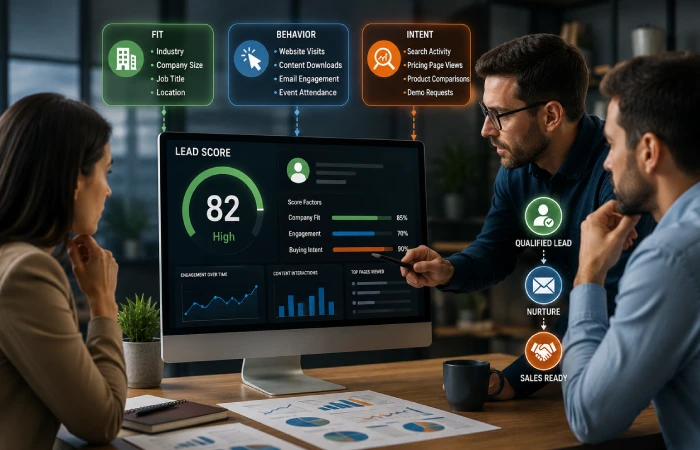
Lead scoring gives a numerical value to a lead depending on who they are and what they do so that highest value leads are prioritized. It is a way of preventing you from treating a student uploading a template the same way as a director requesting a demo.
The three ingredients
1. Fit (demographic/firmographic). Is this person and company part of your ideal customer? Pros for the correct industry, size, title, location. Cons for the wrong ones (competitors, students, countries you don‘t operate in).
2. Behavior (engagement). What have they done? Award points for high intent activities (visiting pricing page, requesting demo, downloading case study), fewer points for low intent activities (reading blog, following on social media). Reduce points further as time goes by so someone active in Jan doesn‘t still look hot in June.
3. Intent signals (external and timing). This is what differentiates a 2026 scoring model from a 2016 one. The indications that a company is in a active buying window:
- Hiring: posting jobs for roles that would use your product.
- Funding: a new round means new budget and growth pressure.
- Leadership changes: new executives bring new vendors.
- Technology changes: a company that just switched CRMs is open to changing adjacent tools.
- Third-party intent data: tools like Bombora, 6sense, and G2 Buyer Intent show which companies are researching your category across the web.
- Repeat visits from multiple people at the same company.
Marketers who combine all of these signals into their targeting and are able to reach people already in market will always outperform marketers from static list sources, whose reach is based on unprompted demand.
A simple starting model
| Signal | Points |
|---|---|
| Job title: Director or above | +20 |
| Job title: Manager | +10 |
| Job title: Student, intern, unrelated | -15 |
| Company size in target range | +15 |
| Target industry | +10 |
| Visited pricing page | +15 |
| Requested demo or consultation | +40 |
| Downloaded case study | +10 |
| Attended webinar | +15 |
| Opened email | +2 |
| Second contact from same company engaged (B2B) | +20 |
| Company posted relevant job in last 30 days | +10 |
| No activity in 60 days | -20 |
Establish, for example, 60 points as the lead score over which the system generates a sales alert. Then, (here‘s the big step most teams forget), check what scored leads have been closed after 90 days and re-calibrate your weights.
For B2B: score the account, not just the person
If buying is done by a committee, a single individual reaching a score of 60 is more informative than three individuals from the same organization each reaching a score of 30. Incorporate an account perspective: how many contacts are there, how many of the critical roles are there and how recently. Route accounts on when the group is involved, not when one individual is.
Lead Nurturing: Staying Useful Until They’re Ready
Most leads aren’t ready. Some are researching for a project six months out. Some are building a case internally. Some downloaded your guide and forgot about you by lunch.
Nurturing is the structured process of staying in front of them with something worth their attention until timing lines up. Forrester’s oft-cited research found that companies good at lead nurturing generate about 50% more sales-ready leads at roughly a third lower cost per lead. The figure is old (2014), but every internal dataset we’ve seen points the same direction.
What good nurturing looks like
- Sequenced, not random. A new lead gets a defined series: welcome, most useful resource, relevant case study, a soft offer to talk. Three to six emails over two to four weeks, then move them to a slower cadence.
- Segmented by what you know. Someone who downloaded your pricing guide gets different follow-up than someone who read a top-of-funnel post. Someone in healthcare gets healthcare examples.
- Triggered by behavior. Visited the pricing page twice this week? That should trigger something (a rep alert, a targeted email), not wait for the next scheduled send.
- Multi-channel. Email plus retargeting ads plus, for high-value B2B accounts, a LinkedIn touch from a real person. People need to encounter you several times before they act.
- Has an exit. Leads who never engage after 90 days go to a quarterly newsletter or get archived. Emailing dead contacts hurts your deliverability to live ones.
Content that nurtures
Case studies (specific numbers, specific timeframe), comparison content, “how to get buy-in” resources, customer webinars, industry benchmarks, and honest pieces about when your solution isn’t the right fit. That last one builds more trust than anything.
Lead Generation Metrics That Actually Matter

You can drown in dashboards. These are the numbers that tell you whether your program is working.
| Metric | Formula | What it tells you |
|---|---|---|
| Lead volume | Count by channel and period | Whether the top of the funnel is healthy |
| Conversion rate (visitor to lead) | Leads ÷ visitors | Whether your pages and offers work |
| Cost per lead (CPL) | Channel spend ÷ leads from that channel | Channel efficiency (but only half the story) |
| MQL to SQL rate | SQLs ÷ MQLs | Whether marketing is sending sales the right people |
| Lead to customer rate | Customers ÷ leads | The real quality measure |
| Customer acquisition cost (CAC) | Total sales + marketing spend ÷ new customers | What a customer actually costs you |
| CAC payback period | CAC ÷ monthly gross profit per customer | How long until a customer pays for their own acquisition |
| Speed to lead | Time from form submit to first human contact | Whether you’re leaving deals on the table |
| Pipeline generated | Sum of opportunity value from leads in a period | What marketing is actually contributing to revenue |
| Sales cycle length | Average days from lead to close | Whether qualification and nurturing are working |
How to read them together
CPL alone is dangerous. A live channel with a 30 CPL is worse than a 300 CPL channel that closes 1/5 of the time. Always cluster CPL with lead-to-Customer Rate or better yet Cost per Customer by channel.
Monitor the ratios between stages. If visitor to lead is good but MQL to SQL falls apart, then your offers attract the wrong market. If MQL to SQL is all right but SQL to close falls apart, then this is a sales, or a pricing problem, not a lead issue.
If you want the program to survive a budget review then report on pipeline & revenue not just leads.
Lead Generation Tools by Category
You don’t need most of these. You need one from each category that matters for your channels, connected properly.
| Category | What it does | Examples |
|---|---|---|
| CRM | Stores and manages every lead and interaction | HubSpot, Salesforce, Pipedrive, Zoho, Close |
| Forms, landing pages, and popups | Captures leads on your site | Unbounce, Instapage, Typeform, OptinMonster, native CRM tools |
| Email marketing and automation | Nurture sequences, newsletters, triggers | HubSpot, ActiveCampaign, Mailchimp, Klaviyo (B2C/ecommerce), Customer.io |
| SEO and content | Keyword research, rank tracking, content optimization | Semrush, Ahrefs, Google Search Console, Clearscope |
| Paid advertising | Search and social ads | Google Ads, Microsoft Ads, LinkedIn Campaign Manager, Meta Ads Manager |
| Prospecting data and enrichment | Finds contacts and fills in company data | Apollo.io, ZoomInfo, Lusha, Cognism, Clay, Clearbit |
| Intent data | Shows which companies are researching your category | Bombora, 6sense, G2 Buyer Intent, Demandbase |
| Outbound sequencing | Multi-step email and call cadences | Outreach, Salesloft, Reply.io, Apollo, lemlist |
| Email deliverability | Warms domains, monitors reputation | Instantly, Smartlead, Warmbox, Google Postmaster Tools |
| Website visitor identification | Reveals which companies visit your site | Leadfeeder (Dealfront), RB2B, Clearbit Reveal |
| Chat and conversational | Qualifies and books leads on-site | Intercom, Drift, HubSpot Chat, Tidio |
| Scheduling | Removes friction from booking a call | Calendly, HubSpot Meetings, Chili Piper |
| Webinars | Hosts and captures event leads | Zoom Webinars, Livestorm, Demio, ON24 |
| Analytics and attribution | Tracks what’s working | Google Analytics 4, HubSpot reporting, Dreamdata, HockeyStack |
| AI search monitoring | Tracks brand visibility in AI answers | Profound, Peec AI, Otterly, Semrush AI toolkit |
A few opinions: start with your CRM and build outward from it, since everything else has to connect to it. Don‘t buy intent data until you‘ve first used up your existing first-party signals. And if you‘re considering a platform that says it will “fully automate” outbound with AI, go ahead and reserve some budget for the brand hit when it inevitably sends something cringeworthy.
Compliance: The Rules You Can’t Ignore
This section is short because the rules are simple and long because to break them is costly.
- GDPR (EU / UK): You will have to have a lawful basis to process personal data. Sending marketing emails to individuals will normally require their consent (opt-in/not pre-ticked) B2B cold email to business addresses can rely on “legitimate interest” in many cases, but you must offer an easy opt-out and honor it. Fines can reach 4% of global turnover.
- CAN-SPAM (US): For commercial email, a physical address, functional unsubscribe, truthful subject line are required. An opt- out request has to be implemented within 10 working days. Cold email is not banned by CAN- SPAM if you observe these.
- CCPA/CPRA (California) and other US state laws: Provide consumers with a right to know, delete, and opt out of the sales of their data. More states add laws every year.
- TCPA (US): Governs calls and texts. Marketing texts and robocalls to mobile numbers require prior express written consent. Penalties are per message.
- CASL (Canada): Among the strictest. Express consent is generally required for commercial email.
- Google/Yahoo bulk sender policy (2024): Must email minimum of 5,000 Gmail accounts daily. Requires full SPF DKIM DMARC authentication, one-click unsubscribe. Spam complaint rate under 0.3%.
Best practices: do not purchase consumer email list; implement a privacy policy outlining how data is used; track opt-in records of each contact; make it easy to unsubscribe as it is to subscribe.
Common Lead Generation Mistakes
We see these repeatedly. Most are cheap to fix.
- No agreed definition of a qualified lead. Marketing celebrates 500 leads; sales says they got 12 real ones. Nobody’s lying. They’re measuring different things.
- Slow follow-up. A lead that waits three days is a lead that talked to your competitor two days ago.
- Sending paid traffic to the homepage. The homepage is built for everyone. A landing page is built for the person who clicked that specific ad.
- Asking for too much, too early. A twelve-field form for a checklist.
- Gating everything. Some content should be free and findable. Gate the things that genuinely signal intent.
- Optimizing for lead volume instead of lead quality. Cheap leads that don’t close are the most expensive kind.
- Ignoring existing customers. Referrals, upsells, and testimonials from customers you already have are the cheapest leads you’ll ever get.
- Treating outbound as a volume game. Bigger lists and more emails don’t fix a bad message. They just burn your domain faster.
- No source tracking. If you don’t know which channel a closed customer came from, you can’t decide where to spend next year.
- Never revisiting the ideal customer profile. Your best customers three years ago may not be your best customers now.
- Letting the CRM rot. DDuplicates, stale contacts, and inconsistent fields go unnoticed which silently breaks segmentation, scoring, and reporting.
- Giving up on a channel too early. SEO at month four looks like failure. SEO at month fourteen looks like the best decision you made.
Three Illustrative Scenarios
These are composites, not client case studies, meant to show how the pieces fit together.
A regional accounting firm. Fifty leads a month, mostly from Google Business Profile and referrals, closing about 15%. Their fix wasn’t more leads. It was speed: a form that pinged the office manager’s phone, a same-day call target, and a three-email sequence for anyone not reached. Close rate on the same volume moved noticeably within a quarter. Then they built two landing pages for their highest-margin services and started ranking for “[service] + [city]” terms.
A B2B software company with a free trial. Plenty of trial signups, weak conversion to paid, and a sales team cold-calling every signup on day one. The change: define a PQL (invited a teammate, connected an integration, or hit a usage threshold within seven days) and route only those to sales. Everyone else went into an onboarding email series. Sales made fewer, better calls; trial-to-paid improved because sales was talking to people who’d actually used the product.
A professional services company doing outbound. Two SDRs sending 300 emails a day each from the main company domain, getting almost no replies and starting to land in spam for customers too. The fix: switch to old dedicated mailing tools, warm the subdomains, keep the daily volume per mailbox to a low number, trim the list to those companies that exhibited a trigger (recent funding, relevant job postings, new leadership) and rephrase the sequence off of a unique point-of-view on each of the companies. Response rates went from sub 1% to the mid teens on a small percentage of the volume.
In-House, Agency, or Marketplace: Who Should Run Your Lead Generation?
The answer would really depend on three factors: How specialised is the work, What volume is there and How quickly you need results.
Build in-house when lead gen is part of your critical success factor (and a significant expense for your organization); you have enough volume to support a full-time dedicated specialist; and you can pay the ramp time (a good in-house marketer may take three to six months to hit his/her stride in a new company).
Use an agency when you need a skill you don‘t currently possess (paid media, SEO, outbound infrastructure), when you want to see results in a timeframe quicker than a hire can manage, or when you want to ramp up or down without headcount decisions. The danger is agencies monitoring activity rather than pipeline, the solution is contracts linked to leads and revenue not deliverables.
Use a marketplace when you want the agency model with more flexibility: matching to a vetted specialist for a defined project, comparing options, and avoiding the long sales cycle of agency procurement. This is where Inc Marketing Place fits. If you‘d prefer not to test out 90+ agencies, [ Link → /get-matched/] and we will direct you to experts who have helped generate leads for similar companies.
Therefore, most growing organizations will have a combination of an internal owner responsible for the business and its coordination, and outside experts that will take care of the specific channels where there is a need for depth.
A 90-Day Lead Generation Plan
If you’re starting from scratch or rebooting, here’s a sequence that works.
Days 1–30: Foundation.
Define your ideal customer profile and your lead stages with sales. Set up or clean your CRM with source tracking. Audit your site for capture points and plug the obvious leaks (add a call-to-action to your top pages, make your main form shorter, add a calendar link). Establish a speed-to-lead goal and a means to reach it. Pick your three channels.
Days 31–60: Build.
Create one strong lead magnet matched to your best-fit buyer. Build one landing page for it. Write a five-email nurture sequence. Launch your paid channel with a small test budget pointed at that landing page. Publish your first two pieces of commercial-intent content. If doing outbound, set up dedicated domains and start warming.
Days 61–90: Measure and adjust.
Look at every stage ratio. Kill what’s clearly not working, double the budget on what is. Interview the sales team about lead quality. Start a basic lead score with five signals. Plan the next quarter’s content around the questions leads actually asked.
At day 90 you won’t have a finished machine. You’ll have a working one and real data about where to invest next, which is more than most companies have after a year.
Frequently Asked Questions
What is lead generation in simple terms?
It’s the process of finding people who might want to buy from you and getting their permission to follow up. A ‘lead’ is someone who is interested and has given you a way to get in touch.
What’s the difference between lead generation and demand generation?
Demand generation familiarizes prospects with your category or industry and your brand, often without asking for anything. Lead generation converts that interest into identifiable contacts. Demand gen fills the pool; lead gen fishes in it. You need both.
What is the difference between a lead and a prospect?
Use differs but, in general, a lead is somebody that has expressed interest and a prospect is a lead that has been qualified as a good fit and is being actively pursued by sales.
How much does lead generation cost?
It could be very cheap (free referrals, organic search after initial setup) or hundreds of dollars a lead (enterprise B2B paid channels). The relevant metric is cost per customer, which is a function of your close rate. A $300 lead that closes 20% of the time costs $1,500 per customer. A $50 lead that closes 1% costs $5,000.
How long does lead generation take to work?
Paid channels and outbound can generate leads in a few days, while SEO and content can take 3–9 months to start generating significant results and continue to improve upon that. Referral programs can take a few months to pick up.
What is a good lead conversion rate?
It really varies by what you‘re measuring, and your industry. The median landing page conversion is quoted at about 6.6% by Unbounce for 2024.15-30% MQL-to-SQL conversions may be typical in B2B. Just improve your own baseline, don‘t chase someone else‘s number.
Is cold email still effective for lead generation?
Yes, when it’s targeted, brief, relevant, and technically sound. Mass, generic cold email is largely dead and increasingly damages your domain. Small, signal-based lists with genuine personalization still produce meetings.
What’s the best lead generation channel for small businesses?
Generally focus on Google Business Profile and local SEO for anything that‘s location based, referrals for services, and one paid channel for near-term volume. Do what your consumers actually use to find businesses like yours and master that before adding additional channels.
How does AI change lead generation?
Three main ways: Buyers are researching in AI tools, so you need to be visible there. (2) AI tools make personalization and research faster for your team. (3) AI-driven spam is making inboxes noisier, which raises the bar for anything you send. It doesn‘t change the fundamentals of relevance, timing and trust.
Should I gate my content?
Gate content that says to me, I really want to and is a sign of real intent (such as pricing guides, an in depth comparison, a tool or template). Keep educative content open and leave room to rank, get shared and build trust. When in doubt, ungated with a strong CTA usually beats gated.
Where to Go From Here
Lead generation isn’t a tactic. It’s the system connecting how people discover you to how they end up buying, and every piece of that system either helps or leaks. The companies that do it right are no longer the ones with the biggest budgets. They are the ones who: defined what a good lead is, showed up where the prospects were researching and made it easy to raise a hand and followed up quickly.
If you want help working out which part of your system is the bottleneck, [Link → /lead-generation-audit/] and we’ll take a look. Or [Link → /get-matched/] to be connected with a lead generation specialist who fits your industry and budget.
Either way, start with the definition document. Everything else gets easier once marketing and sales agree on what they’re trying to produce.

I’m Thomas — Editor & Admin of incmarketingplace, Blogger, and Senior SEO Analyst. writer at Inc Marketing Place, sharing insights on SEO, branding, content marketing, and online business growth. I focuses on creating practical and easy-to-understand content for marketers, entrepreneurs, and growing businesses