Lead Generation Strategies in 2026: What’s Actually Working and What I’d Stop Doing

Last Updated: September 18, 2026
If I had a dollar for every ‘ultimate guide to lead generation’ that’s been published in the last three years, I’d have enough money to run the paid ads those guides recommend — and then some.
What I’m going to do here is different. I’m going to tell you what’s genuinely moving the needle for businesses right now, what’s quietly stopped working, and what most of those other guides skip past because it doesn’t make for a clean listicle.
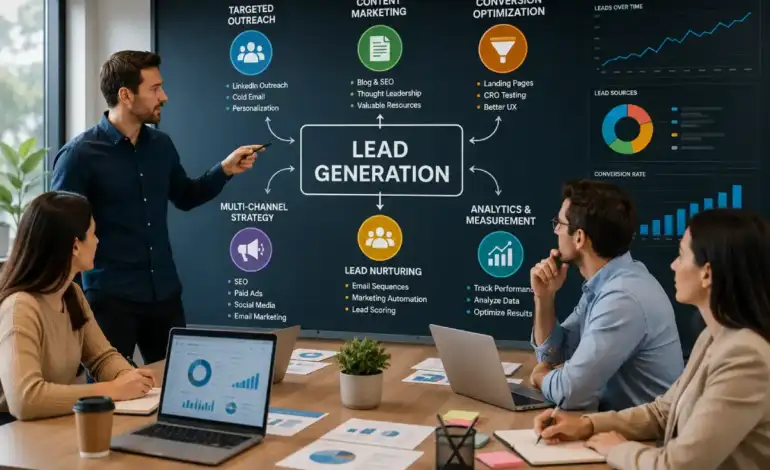
Lead generation strategies are, at their most basic, the repeatable methods you use to bring qualified prospects into your sales pipeline. Not one-off campaigns. Not the spike you get when a post goes viral. Repeatable. Consistent. Month over month. That‘s the difficult part actually, and it‘s what this guide is concerned with.
B2B Lead Generation — The Stuff That’s Actually Working Right Now
Let me be direct about something. A lot of B2B lead generation advice was written by people who haven’t run an outbound campaign recently, or haven’t had to personally explain a weak pipeline to a founder. A lot has changed. What was effective in 2021 is effective in 2026 perhaps even less effectively.
Cold email open rates have tanked. Not because the channel is dead, but because everyone started doing it, the tools got cheap, and inboxes got smarter. If your open rates are under 30% on cold outreach, your domain reputation is probably the issue, not your subject lines.
LinkedIn outreach, done right, still works. Done wrong — which is how 90% of people do it — it just annoys people. The difference depends on whether you have viewed the person‘s profile and have a specific and relevant comment to make, or if you are running a sequence that says ‘Hi [First Name], I see you work in [Industry]…’
Here‘s what I‘d focus on for B2B right now, in the order I‘d actually prioritize:
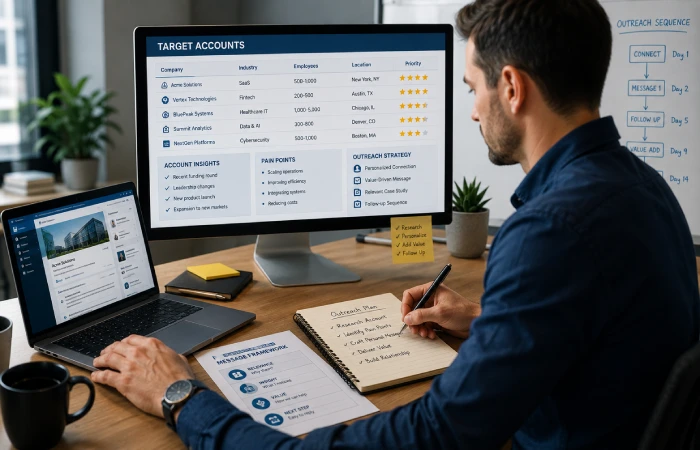
- LinkedIn, but targeted. Pick 200 accounts. Not 2,000. Two hundred. Research them. Send 15-20 personalized messages a week (rather than 150 templated messages). You can get 20-30% responses to this kind of effort. I have seen it happen.
- Content-led SEO. This takes 4-6 months to produce meaningful results and most teams abandon it at month two when they don’t see movement. The teams that stick with it build compounding organic traffic that their competitors can’t easily buy away from them.
- Referral programs that are actually structured. Most companies get referrals because they do good work, which is great. But most have no formal process for asking, tracking, or incentivizing referrals. Adding that structure — even something simple — usually doubles referral volume within a quarter.
- Account-based marketing for big targets. If you have a handful of dream accounts, run ABM. Specific content for their industry, retargeting ads only to those companies, outreach tied to things happening in their business. Expensive per account. Cheap per closed deal.
According to HubSpot’s State of Marketing research, lead generation remains one of the biggest challenges facing marketers, which is both reassuring (you’re not alone) and a little alarming (most people are struggling with the same thing and nobody’s cracked it universally). Which is both reassuring (you’re not alone) and a little alarming (most people are struggling with the same thing and nobody’s cracked it universally).
| One thing nobody tells you about B2B lead gen timelines
The average B2B sales cycle is over 100 days, according to Salesforce’s State of Sales report. The content you publish today, and the outreach sequences you build this month, often won’t show up as revenue until a future quarter. The content you publish today, the outreach sequences you build this month — they won’t show up as revenue until Q3 or Q4 at the earliest. Teams that switch tactics every 6 weeks because ‘it’s not working’ are basically resetting their pipeline clock every 6 weeks. The companies winning at B2B lead gen are boring and consistent, not clever and reactive. |
Lead Generation Consulting — Honest Talk About When It’s Worth It
I have a complicated relationship with the idea of lead generation consultants. I’ve seen it work really well. I’ve also seen companies spend $8,000 a month on a consultant who delivered a 47-slide deck and three months of meetings that produced no measurable change in pipeline.
So here’s my honest take on when it makes sense.
Totally makes sense if you have particular diagnosable problem, say for example, low conversion rate at a particular funnel stage. Cold outreach that’s not booking meetings despite decent volume. Content that’s getting traffic but not converting to leads. A consultant who’s seen that exact problem thirty times can usually find the fix faster than you’d find it internally.
It doesn’t make sense when the problem is that your offer isn’t positioned well, your pricing is off-market, or your product has real issues you haven’t fixed. No lead generation consultant can overcome a fundamentally uncompetitive offer. (I’ve watched people try. It’s not pretty.)
What good consulting actually looks like — and what to ask for before you sign anything:
- Diagnostic phase: where they actually determine the true bottleneck the symptom, if a consultant can‘t tell you exactly where your leads are leaving the pipeline in the first two weeks you are talking to them, then they are a red flag.
- Priority, identify your critical few recommendations not a list of 20-30 things you might do, but the 3-4 things that will make the biggest difference for you.
- Deliverables you can keep. Playbooks, documented sequences, training your internal team can run. Not a dependency on the consultant being on retainer forever.
- Agreed success measures prior to engagement. If they won‘t commit to determining success in measureable results, walk away.
Generally retainer levels are between $3,000 and $15,000 per month depending on the consultant‘s track record and the work involved. That only makes sense if you can honestly see a path to enough incremental closed revenue to justify it within 90 days. If you can’t see that math working before you start, wait.
Sales Funnel Optimization — Most Companies Have a Conversion Problem, Not a Traffic Problem
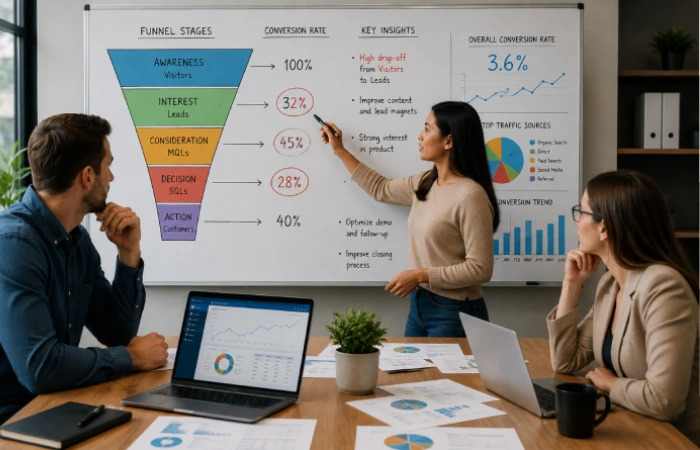
Nine times out of ten when someone tells me they need more leads, what they actually have is a funnel that’s leaking badly at one or more stages. More traffic just means more people falling through the same holes.
There have been countless instances when I‘ve asked someone about their lead-to-first-contact rate, only to be met with a blank stare. Or asked how many of their proposals close and heard ‘I’m not sure, maybe 20%?’ — and then we go look and it’s actually 7%.
You can’t fix what you’re not measuring. That’s the starting point.
The most common places pipelines leak, in order of how often I see it:
- Form submission to first contact. Somebody completes a form on your site at 9pm on a Tuesday. When do they get a reply? If the answer is ‘probably Wednesday afternoon when someone checks the inbox,’ you’ve already lost most of them. Research consistently shows that responding within 5 minutes versus 5 hours produces connection rates 10x higher. Automate this. There’s no good reason not to.
- First contact to qualified conversation. The initial follow-up is generic. It doesn’t reference anything specific about what the person asked for or where they came from. They disengage. Personalization here doesn’t mean knowing their birthday — it means knowing what they downloaded, what page they came from, what their company does.
- Proposal to close. The proposal goes out and then… nothing. No structured follow-up. The sales rep sends one ‘just checking in’ email and then gives up. A three-touch follow-up sequence over two weeks — each touch adding something useful, not just bumping the thread — recovers a meaningful percentage of deals that would otherwise go cold.
| Funnel Stage | What’s Usually Breaking | Practical Fix |
| Awareness → Lead | Landing page converts at 1% or less | (Test headline, cut form fields, add specific social proof) |
| Lead → First Contact | 24-48 hour response times | Automated reply within 5 minutes, followed up later same day |
| Contact → Qualified | Generic outreach, low reply rate | Segment by lead source, personalize first message to their context |
| Qualified → Proposal | Slow turnaround, unclear next steps | Proposal templates, define next step in every call |
| Proposal → Close | No follow-up structure | 3-touch sequence over 14 days, each message adds value |
There’s a version of funnel optimization that requires expensive tools and a dedicated CRO team. And then there’s the version where you fix your follow-up speed and your proposal process in a week and close 15% more deals from the same pipeline. Start with the second version.
Conversion Optimization — This Is Where Most People Leave Money on the Table
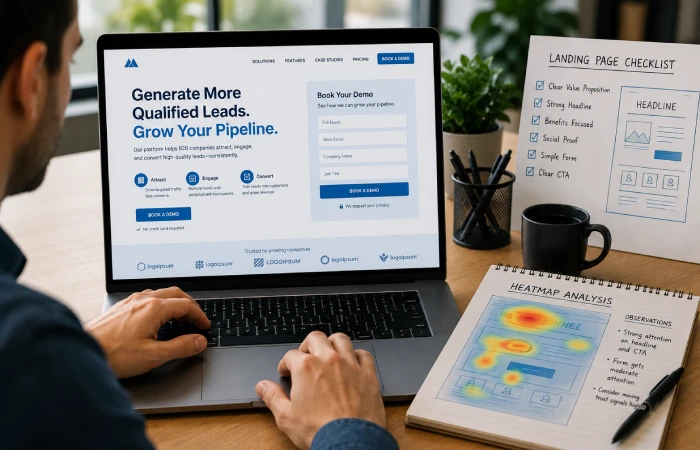
Average landing page conversion rate across industries: about 2.35%. Top quartile: over 5%. The gap between those two numbers, on the same ad spend, is enormous.
CRO gets a bad reputation because people expect quick wins from surface-level changes — button colors, font sizes — and then get frustrated when a two-week test on their CTA button produces no movement. That’s not really CRO. That’s decoration.
Real conversion optimization starts with understanding why people aren’t converting. Not guessing. Actually watching.
Install Microsoft Clarity. It’s free. Watch session recordings on your highest-traffic landing pages for 30 minutes. I promise you’ll see things that make you cringe — confusing navigation, form fields that break on mobile, value propositions buried below the fold — that no amount of button-color testing would have surfaced.
After that, here’s where the real leverage usually is:
- Your headline. Not your button. Your headline. It’s the first thing people read and it does most of the work of deciding whether someone stays or leaves. A headline that calls out a specific pain point converts better than a clever, brand-forward one almost every single time. Test it.
- Your form length. Every field is friction. Do you actually need the company name and phone number and job title and company size before a first conversation? Probably not. Cut everything you don’t need right now. You can ask the rest in the first call.
- Your social proof. ‘Trusted by hundreds of businesses’ is the kind of claim that people have trained themselves to ignore completely. A specific result — ‘helped increase qualified leads 40% in 90 days for a mid-sized SaaS company in Chicago’ — is believable because it’s specific. Specificity converts.
- Your page speed. Google’s research on Core Web Vitals and page experience continues to show the business impact of site performance, making page speed one of the highest-leverage conversion improvements available before running additional CRO tests. Fix slow-loading landers on mobile before you even begin testing.
| One thing worth knowing about CRO testing
Ideally you want approximately 100 conversions per variation in order to get statistically significant insights from an A/B test. So while you might be getting 20 leads a month to a page, you‘ll be conducting an A/B test for five months. get clean data. On high-traffic pages, you can run a test in a week. Focus CRO efforts on your highest-traffic pages first — that’s where the compounding happens fastest. |
Online Lead Generation — What’s Working, What’s Costing Too Much, and What I’d Cut
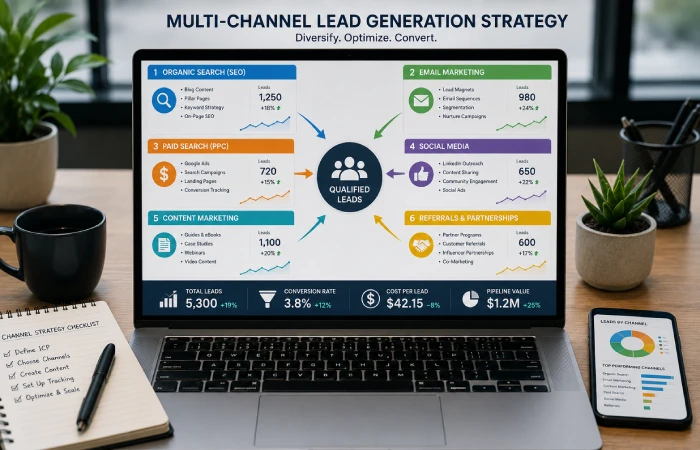
Online lead gen in 2026 costs more and is more fragmented than in 2023. The changes to iOS privacy has broken a lot of Facebook ad attribution models. Organic reach on most social platforms continues to drop. Google is eating more queries with AI Overviews and sending fewer clicks to external sites. Cold email deliverability is harder to maintain.
None of this means online lead generation is broken. This means the less familiar channels demand more skill and patience than they once did. Here’s my honest read on each:
SEO and content – or still the long-term play. Not the spray-and-pray version where you publish 40 posts a month and hope rank. But one to really build topical authority in the exact problems your buyers are searching for when they‘re just about ready to buy. Will take 3-6 months to really move the needle. Compounds in a way paid channels never do. The companies that took this seriously in 2022 and 2023 are benefiting enormously now.
Paid search on high-intent keywords — expensive but worth it at the right deal sizes. Someone typing ‘B2B lead generation agency for SaaS companies pricing’ into Google is close to a decision. Bidding on that converts at 5-8x the rate of broad awareness keywords. CPCs are higher but it still works if your average deal is over $5,000.
LinkedIn ads — precise targeting, savage CPCs. The professional targeting on LinkedIn is truly second to none job title, seniority, company size, industry. The problem is it costs $10-15 per click for competitive B2B audiences. At those numbers, you need either very high conversion rates or very high-value deals to make the math work. Worth testing on a small budget first.
Email to an owned list — underrated, underused. Your email list is the one channel you actually own. It doesn’t depend on an algorithm, an ad auction, or a platform deciding to change its reach model. Growing it consistently — through lead magnets, gated content, webinar registrations, event signups — and nurturing it with content that’s actually useful is one of the better long-term investments in lead gen. Most businesses treat their list like an announcement channel. The ones treating it like a relationship-building channel get dramatically different results.
What I’d cut or deprioritize right now: organic social for lead gen purposes (reach is down across the board and the ROI on the time investment is hard to justify for most B2B companies), generic lead magnets that nobody actually reads, and cold email at scale without serious personalization and list hygiene.
The Part Most Lead Gen Guides Skip: Building Something That Runs Without You
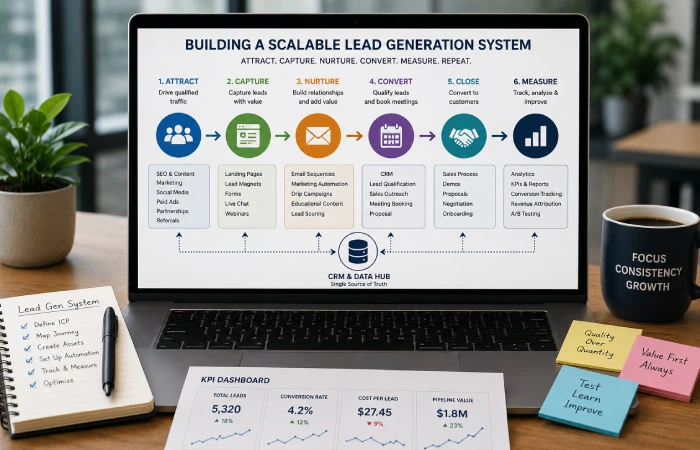
Here’s the thing about most lead generation advice. It’s all tactics. Run this campaign. Post this type of content. Send this type of email. And tactics are fine — you need them. But tactics require you to be paying attention and pushing them forward manually.
A system runs with oversight, not constant intervention.
The difference between a tactic and a system is documentation, automation, and measurement. A documented outreach sequence that anyone on your team can run is a system. An ad campaign that someone manually manages every day is a tactic.
Most businesses have some version of lead generation tactics. Almost none have lead generation systems. Which is why their pipeline looks like a heart rate monitor — spikes when someone’s pushing hard, flatlines when they stop.
If I had to rebuild lead gen from the ground up today for a B2B services company–say a $1M-$5M revenue business, 5-15 people here‘s what I would do: SEO content strategy to target 20-30 high-intent keywords, publishing consistently over a year. LinkedIn outreach to 200 targeted accounts, 20 personalized message/ week, tracked in HubSpot. Automated email nurture sequence for leads that don‘t convert instantly five emails over 30 days, each value-added and specific. And a weekly review of the funnel metrics so I can see in the first week whether something is broken.
Four things. None of them complicated. All of them connected. That’s a system.
Straight Talk on the Bottom Line
Lead generation strategies aren’t complicated in theory. Attract the right people, give them a reason to raise their hand, follow up well, measure what’s working. That’s the whole model.
What’s hard is the execution — the consistency when you’re not seeing results in week three, the discipline to track metrics you’d rather not look at, the patience to stick with an SEO strategy that won’t produce results for another two months.
The businesses I’ve watched actually solve their lead gen problem didn’t find a magic channel or a brilliant campaign idea. They fixed their follow-up speed. They cleaned up their funnel. They committed to two or three channels long enough for them to actually work. Boring stuff. Real results.
Each section in this guide links to a much deeper tactical breakdown. Begin wherever your pipeline is weakest, be it top-of-funnel volume, mid-funnel conversion, or simply the infrastructure to hold everything together and work from there. Don‘t attempt to address all the issues at once.
FAQs
Q: What are lead generation strategies, actually?
The mode and method by which you consistently bring a fresh stream of high quality leads into your pipeline (not only on a campaign basis but continuously) could be SEO, paid traffic, cold outreach, referrals, a mix of several, or any other way. The strategy is which of these you use, in what order, and how you make them work together so pipeline isn’t dependent on any one person pushing it forward manually.
Q: What’s the most effective B2B lead generation tactic in 2026?
It varies based on your deal size and sales cycle, but for most B2B services orgs with average deal size above $5K and sales cycle over 60 days, a blend of content-driven SEO and strategic outreach via LinkedIn provides the best cost-per-qualified-lead over 12+ months. In the near term shorter cycle pipeline, paid search on high intent keywords or structured cold outreach paired with intensive personalization tend to perform better.
Q: How long before lead generation strategies produce results?
It really depends on the channel. Paid search can generate leads within a week of launch. Properly executed cold outreach in 2-4 weeks. SEO and content (at least the way we do it) require 3-6 months to produce meaningful organic results, and often even longer for highly competitive categories. Most companies want a combination of short-term channels (to fill the pipeline) and long-term channels (to compound on each other).
Q: What is sales funnel optimization and how is it different from lead gen?
Top of the funnel lead generation gets the right people into your pipeline, but optimized funnel efficiency gets more from those people through each stage (lead to 1st contact, 1st contact to qualified conversation, proposal to close). Frequently the best ROI investments are in funnel optimization, not top of the funnel lead gen, because solving that conversion problem yields exponential gains against other lead investments you‘ve already made.
Q: When does hiring a lead generation consultant actually make sense?
If you have a concrete, diagnosable problem, and you want someone who has solved that same type of problem for other businesses to help you solve it faster. (It‘s not the right solution if the actual problem is a positioning or product issue that no amount of lead gen work will fix, or if you‘ve not clarified what success looks like before you begin the engagement.)
Q: What’s the difference between lead generation and demand generation?
Demand generation is about creating awareness of you making your target audience aware that you exist and why they might have a need for you. Lead generation is about capturing that attention by turning it into lead-candidates with contact info to put into your pipeline. Both are important. Most startups should focus on lead generation first and work demand generation into their message when they able to produce more marketing capacity.
Q: What’s a realistic landing page conversion rate for B2B lead gen?
Average conversion rate by category is about 2.35%. The best converting pages convert at 5% or more. For items with very high purchase intent, page with highly relevant offer, and great social proof, 8-12% is likely. If you‘re under 1.5%, even the landing page should be audited (headline, form length, offer clarity, social proof) before paying to drive additional traffic.
Also Read : digital marketing consulting

I’m Thomas — Editor & Admin of incmarketingplace, Blogger, and Senior SEO Analyst. writer at Inc Marketing Place, sharing insights on SEO, branding, content marketing, and online business growth. I focuses on creating practical and easy-to-understand content for marketers, entrepreneurs, and growing businesses