

Digital Marketing Strategy: A Practical Guide (2026)

Last Updated: September 18, 2026
There are hundreds of digital marketing strategy guides. Most follow the same template: define the term, list the channels (SEO, social, email, paid, content, video), explain each one briefly, add a section on measurement at the end. Competent. Thorough. And almost completely useless for anyone trying to build something that actually works, because the missing piece — how all those channels connect to each other — never gets addressed.
Here’s a question worth asking before doing anything else: does your marketing compound, or does it reset? A business running paid ads that drive traffic to a page, where nothing is captured, and the traffic leaves and never comes back — that’s not a strategy, that’s a media buy. A business where organic content builds an email list, the email list nurtures leads, the leads convert at known rates, and the data from conversions feeds back into targeting — that compounds. The difference isn’t budget. It’s architecture.
Five components get covered here, each one a real piece of a working strategy. Jump to whichever section matches where things are currently breaking down. Each one links to a deeper guide.
Online Marketing Strategy: The Channels, and How They Connect
Knowing the channels is not a strategy. SEO, content, paid search, social, email, video — after a year in marketing, everyone can list them. The question that actually matters is which combination makes sense for this business, at this stage, with this budget, and how those channels are supposed to hand off to each other. That’s the strategy. The list of channels is just vocabulary.
The most expensive channel mistake isn’t picking the wrong platform — it’s running channels that don’t talk to each other. Someone clicks a paid ad, lands on the homepage, doesn’t see anything relevant, and leaves. No retargeting pixel. No email capture. No follow-up. The visit cost real money and produced nothing permanent. Run that same ad to a dedicated landing page that captures an email, triggers a five-part nurture sequence, and feeds conversion data back into audience targeting — same spend, completely different compounding effect over six months.
The channel combinations that actually compound

- SEO + content + email organic gets pointed back to an email-list that will hold it‘s value regardless of changes in algorithms.
- Test paid social + retargeting + landing pages come for paid, get the retargeting visitors to convert, and optimize landing pages over time to increase conversion rate
- Content + SEO + YouTube long form content builds authority, YouTube builds its own audience, will elevate each other in search
- (LinkedIn + email + webinar Sequence in B2B that creates trust before asking for something. Most B2B) professional services.
| The channel prioritization question nobody answers honestly
A B2B professional services firm and a Shopify store selling $40 skincare products need almost completely different channel mixes. One has a 4-month sales cycle, requires trust and education before any purchase happens, and gets its best returns from LinkedIn, email, and SEO. The other can close a sale in eight minutes with the right Instagram ad and a well-built product page. Strategy guides almost never address this. They write channel recommendations as if all businesses are the same, which is why the advice fits nobody particularly well. |
Lead Generation Strategy: Getting the Right People Into the Pipeline
Walk through the analytics of most small business websites and you’ll find the same problem. Traffic is coming from somewhere organic, referral, social, paid. But people are coming, and leaving in a matter of two or three minutes. Conversion rate on the homepage: between half a per cent and two per cent. Email subscribers per month: 2 or 3. Retargeting audience: not set up. Thousands of visitors showing up, reading something, and disappearing into the void with no way to reach them again.
Lead generation infrastructure is what converts traffic from a one-time event into a persistent asset. The traffic came. Great. If nothing grabbed it no email opt-in, lead magnet or retargeting pixel that traffic is lost at the end of the session. Creating that infrastructure is a: persuasive enough offer to get people to give up their contact info, a landing page designed for that specific conversion, a follow-up sequence that makes people glad they signed up, a tracking system to show where they abandoned.
What a functional lead gen setup looks like

- A very clear offer not just “subscribe to our newsletter” but something specific people actually want (a guide, a template, a free audit, a tool)
- A dedicated landing page — separate from the homepage, built for one conversion action.
- An immediate follow-up sequence — at minimum, a confirmation email and a 3-email welcome sequence
- Traffic driving to it — at least one channel actively sending qualified traffic to the offer
- A measurement baseline — what’s the conversion rate, where are people dropping off
The most common lead gen mistake: spending 95% of the marketing budget driving traffic and 0% building anything to capture it. The bucket leaks. More traffic just leaks faster. Fixing the capture mechanism — even a basic landing page with a relevant lead magnet and a three-email follow-up — changes the economics of every traffic channel immediately.
Customer Acquisition Strategy: The Costs Most Businesses Don’t Track

Most businesses can tell you their total marketing spend. Ask them what it costs to acquire a customer specifically from paid search versus from SEO versus from referrals, and the answer gets vague fast. That blended number — total spend divided by total customers — is hiding something almost every time. Usually it’s hiding the fact that two or three channels are doing most of the acquiring and one or two are quietly expensive for what they produce.
Real example of how this plays out: a business spending $10k/month split across SEO, paid social, and Google Ads. Generally, the blended CAC looks OK call it $140. By channel, the SEO customers cost $35, the paid social customers cost $120 and the Google Ads customers cost $390. The blended number looked fine. The Google Ads number, on its own, might mean the channel doesn’t make sense for this business at this margin. Nobody would ever know without breaking it down.
| Channel | Typical CAC Range (B2B varies widely) | Trade-off |
| Organic SEO | $20–80 (mature programs) | High intent, compounding returns, slow to build |
| Content / inbound | $40–120 | Trust-based, longer cycle, good LTV correlation |
| Paid search (Google) | $80–300+ | High intent, immediate, scales with budget |
| Paid social (Meta) | $60–250+ | Broader targeting, good for awareness stage |
| Email marketing | $5–30 (existing list) | Highest ROI on established lists, requires prior investment |
| Referral / word of mouth | $10–50 (program cost) | Highest quality leads, hard to scale predictably |
CAC on its own tells you nothing useful. A $300 cost to acquire a customer who spends $4,000 over two years is a great deal. A $90 CAC for a customer who buys once and churns is not. The number that makes CAC meaningful is LTV. For a deeper understanding of customer acquisition cost and lifetime value relationships, the Corporate Finance Institute’s guide to Customer Acquisition Cost (CAC) provides a useful framework for evaluating marketing efficiency across channels.— and not just average LTV, but LTV broken down by acquisition channel, because customers from different sources frequently behave very differently after the first purchase.
Marketing Funnel Strategy: Where Most Leads Go to Die
Ask most marketing teams to show you their funnel and they’ll show you their blog (top) and their pricing page or contact form (bottom). The middle — the nurture content, the comparison guides, the objection-handling, the case studies — either doesn’t exist or is buried somewhere nobody finds it. This isn’t unusual. It’s actually the default state for most businesses that haven’t explicitly built out all three stages. And that‘s why so many leads that opt in at the top of the funnel go cold before they ever hit the bottom.
The failure mode is painfully predictable. Someone downloads the lead magnet, receives the confirmation email and then silence for three weeks. Suddenly they receive a sales email. No nurturing, no education, no trust built in the gap. The conversion rate on that sales email is terrible and everyone wonders why. The answer is that nothing happened in the middle. The funnel had an entry and an exit with nothing connecting them.
The three funnel gaps that kill conversion
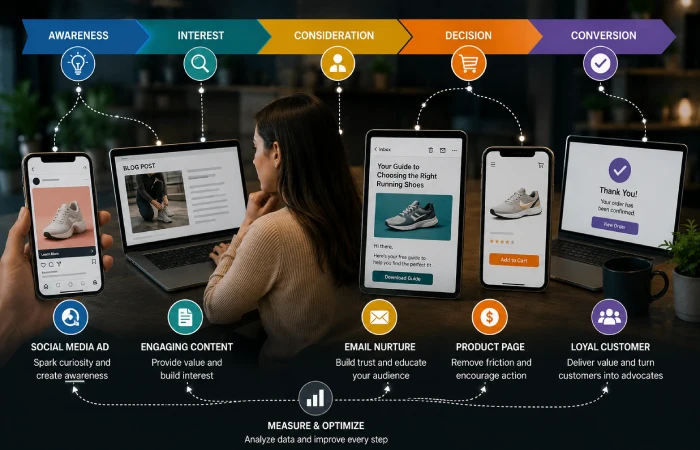
- No middle-of-funnel content. Most companies have blog posts (TOFU) and a sales page (BOFU) and nothing in the middle. For example, nurture content, case studies, comparison guides, objection-handling content they all go into the middle.
- No nurture sequence — leads that opt in and don’t convert immediately need a follow-up system. A single welcome email is not a nurture sequence.
- No lead scoring — treating a lead who downloaded a free checklist and a lead who viewed the pricing page three times the same way means the sales team is working the wrong leads in the wrong order.
| The funnel myth worth correcting
The funnel is a planning model, not a description of reality. Real buyers enter at random stages, read a pricing page before they’ve read any content, disappear for three months, come back directly to the contact form, and convert having skipped everything in the middle. A useful funnel strategy plans for re-entry, long consideration cycles, and multi-touch attribution — because the people who convert after six touches are not the same as the people who convert after one, and treating them identically loses both. |
Business Marketing Plan: The Document That Makes Strategy Executable
There’s a version of digital marketing strategy that lives in decks and planning documents and never touches actual execution. The strategy meeting produces slides. The slides produce nodding. The nodding produces no change in what anyone does on Monday. This happens because strategy and planning got treated as the same thing when they’re not. Strategy is deciding which battles to fight. Planning is who picks up a weapon, when, and how you’ll know if it’s working. Most businesses do a rough version of strategy and skip planning almost entirely.
The marketing plan need not be long. In practice, three specific aims, agreed to one per page, with a measurable objective included, to be followed up at a specific time, is much more useful than a 40-slide presentation that shows well in front of a group and then goes into the heap of other paper. What you want is the plan to create accountability. The marketing plan is a work document, not a deliverable.
What belongs in a 90-day marketing plan

- Top 3 priorities — specific, not vague. Instead of “improve SEO” do “publish 8 articles with commercial keywords and generate 15 backlinks”
- Budget allocation where the money is spent and divided by channel & by type (pay media, tools, creation of content, agency)
- KPIs with baselines each initiative is assigned a measurable result and baseline to measure from Google’s GA4 reporting and measurement documentation explains how businesses can establish conversion tracking, performance benchmarks, and channel-level measurement to support ongoing marketing plan reviews and optimization
- Channel owners — who is responsible for what, including external vendors or agencies
- Review checkpoint — weekly check-in, monthly deep review, 90-day planning cycle restart
Plans that get made in January and reviewed in December are not plans — they’re guesses preserved in a document. Campaign data comes in. Channels underperform. New opportunities appear. Competitors move. A marketing plan that doesn’t get refreshed every 90 days is out of date by Q2 and completely irrelevant by Q3. The discipline is the quarterly reset: what worked, what didn’t, what the next 90 days needs to look like given what we now know.
How the Five Pieces Work Together (and Why Most Strategies Are Missing at Least Two)
None of these five components works in isolation. Pull the lead gen infrastructure out and the traffic channels produce nothing permanent. Pull the funnel out and leads capture but don’t convert. Pull the CAC tracking out and budget keeps flowing to channels that don’t justify it. Pull the planning out and everything stays theoretical. The five components are a system — each one depends on the others to work properly, and the weakest one determines the system’s ceiling.
The businesses with marketing that compounds are not necessarily spending more. They’ve usually just closed the gaps between the five components. Traffic flows into lead gen. Lead gen feeds the funnel. The funnel converts at measured rates. CAC data tells them which channels to invest more in. The plan gets updated every 90 days based on what the data says. That loop, running consistently, is what strategy actually looks like in practice.
| Missing Element | What Breaks Without It |
| No lead gen infrastructure | Traffic comes in, leaves, never gets captured — acquisition costs are high because nothing compounds |
| No funnel middle | Leads opt in and go cold — conversion rates are low because nobody is being nurtured toward a decision |
| No CAC tracking | Budget gets misallocated — money goes to expensive channels because blended numbers hide the problem |
| No 90-day plan | Strategy stays theoretical — initiatives don’t get resourced, reviewed, or improved |
| Channels not connected | Each channel operates in isolation — no remarketing, no nurture, no compounding returns across touchpoints |
Free strategy audit available : INC Marketing Place works with businesses that have marketing happening and results that don’t match the effort. Nine times out of ten it’s a gap in one of these five areas — and usually it’s visible within the first conversation. Reach out at incmarketingplace.com. The first call is free and most people leave it knowing exactly what to fix first.
Also Read : digital marketing consulting
FAQs
What actually goes into a digital marketing strategy?
At a bare minimum, Five things: What channels and why those channels specifically? How you’re capture people from those channels before they leave? How much it costs to convert them and what each conversion is worth? What the nurture path looks like between opt-in and purchase? And an operational plan with owners and KPIs? Most business have pieces of two or three of those. The missing pieces of the puzzle are where results will go missing.
What’s the difference between a digital marketing strategy and a marketing plan?
Strategy is the decision layer which channels, which audiences, which message, which offers. Your marketing plan is the execution layer who does what, by when, measured how, reviewed when. Yes, it is possible to be brilliant on strategy and weak on execution because no one developed a plan, just as it is possible to have a meticulous plan with a wrong strategy to execute upon. Both mistakes are quite usual. The distinction is critical because trap #1 does not fix trap #2.
How long does it take to build a digital marketing strategy that works?
The strategy itself takes a week to frame. Getting it producing measurable results takes three to six months. Getting to the point where organic channels are compounding without ongoing paid spend takes a year or more, sometimes two. This timeline is where most strategies die — not because the strategy was wrong, but because whoever was running it expected faster results and pulled the plug before the compounding started. Paid channels can show results in weeks. SEO, content, and email take longer and money and will give you long-term returns. The practical approach would be to run both without hesitation: paid for short-term revenu, organic for long-term asset creation.
What digital marketing channels should a small business prioritize?
Will bear completely on how the target consumer of the business makes purchasing decisions. A plumber’s customer searches Google when the pipe bursts — local SEO and Google Ads, full stop. A software company selling to procurement teams needs LinkedIn, email nurture, and case studies because the sales cycle is six months and three people sign off. A clothing brand needs Instagram and TikTok because the purchase is visual and impulse-driven. A channel strategy that doesn‘t begin with the customer is nothing but blind guessing on a grand scale at a high cost.
How do I know if my digital marketing strategy is working?
Traffic up, revenue flat. That‘s not a strategy. That‘s a visibility issue. Show me the real key numbers: What percentage of visits from each channel convert into leads and what percentage of leads into customers? What‘s the cost to acquire a customer from each channel independently? How much is the mailing list growing? What‘s the lifetime value of a customer from various sources? If those numbers are absent and average out, then the strategy is just an instrumentless flight.
Do I need a different digital marketing strategy for B2B vs B2C?
Same principles, completely different execution. B2B has longer cycles, multiple decision makers, requires documented trust before anyone commits, and performs best with content that’s educational, specific, and heavy on evidence. The best B2B content often looks nothing like marketing — it looks like genuinely useful industry analysis. B2C is more rapid, more emotional and with the right product and creative strategy you can go from awareness to purchase in 24 hours. Introducing a B2C approach into a B2B sale accelerates the pace of an unavoidable timeline. Applying B2B logic to a B2C purchase overthinks a decision that happens on gut.
What’s a realistic digital marketing budget for a small business?
Consistently the most common standard mentioned in research is: a growing business spends 7–12% of revenue on marketing, with the majority on digital. For a $1M business that’s $70k–$120k annually — roughly $6k–$10k a month. The allocation matters more than the total. $5k/month spread across six channels is worse than $5k/month focused on two channels executed well. At very early stages, before the business has proven what it sells and to whom, content and SEO are the highest-leverage investment because they produce compounding returns that don’t stop when the budget does.

I’m Thomas — Editor & Admin of incmarketingplace, Blogger, and Senior SEO Analyst. writer at Inc Marketing Place, sharing insights on SEO, branding, content marketing, and online business growth. I focuses on creating practical and easy-to-understand content for marketers, entrepreneurs, and growing businesses