
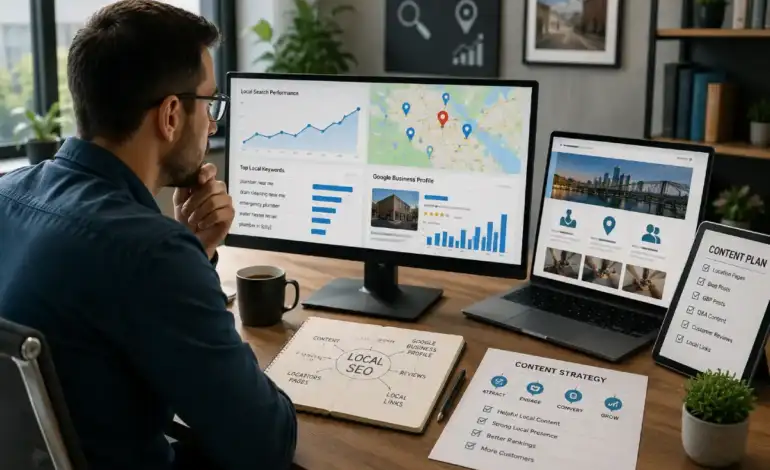
Local SEO Content Marketing: Build Authority That Ranks

Last Updated: September 18, 2026
Let me be straight with you. I’ve seen businesses spending $3,000 a month on ads, zero dollars on content, then wondering why they don’t rank. Meanwhile the HVAC guy two blocks over — smaller team, older website — is showing up for every near-me search in the county. The difference? He’s been quietly doing local SEO content marketing for 18 months. Nothing fancy. Right content, in all the right places, saying the right things to Google.
That’s what this guide is about. Not theory. Not a checklist of 47 things. Just the core of what actually works when you want your local business to show up — and stay up.
So What Exactly Is Local SEO Content Marketing?
Short version: it‘s the content that tells Google your location, your target audience, and how you‘re superior to the 12 other companies providing the same service in your zip code.
Longer version it‘s a combo of location landing pages, blog articles written around real local questions, a Google Business Profile you actually update and internal links that put all of this together. Nothing works on its own. But when they work together? Your business stops being invisible.
Warning: In 2026 a big slice of local search is completed right within Google AI summaries, map packs, zero-click answers. Customers will have made up their minds before they even get to your website. Your content needs to appear within these experiences not just on your homepage.
Whether you‘re operating a dental office in Phoenix, a landscaping firm in suburban Ohio, or a law practice seeking to rule one metro area this is important. The fundamentals are the same.
Local SEO Services: What You’re Actually Paying For
Most local SEO packages pack a bunch of things together – keyword research, citation building, GBP management, on-page fixes, perhaps even some content. Sounds comprehensive. And it can be. But a lot of businesses pay for that full package and see mediocre results because content was treated as an afterthought, not the engine.
Here’s the reality of what actually moves the needle:
- Citations and technical fixes create a foundation. Content is what builds the house on top of it.
- A business with 50 citations but no local content will lose to a business with 20 citations and six solid location pages — every single time.
- The fact that an agency isn‘t questioning your content strategy during initial conversations is actually a warning sign.
Before you hire anyone, do this:
Spend 20 minutes auditing your own website. Count your location pages. Read your homepage. Ask yourself honestly: does this content actually talk about where I operate and who I help? If the answer is vague, that’s your starting point — not someone else’s link-building campaign.
Bottom line: Local SEO services work best when content is woven into the strategy from day one, not bolted on later when rankings stall.
Google Business Profile SEO: The Free Channel Most Businesses Waste
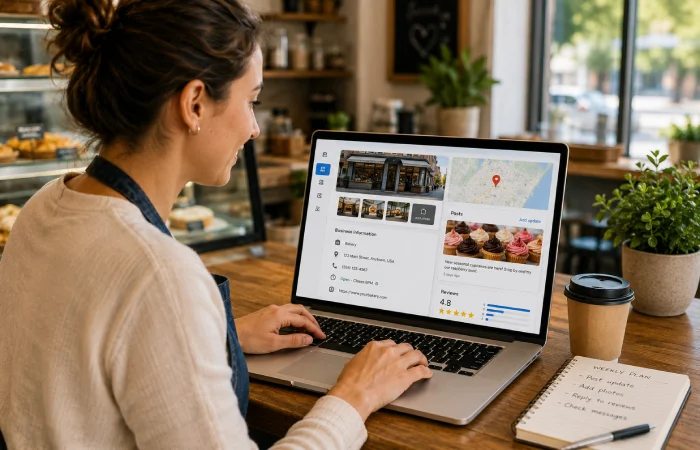
Your Google Business Profile is not a form you fill out once and forget. Google itself recommends keeping profiles accurate, complete, and regularly updated because fresh information helps customers find and engage with local businesses more effectively. See Google’s guidance on how to improve your local ranking on Google. I know that’s how most people treat it. Set it up, add your hours, call it done. But the businesses ranking consistently in the local pack? They’re treating GBP like a content channel — because that’s exactly what it is.
Think about it. Your GBP shows up before your website in most local searches. It’s the first thing someone sees. And most profiles look abandoned. No posts. Unanswered Q&As. Six photos taken in 2021 on someone’s flip phone.
What actually makes a GBP perform:
- Your business description should include your primary service and city — written for a human reader, not keyword-stuffed
- Post weekly. It doesn‘t need to be lengthy. Tip of the season, the latest news, a photo with its caption. Freshness signals matter.
- The Q&A section is gold launch it yourself with the questions your customers really ask and answer them well.
- The photos should be up-to-date and genuine. They need to be named with obvious description prior to uploading — hvac-repair-columbus-ohio.jpg, not IMG_4832.jpg.
Real-world example:
A plumbing company in San Antonio started posting weekly GBP updates every Tuesday — nothing elaborate, just tips about hard water damage specific to that region. Within four months their profile views had doubled and calls from the GBP jumped 34%. They didn’t touch their website once during that stretch. That’s what treating a profile as a living content channel actually looks like.
The takeaway: GBP is free real estate at the top of local search. Weekly posts, real photos, and active Q&As are all it takes to pull ahead of competitors who set theirs up and walked away.
Local Business Content Marketing: You Need a System, Not Just a Page
Here’s where a lot of local businesses go wrong. They create one Services page, list their offerings, add a city name in the title tag, and expect rankings. That’s not a content strategy. That’s a business card.
What actually works is thinking in layers. Your location landing pages handle the service-in-city searches. Your blog posts handle the questions people ask before they’re ready to hire — the research phase. Your GBP posts handle freshness and discovery. And internal links tie all of it together so Google understands the full picture of your expertise.
The three content types you need:
| Content Type | What It Does | Real Example |
| Location landing pages | Ranks for service + city searches | “Roof Repair in Dallas, TX” |
| Local blog posts | Captures research-phase traffic, builds authority | “How Dallas Weather Destroys Roof Shingles Faster” |
| GBP posts | Keeps your profile fresh, boosts local pack visibility | “Winter Roof Checkup Special — Serving Dallas & Suburbs” |
The mistake that kills local rankings:
Copy-pasting the same page across 12 cities and only swapping out the city name. Google catches this fast. If your Plumber in Denver page and your Plumber in Boulder page are word-for-word identical except for the city, you’re not building authority — you’re building a thin content problem waiting to surface. Each location page needs to talk about that specific area. Local landmarks. Regional weather patterns. Local regulations if they apply. Something that proves you actually serve that place.
Remember: local content marketing is a system. Each piece feeds the next -When it clicks, your rankings go up every month rather than flatline.
Location-Based SEO: Get Granular or Get Overlooked
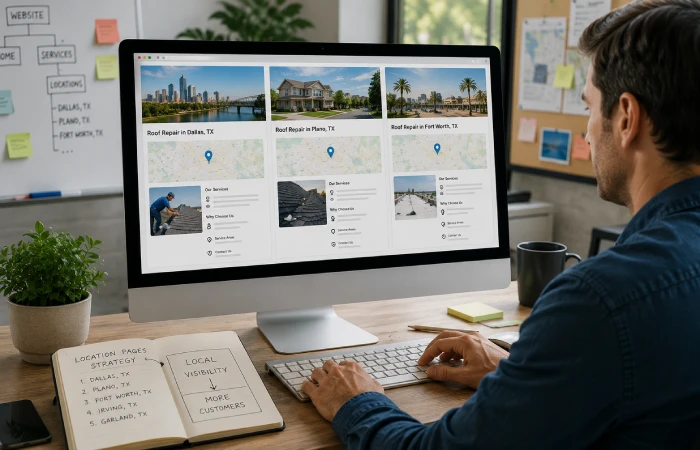
“Houston dentist” is a brutal keyword to win. There are a hundred dentists fighting for it. “Dentist in Montrose Houston” is a completely different story — and it’s also the search a real person types when they want to book an appointment near where they actually live.
Location-based SEO is about getting specific. Not just city-level, but neighborhood-level. In 2026, with AI handling more broad queries and serving generic answers, the searches that convert are the hyper-local ones. Those go to whoever has the most relevant, specific content for that exact area.
How to approach it practically:
- List every neighborhood, suburb, or district you realistically serve — not aspirationally, actually
- Go to Google Autocomplete and type your service plus each area. Write down every suggestion. Those are real searches. For additional keyword discovery and local search trend validation, Google’s Keyword Planner can help identify location-specific search demand and uncover new service-area opportunities.
- Check the People Also Ask box for each one. Every question is a blog post waiting to be written.
- Build one solid location page per major service area, then link them back to your main services page
Fast win you can do today:
Open Google, type your main service followed by the word near, and let autocomplete finish it. You’ll see neighborhood names, landmarks, zip codes. Pick the top three you don’t have content for yet. That’s your next month of writing, handed to you for free.
The businesses winning local search aren’t targeting the whole city. They’re owning their corner of it — one neighborhood page at a time.
Local Search Optimization: The Stuff Under the Hood
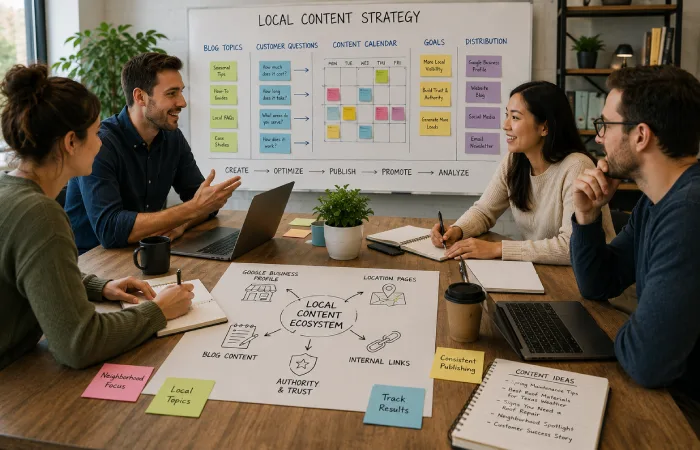
Good content with bad technical signals is like a great restaurant with no sign outside. People who already know you will find you. Everyone else won’t. Local search optimization is the sign.
The good news: the technical side isn’t as complicated as some agencies make it sound. Five things genuinely matter here.
- Schema markup — specifically LocalBusiness schema on every location page. The official Schema.org LocalBusiness documentation provides the structured data standards search engines use to better understand business details such as location, operating hours, contact information, and service areas. It gives Google structured information about your business: name, address, hours, service area. Without it, Google is guessing. With it, Google knows.
- NAP consistency your Name, Address, and Phone number need to be exactly the same on your website, GBP, and each directory listing. Even a small variation between Google Maps, the footer of your website and Yelp can cause errors in the search engines.
- Mobile speed. Every local search is probably done on a mobile phone, while someone is already out and about looking for a business next door. If your site takes five seconds on a mobile, the person searching will already be calling your competition.
- Internal linking — your location pages, service pages, and blog posts need to connect. A blog post about roof repair in Dallas should link to your Dallas roofing page. Google follows those links to understand how your content relates.
- Unique page content Don‘t just stuff your page with keywords; make it different for every city. Your Tampa page shouldn‘t be the same as your St. Pete page, just with a different city name.
One thing perhaps worth naming explicitly: In 2026, AI-created content has overwhelmed local search. The businesses cutting through are publishing content that reads like it came from someone who actually knows the area and has real opinions. This isn‘t coincidental it‘s a choice to attempt at appearing human, not a machine-of-content.
When content quality and technical signals align, rankings follow. Let either one slide and you’re leaving performance on the table — no matter how good the other one is.
Your 30-Day Starting Point
Don‘t try to do it all at once. Here‘s what four laser focused weeks of is really like for a business starting from nothing:
| Week | Focus | What to Do |
| Week 1 | Google Business Profile | Fill out every field completely. Upload at least 5 real photos. Write and post your first GBP update — keep it short and local. |
| Week 2 | Location Pages | Pick your top 3 service and city combinations. Write or rewrite one dedicated page for each — with actual local detail, not generic copy. |
| Week 3 | Local Blog | Answer two questions your customers genuinely ask. Write them as blog posts. Link each one back to the relevant location page. |
| Week 4 | Citations and NAP | Get listed on the top 10 local directories. Confirm your name, address, and phone are identical everywhere — no exceptions. |
Then do it again next month. Local SEO content marketing compounds. The businesses that win are the ones still publishing content when everyone else has quietly given up.
Conclusion
You don’t need a massive budget to rank locally. You need a content system that keeps showing up — week after week, page after page — until Google has no choice but to treat you as the authority in your market.
Local SEO content marketing is that system. A GBP that stays fresh. Location pages that actually reflect the places you serve. Blog posts answering the questions your customers are already typing into Google. Technical signals making sure all of it can be found and trusted.
The businesses that figured this out aren’t the ones with the biggest ad budgets. They committed to the long game. If that sounds like where you want to be, INC Marketing Place can help you build the strategy. Visit incmarketingplace.com to get started.
FAQs
What is local SEO content marketing?
It’s the practice of creating content — blog posts, location pages, GBP updates — specifically designed to make your business show up when someone nearby searches for what you offer. Less about tricks, more about being genuinely present in the places people look.
How does content marketing actually help local SEO?
Search engines need signals to understand who you are and where you operate. Content gives them those signals — consistently, at scale. A well-written location page or a regularly updated GBP tells Google far more than a citation on a directory ever will.
What type of content works best?
Location landing pages for the direct service-plus-city searches. Blog posts for the questions people ask before they’re ready to hire. GBP posts for freshness. FAQ pages for the specific things your market keeps asking. In that order of priority.
How often should I be publishing?
One blog post a week is a solid goal. One GBP post a week is non-negotiable if you want to stay visible in the local pack. To be honest, consistency wins every time A business that published out once a week for a year will outperform one that published 30 articles one month then disappeared.
Do I need a separate page for every city I serve?
Yes. Not due to some SEO technical requirement but because a page for Chicago and a page for Naperville should really be saying different things. They’re different markets, different customers, different local context. Generic pages that swap out a city name don’t convert anyway.
What’s the real difference between local SEO and general SEO?
General SEO targets broad keywords that could come from anywhere. Location SEO gains you even more local specificity –location-based pages, GBP signals, schema markup, local citations so that if someone from your city is searching for what you do, you appear for them.
Can a small business handle this without hiring an agency?
Absolutely. The fundamentals are not complicated. Start with your GBP, build one good location page per service area, write one local blog post a month. Do that consistently and you will experience results. Hire more help when you want to grow quicker, not because you can‘t do it yourself.

I’m Thomas — Editor & Admin of incmarketingplace, Blogger, and Senior SEO Analyst. writer at Inc Marketing Place, sharing insights on SEO, branding, content marketing, and online business growth. I focuses on creating practical and easy-to-understand content for marketers, entrepreneurs, and growing businesses