
Content Marketing vs SEO: The Honest Breakdown Nobody Gives You

Last Updated: September 18, 2026
Let’s get the bad take out of the way first. Someone, somewhere in your LinkedIn feed, is insisting you have to pick one — content marketing vs SEO, as if they’re rival candidates and you’ve got one vote. They’re wrong. But understanding why they’re wrong requires actually understanding what each one does, which most of the people posting takes on this topic skip entirely.
Content marketing vs SEO is genuinely one of the more searched comparisons in digital marketing right now, and the reason is that most explanations of both are terrible. Either they’re vague (‘content marketing builds relationships!’) or they’re so tactical they miss the point. This article tries to be actually useful.
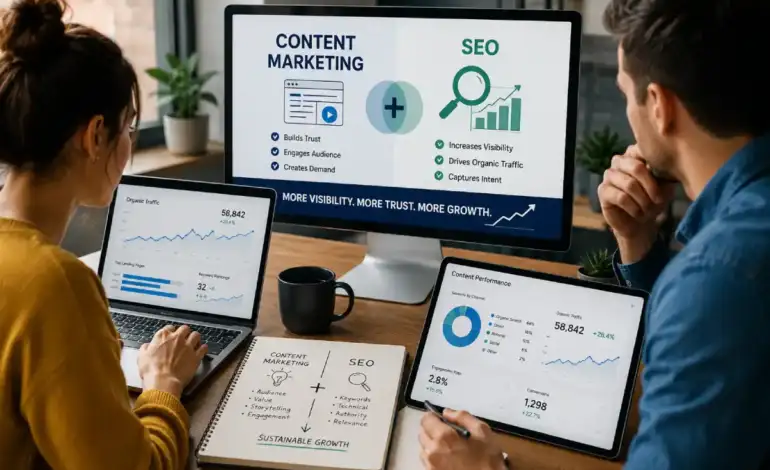
Short version: SEO is about getting found. Content marketing is about what happens after you’re found. You need both, but knowing which one is failing you — and why — is the whole game.
SEO vs Content Marketing: What They Actually Are
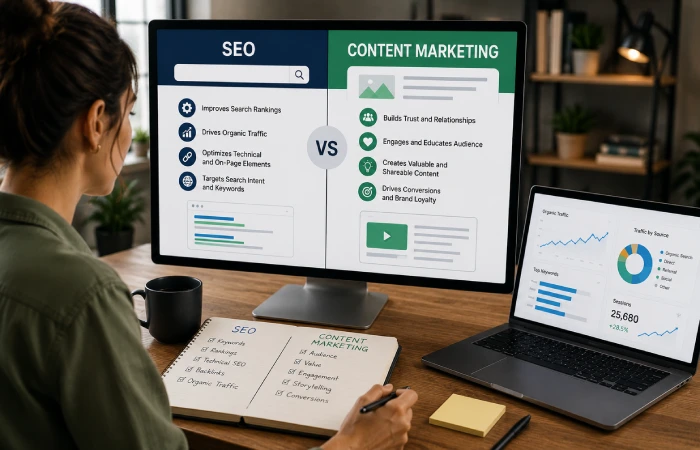
SEO – search engine optimization – are the techniques that impact how search engines interpret, classify and assign ranking to your site. Some is technical: speed, crawlability, structured data and interlinking. Other represents what you publish to what people want to find.. And increasingly, some of it is about whether AI-powered search systems like Google’s AI Overviews decide to cite you at all.
Content marketing is broader than that, and honestly a bit harder to define cleanly. It’s the practice of creating and distributing material — articles, videos, newsletters, podcasts, whatever format — that your target audience finds genuinely useful or interesting, with the goal of building enough trust and awareness that some percentage of them eventually buy something. The key word is ‘eventually.’ Content marketing is a slow burn.
Here’s where people get tangled up. A blog post can be both an SEO asset and a piece of content marketing at the same time. Most good ones are. The difference isn’t the format — it’s the intent behind why it was created and how success gets measured.
The clearest way to separate them:
- SEO is all about responding to what people search for and then building content around it.
- Content marketing begins by understanding what your target audience needs to know and then finding a way to deliver that content to them.
- SEO success = rankings, clicks, organic traffic
- Content marketing success = engagement, trust, conversions, brand lift
- SEO without good content ranks for nothing worth ranking for
- Content marketing without SEO often doesn’t get found by people who’d actually want it
Content SEO Strategy: Where the Two Actually Merge

The phrase ‘content SEO’ gets tossed around a lot, but it describes something real: the practice of creating content specifically designed to perform in search. Not content that’s been stuffed with keywords after the fact. Not content that’s technically optimized but hollow. Useful information that is well organized for search engines to read and aimed at query topics with a real user intent.
According to HubSpot’s State of Marketing research, SEO and blog content continue to rank among the highest-performing marketing channels, outperforming many paid and outbound tactics in long-term ROI. That’s a notable finding given how much attention paid channels get. It indicates that when content and SEO are in sync, the compounding impact is difficult to beat.
Here‘s the content SEO strategy that will be working in 2026. You identify topics your audience actually searches for. You understand the intent behind each search — are they researching, comparing, ready to buy? You create content that genuinely answers the question better than what’s already ranking. And you structure your site so that related pieces link to each other in ways that build topical authority over time.
That last part — topical authority — is worth pausing on. Google has moved away from treating individual pages as isolated ranking units. It now evaluates whether your site, as a whole, covers a subject with enough depth and breadth to be trusted. A single great article on a topic isn’t enough anymore. You need the article, plus supporting pieces, plus a structure that signals expertise.
What a content SEO strategy actually requires in 2026:
- Keyword research that looks at intent, not just volume — high-traffic queries with wrong intent are useless
- A topic cluster structure: one pillar page per core topic, multiple supporting cluster articles
- Original insights, not just rephrased versions of what already ranks
- E-E-A-T signals: who wrote it, why they’re credible, what experience they’re drawing on
- Internal linking that connects related content, not just random links
Search Engine Marketing: The Paid Side of This Equation
One thing that confuses the content marketing vs SEO debate is that the term ‘search engine marketing’ is often inserted into the conversation, and SEM usually means paid search Google Ads, advertising for certain queries.
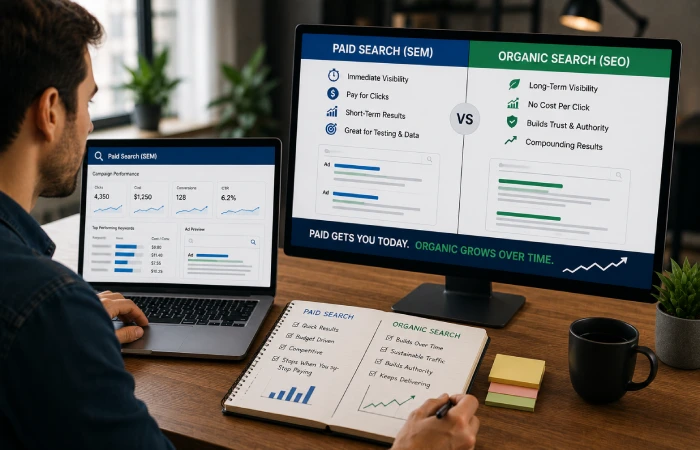
Paid search and organic SEO are different. They battle for the same audience on the same results page, but they ‘do’ in different ways. Paid shows up immediately and stops the moment you stop paying. SEO takes months to build and, when it’s working, keeps delivering traffic without ongoing spend per click.
Content marketing doesn’t usually overlap much with paid search — it’s mostly an organic play. But there’s a relationship worth understanding: paid search can buy you time and data while your organic strategy matures. You can run ads on keywords you’re trying to rank for organically, see which ad copy gets clicked, and use that to sharpen your content angles. That’s a legitimate use of SEM that most people don’t bother with.
The honest answer on SEM vs content marketing: SEM gets you in front of people today. Content marketing gets you in front of people six months from now, and keeps doing it without a media budget.
When paid search makes sense alongside content and SEO:
- You’re launching something new and can’t wait 6-12 months for organic traction
- You want to test messaging before investing in long-form content
- You have high-value conversions where the math works even at paid CPCs
- Your organic rankings are inconsistent in a competitive space
Organic Marketing Strategy: The Long Game
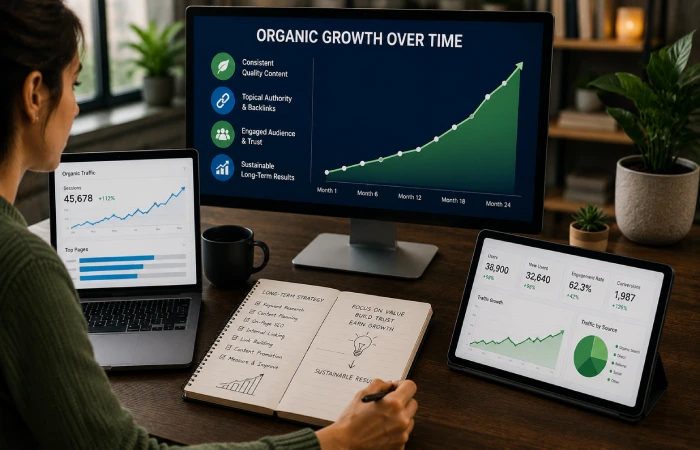
Organic marketing — traffic and attention you earn rather than buy — is the umbrella that covers both SEO and content marketing. And in 2026, the case for investing in organic has arguably never been stronger, even as the landscape gets more complicated.
Here’s the complication. Google’s AI Overviews now handle roughly 18% of commercial queries on-page, meaning the user gets an answer without clicking anything. Zero-click searches aren’t new, but they’re more common now. Traditional SEO logic — rank number one, get the click — is incomplete. Google has also emphasized through its Search Central guidance on creating helpful, people-first content that visibility in modern search increasingly depends on demonstrating expertise, usefulness, and credibility rather than simply targeting keywords. You also need to be the source that AI Overviews cites, which requires the kind of depth and credibility that content marketing builds.
So the organic strategy that makes sense now isn’t just ‘publish articles and optimize them.’ It’s build genuine topical authority so that both human searchers and AI systems see your site as a credible, comprehensive source on your topic. That’s a content marketing goal achieved through SEO infrastructure.
The ROI case for organic is straightforward, even if the timeline is frustrating. One published article that ranks well can generate traffic for years. The math from one analysis: spend $5,000 producing a content series, generate 20 leads worth $500 each — that’s 100% ROI, and it compounds as the content ages and earns more links. Paid traffic has a cost-per-click every single time. Organic traffic doesn’t.
The organic strategy framework that holds up in 2026:
- Build topical authority by covering subjects with depth across multiple related articles
- Optimize for search intent, not only keywords matches the real question of the query.
- Content should be structured so that it is citable by the AI (e.g. definitions should be clear and directly answer the question or claim, sources should be authoritative).
- Measure impressions and brand visibility, not just clicks — zero-click doesn’t mean zero value
- Publish consistently enough that Google sees the site as actively maintained
Read More: Content Marketing SEO Services
Inbound Marketing SEO: Pulling People Toward You
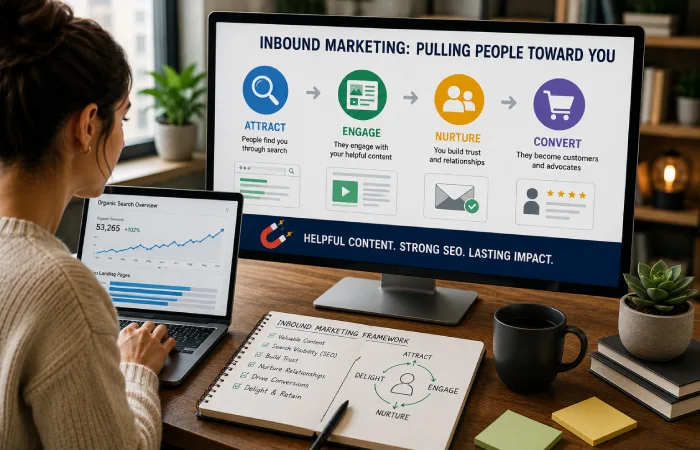
Inbound marketing is a philosophy before it’s a tactic. The core idea is that you attract potential customers by being genuinely useful — rather than interrupting them with ads. Blog posts, guides, comparison pages, tools, newsletters — all of this is inbound. SEO is what makes inbound content findable by the people who’d actually benefit from it.
The significance of this framing: it will affect the mindsets of what you can or should produce. Outbound marketing (cold calls, display advertising, interruption-based tactics) asks ‘who should we reach?’ Inbound asks ‘the people we want to reach are already searching for this’ Those are different starting points and they produce very different content.
SEO fits in the inbound model because it tells you what there is an existing demand for. People searching in specific ways for specific things for specific reasons. SEO research tells you what those are. Content marketing resources give you the ability to create content that fulfills those queries in a way that is building a relationship not simply answering and then moving on.
Where inbound strategies break down in reality, they‘ve reduceded to producing content, for content‘s sake, that isn‘t driven by search intent.. Or they create great content that’s technically invisible because the SEO fundamentals aren’t there. The integration is the hard part. Writing a genuinely useful guide is one skill. Structuring it so search engines understand it, targeting the right query, and building internal links that strengthen the whole cluster — that’s a different and additional skill.
The inbound + SEO combination that actually works:
- Start with keyword and intent research — what is your audience already searching for?
- Create content that genuinely answers that intent, not just matches the keyword
- Build content clusters: one comprehensive piece on each core topic plus supporting articles
- Distribute beyond organic search — email, social, communities — to get initial traction
- Measure the full funnel: traffic, engagement, lead quality, eventual conversions
Myth vs. Fact: The Nonsense That Keeps Circulating
| The Myth | The Reality |
| SEO and content marketing are competing strategies | They operate on different layers. SEO is infrastructure. Content marketing is what runs on that infrastructure. |
| You can just optimize existing content for SEO | Optimization helps, but thin content optimized well still performs worse than genuinely useful content with decent SEO. |
| AI is killing SEO | AI search changed SEO. It didn’t end it. Being cited in AI Overviews is an SEO outcome now. |
| Content marketing takes too long to show ROI | Given timeline: 6-12 months to rank, given benefit: traffic for years after without ongoing cost per click. |
| More content = more traffic | Content wins over competition every time. 10 focused articles will outperform 100 average articles. |
| You need to pick one and commit | The businesses winning in 2026 are not choosing. They’re integrating both into a unified strategy. |
Conclusion
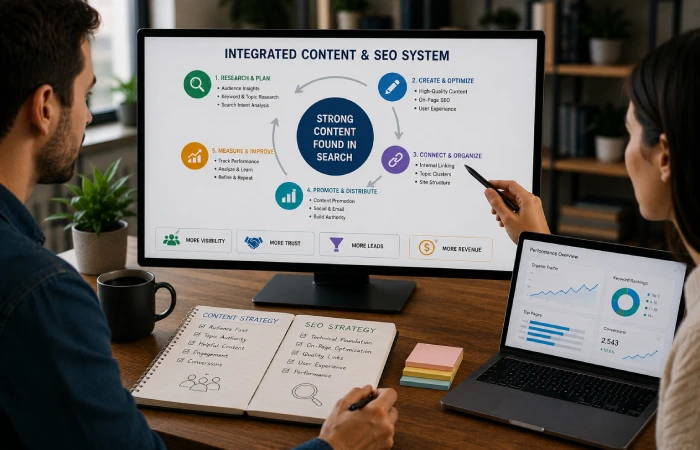
Content marketing vs SEO is the wrong frame. It implies a competition that doesn’t exist in practice. The more relevant question is: how do you construct a system in which your content is found by the right people, it delivers enough value to gain their trust, and a portion of this trust ultimately results in the business?
The SEO however, gives you clues what people are searching for and build the technical conditions that make your content visible. Content marketing creates the material that makes people trust you once they arrive. You need both or you’re either invisible (content without SEO) or irrelevant (SEO without good content).
Begin with whichever is more broken for you. If you simply have good content with no organic traffic, then the SEO infrastructure is most likely broken. If you have technical SEO dialed in but nothing’s converting, the content isn’t doing its job. Usually it’s some of both.
The compounding effect of getting this right is real. Organic content that ranks keeps working long after you’ve stopped actively promoting it. That‘s the argument it‘s not that content marketing and SEO are magic, but that they‘re the marketing investments that are most likely to compound over time rather than disappear the instant you stop paying for them.
FAQs
Q: Is content marketing part of SEO, or are they separate?
They’re separate disciplines that overlap significantly in practice. SEO is about technical optimization and search visibility. Content marketing is about creating material that builds trust and drives action. A blog post optimized for search is doing both jobs at once — but the underlying goals and measurement approaches are different.
Q: Which should I invest in first — content marketing or SEO?
It depends on what‘s broken. If you don‘t have any content that‘s getting organic hits, then get the fundamentals right: site architecture, keywords, pings, snails; everything you can‘t see that affects Google. If you‘ve got some decent traffic but it‘s not converting, then your content isn‘t working for you. If you‘ve got nothing, then build a content SEO strategy that combines the two from the outset rather than handling them separately.
Q: How long does it take content marketing and SEO to work?
It normally takes 3-12 months for an organic campaign to build results (depending on domain authority, competition, and content match to intent). Content marketing results like trust and brand awareness are cumulative over much longer periods of time. Neither is a quick channel but both continue to build after the initial investment, unlike paid channels.
Q: Does AI search change the content marketing vs SEO equation?
Yes, in one important way. Google’s AI Overviews now answer roughly 18% of commercial queries on the results page, reducing click-through on some queries. That means ranking alone isn’t enough — you also need your content to be cited by AI systems. If you want to be citable you need the kind of depth, clarity and credibility that content marketing gives you. So in 2026 it‘s more, not less, that SEO and content marketing will go hand in hand.
Q: Can you do SEO without content marketing?
Technically yes — you can optimize technical elements without producing content. But Google’s current algorithms, built around E-E-A-T and helpful content signals, don’t rank thin or low-value pages well regardless of technical optimization. SEO without substantive content is mostly engine without fuel. It gets you set up to perform, but there’s nothing to rank.
Q: What’s the ROI difference between content marketing and paid search?
Paid search delivers immediate traffic and stops when you stop paying. Content marketing and SEO deliver traffic that compounds over time without ongoing cost per click. A well-ranked article published today can generate traffic for 3 to 5 years. The ROI case for organic is strong once you account for that compounding — it just requires patience in the first 6 to 12 months.

I’m Thomas — Editor & Admin of incmarketingplace, Blogger, and Senior SEO Analyst. writer at Inc Marketing Place, sharing insights on SEO, branding, content marketing, and online business growth. I focuses on creating practical and easy-to-understand content for marketers, entrepreneurs, and growing businesses