
Topic Cluster Strategy for SEO and Topical Authority

Last Updated: September 18, 2026
Walk into most marketing teams and ask them why one competitor is ranking for sixty keywords on a topic while they’re ranking for four, and you’ll get a lot of theories. Backlinks. Domain age. Budget. Posting frequency.
Rarely do people say content architecture. But that’s usually the actual answer.
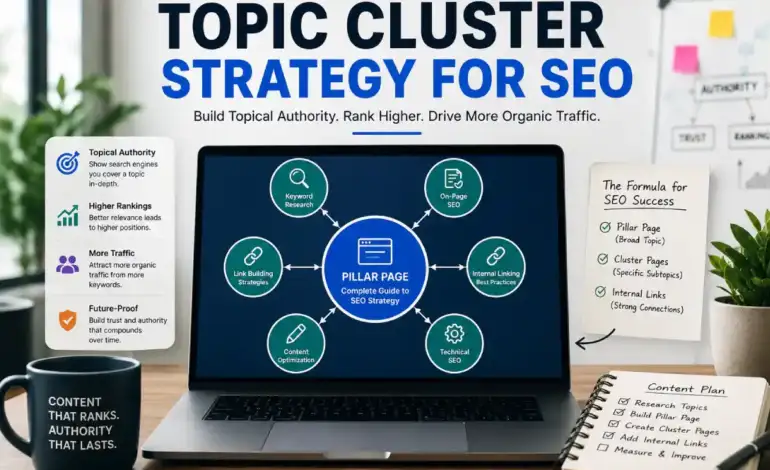
Topic cluster strategy for SEO is the practice of organizing your content so that Google can see — clearly and unmistakably — that your site covers a subject in real depth. Not one good article. Not a dozen disconnected posts. A structured system where a central page connects to a web of supporting content, all of it reinforcing the same topic expertise.
This isn’t a complicated idea. The execution, though, is where most sites get it wrong. This guide covers all of it — what clusters are, why topical authority has become the real ranking factor, how to build the pages, how to link them, and how to actually measure whether any of it is working.
What Are Topic Clusters?
The concept is simpler than the jargon makes it sound.
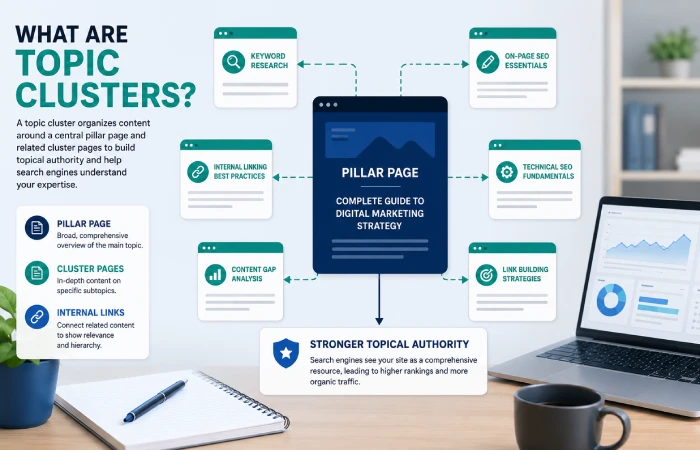
You’ve got one central page — the pillar page — that covers a broad topic at a high level. Then you’ve got a set of cluster pages, each of which digs into one specific subtopic in real detail. Every cluster page links back to the pillar. The pillar links out to each of the clusters. The whole thing is connected.
Say your site covers digital marketing. Your pillar page might be something like “SEO Strategy: The Complete Guide.” Your cluster pages are things like “How to Do Keyword Research,” “Internal Linking Best Practices,” “Topic Cluster Strategy for SEO,” “How to Fix Keyword Cannibalization” — each one a complete, focused article on a specific slice of the main topic.
That‘s the reason it is important: Google no longer only determine which page will be ranked higher. Google analyzes your page and try to determine if you really have expertise in a particular subject, or if you just post a handful of articles. A proper cluster answers that question clearly. A bunch of isolated articles doesn’t.
The hub-and-spokes structure (center pillar,surrounding clusters of pages) is the most popular image of this. Less clear is that the structure also accomplishes something quite simple: it provides Google‘s spiders with a clear “highways”, informs them as to the relative importance of each of the pages, and stops your own articles fighting each other for the same keywords.
Three things make up every topic cluster. The pillar page, which is broad and comprehensive. The cluster pages, which are specific and deep. And the internal links that tie them together. Get all three right and the whole system compounds over time.
Key Takeaway : Topic clusters shift the game from optimizing individual pages to building site-wide authority on a subject. Google rewards sites that cover a topic completely — clusters are the architecture that makes that possible.
Benefits of Topical Authority
“Topical authority” gets used a lot in SEO circles, sometimes loosely enough that it starts to sound meaningless. It isn’t. It has a specific definition and a specific effect on rankings.
Topical authority is the degree to which Google trusts your site as a reliable, comprehensive source on a specific subject. It’s not just about having good articles. It’s about whether your site, taken as a whole, covers a topic in the kind of depth that makes it the go-to resource — not one of several options.
And that gap is increasing. On average, sites with well-structured content clusters have 40% more organic traffic than sites with a scattergun, keyword-for-keyword method. Sites that completely adopt a content cluster approach from the scattered keyword search approach see anywhere from a 50 to 300% increase in traffic in six to twelve months. Those statistics keep cropping up often enough to be taken seriously.
The structural reason it works is this: Google’s systems evaluate three things simultaneously — how deeply you cover a topic, what kind of real expertise your content demonstrates, and how coherently your internal link graph is organized. Google’s own documentation on creating helpful, people-first content emphasizes demonstrating expertise, providing substantial value, and building content that serves users rather than search engines, which closely aligns with how topical authority is developed across a site (Google’s Helpful Content Guidance).A well-built cluster satisfies all three. A standalone article, even a very good one, satisfies maybe one.
There’s also an AI dimension here that most people haven’t fully reckoned with yet. When Google AI Overviews, ChatGPT, or Perplexity are generating answers and deciding which sources to cite, they pull from sites they’ve recognized as consistently comprehensive and reliable on specific subjects. Surface-level content doesn’t get cited. Deep, structured, interlinked content becomes the default reference. If you want to show up in AI-generated answers — and increasingly you need to — topical authority isn’t a nice-to-have. Google’s Search Quality Evaluator Guidelines also place significant emphasis on experience, expertise, authoritativeness, and trustworthiness when evaluating content quality, making deep topical coverage increasingly important for both traditional rankings and AI-generated search experiences (Google Search Quality Evaluator Guidelines).
One more thing worth saying plainly: topical authority now beats domain authority on competitive terms. A smaller site with three deeply developed clusters will regularly outrank a much bigger domain that has thin, scattered coverage on the same subjects. That’s not always true, but it’s true often enough that smaller sites have a genuine path to competing on hard keywords — if the cluster architecture is right.
Key Takeaway: Topical authority is measurable, buildable, and directly tied to rankings and AI citations. The sites pulling the most organic traffic in 2026 didn’t get there by chasing individual keywords. They built subject-matter depth that compounds.
Building Pillar and Cluster Pages
The theory is easy to explain in ten minutes. Executing it cleanly is where the actual work is.
Start with the pillar page — and don’t overload it
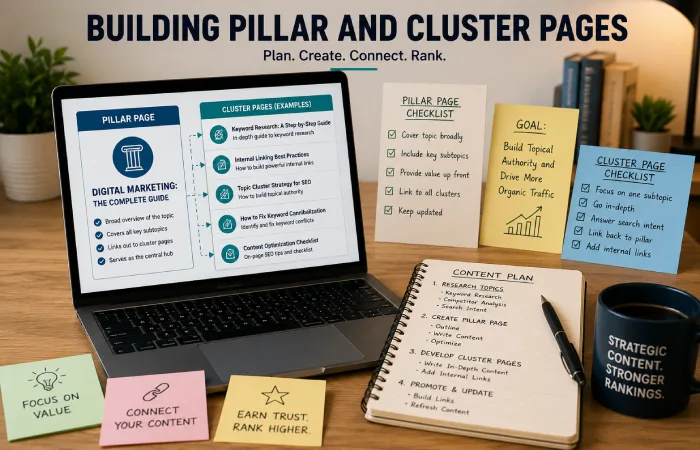
The pillar page’s job is to cover the main topic at a high level. Broad enough to introduce everything that matters. Specific enough to be genuinely useful on its own. What it’s not supposed to do is exhaustively cover every subtopic — that’s what cluster pages are for.
A pillar page on “SEO Strategy” introduces keyword research, explains why it matters, and links to the cluster page that goes deep on it. It does not try to be the definitive keyword research guide. That’s a different page.
Most pillar pages run between 2,000 and 5,000 words. That’s not a rule — it’s a reflection of how much depth it actually takes to cover a broad topic’s primary questions without wandering into every subtopic. Think of the pillar as the map. The clusters are the territories.
Build clusters around one specific intent per page
Each cluster page should have one clear job: answer one specific question or address one specific subtopic, better than anything else ranking for it.
“How to do keyword research for a new blog” is a cluster page. “Keyword research” is too vague — it’ll compete with your pillar and with half your other cluster pages. The more specific the intent, the cleaner the cluster, and the less you end up in keyword cannibalization territory.
In terms of how many: most topic areas support eight to fifteen cluster pages before coverage starts overlapping. But honestly, three to five deeply developed clusters will outperform ten shallow ones almost every time. Depth beats volume. Don’t publish thin cluster pages just to hit a number.
Audit before building anything new
This step gets skipped constantly and it causes problems later.
Before writing a single new page, do a content audit on what you already have. Existing articles often slot into new cluster structures with a bit of updating. Some will need redirecting. A few might be candidates for consolidation if they’re covering nearly identical ground. And some will be sitting there with no internal links pointing to them — orphaned, invisible to crawlers, doing nothing.
Fix the existing architecture first. Building new cluster content on a broken internal structure is like renovating the top floor of a building with a cracked foundation.
Key Takeaway: The pillar page introduces the topic — it doesn’t explain all of it. Cluster pages go deep on one intent each. And before adding anything new, audit what’s already there.
Read More: Content Marketing SEO Services
Internal Linking Best Practices
This is the part that breaks most cluster strategies. Not the content itself — the linking.
Underlinking is probably the more common failure. Sites build decent cluster pages, then drop one internal link somewhere in the footer and call it done. The page never gets proper crawl priority, the authority doesn’t flow, and the cluster never performs the way it should. On the other end, overlinking — cramming keyword-rich anchor text into every paragraph — creates patterns that look like gaming, and Google is increasingly good at recognizing that.
Here’s what actually works:
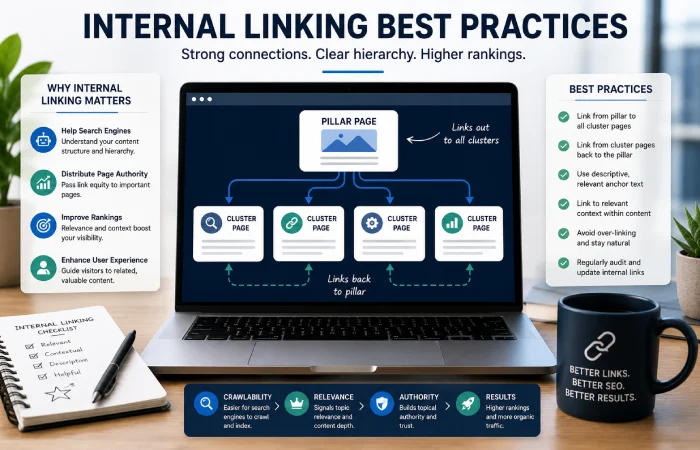
- Pillar links to every cluster page. Non-negotiable. Every cluster in your architecture needs at least one link from the pillar. That’s the foundational crawl signal — it tells search engines these pages belong to a connected system.
- Every cluster links back to the pillar. And one or two adjacent cluster pages where the connection is natural. Don’t force it. A link that makes sense editorially is worth far more than a link that was placed to hit a quota.
- Anchor text should describe the destination. “Click here” and “learn more” are dead weight. “How to build a pillar page” or “internal linking strategy guide” tells Google exactly what’s on the other end of the link. Use that.
- Three to five internal links per article. More than five and you start diluting the signal. Fewer than three in a cluster page usually means the page isn’t properly connected to its ecosystem.
- Orphaned pages are a silent killer. Run a crawl check every few months. Any cluster page sitting with no internal links pointing to it might as well not exist from Google’s perspective.
One thing that’s easy to miss: none of this works if your pages have crawl errors. A perfectly structured cluster with clean anchor text and proper link placement, sitting on a page that Google can’t fully render, routes all that link equity to a dead end. Technical hygiene is not separate from cluster strategy — it’s part of it.
Key Takeaway: Pillar links to clusters. Clusters link back. Anchor text describes the destination. Three to five links per page max. And check for orphaned pages regularly — they’re more common than most people realize.
Measuring Topic Cluster Success

Most teams build clusters and then check rankings after three months and make a judgment call. Rankings are a lagging indicator — by the time they move significantly, you’ve already missed weeks of earlier signal that could have told you what was working and what wasn’t.
Here are the things that actually tell you something useful:
Keyword coverage — not just primary keywords
Look at how many total keywords your cluster topic is generating impressions and clicks for. Not just the primary keyword on each page — the long-tail variations, the question-based queries, the related terms. A healthy cluster expands keyword coverage over time. If you’re ranking for fewer keywords after two months than you were before building the cluster, something’s off structurally.
Total traffic to the cluster, not individual pages
Add up the organic traffic going to your pillar page plus every cluster page combined and track that number. It should be growing. When the pillar is strong and the clusters aren‘t ranking for anything, you need to work on the subtopic page that it‘s targeting or quality of the content on your cluster pages. When clusters are getting visitors and the pillar isn‘t, it typically signals there‘s an issue with how the hub page is structured or connected.
Are users actually clicking the internal links?
Your Search Console and analytics will reveal if people click from cluster pages to the pillar and back. If clicks on those internal links are close to zero, then the links are badly placed, the anchor text isn‘t what people want next, or the flow through the content isn‘t naturally carrying people there.
AI Overview and featured snippet appearances
Begin monitoring if your pages are being shown in Google‘s AI Overviews, Snippets and People Also Ask. These are topical authority signals which often appear before traditional page-1 rankings. If you’re getting AI Overview citations on cluster topics, that’s a strong sign the structure is working.
Directional ranking movement in 60 to 90 days
You’re not looking for top-three rankings in two months. You’re looking for movement — any upward directional trend on the primary and secondary keywords across the cluster 3 months of good interlinking (plus good content) and nothing has moved, then it‘s time to audit for content mismatch, thin content or crawl issues rather than waiting another longer.
Key Takeaway: Measure the cluster as a system. Kept track of total keyword coverage, combined cluster traffic, internal link click-through, the frequency we show up in an AI, and movement in our directional ranking over a period of 60 to 90 days. Individual page rankings are worthless on their own.
Read More: SEO Blog Writing Services
Putting It All Together
A topic cluster strategy for SEO is one of those things that sounds obvious once you understand it and then turns out to be more work than expected. Most sites can describe the hub-and-spoke model accurately. Far fewer actually execute it — clean pillar pages, focused cluster content, real internal linking, and a measurement system that tracks the cluster as a whole rather than individual pages in isolation.
The compounding effect is genuine. Businesses switching from scattered keyword-by-keyword posting to a proper cluster architecture consistently see traffic double or triple within a year. But the compounding only kicks in if the architecture is sound — which means doing the content audit before building, keeping cluster pages tightly focused on one intent, and not letting internal links become an afterthought.
The other thing worth saying: this isn’t a one-time project. Clusters need revisiting as topics evolve. New subtopics emerge, old content goes stale, and orphaned pages accumulate quietly if nobody’s checking. The sites dominating their topics in 2026 built their clusters a year or two ago and have been maintaining and expanding them since. That’s the actual competitive advantage — not any single great article, but a content system that keeps getting deeper.
Frequently Asked Questions
What is a topic cluster strategy for SEO?
A topic cluster approach groups your website‘s content by the pillar page, which explains the broad subject, and cluster pages that focus on specific subtopics. Every cluster page links back to the pillar, and the pillar links out to each cluster. The connected structure tells search engines your site covers the topic comprehensively — which is increasingly how Google decides which sites rank and which don’t.
How many cluster pages does a topic need?
Most topics support eight to fifteen cluster pages before content starts overlapping. That said, three to five deeply developed clusters will consistently outperform ten shallow ones. The quality and specificity of each cluster page matters far more than hitting a particular number.
How long until topic clusters improve rankings?
Most sites see directional ranking movement within 60 to 90 days of properly interlinking a cluster. Significant traffic growth from topical authority compounding typically takes six to twelve months. Each timeline differs depending upon current site authority, quality of content and set up of architecture from the beginning.
What’s the difference between a pillar page and a cluster page?
A pillar page covers a broad topic at a high level — it’s the hub of the cluster. A cluster page goes deep on one specific subtopic and links back to the pillar. Pillar pages are longer-form, 2,000 to 5,000-word, pages answering the questions about your topic. Cluster pages are more in-depth and targeted at one clear search intent.
Do topic clusters help with Google AI Overviews?
Yes. AI search systems draw from sources they recognize as comprehensive and reliable on specific topics. A well-structured cluster — with deep coverage, clear semantic relationships between pages, and strong internal linking — signals exactly that kind of authority. Surface-level content rarely gets cited. Structured, comprehensive cluster content often does.
What should I do with existing content that doesn’t fit a cluster?
Run a content audit first. A lot of existing articles can be updated to fit a cluster with minor edits. Some will need to be redirected to more relevant pages. Others might work as sub-clusters in their own right. Content that’s completely off-topic from your cluster focus is worth evaluating for consolidation or removal — scattered, unrelated content dilutes the topical signals you’re trying to build.

I’m Thomas — Editor & Admin of incmarketingplace, Blogger, and Senior SEO Analyst. writer at Inc Marketing Place, sharing insights on SEO, branding, content marketing, and online business growth. I focuses on creating practical and easy-to-understand content for marketers, entrepreneurs, and growing businesses