

appfolio property management: Features, Pricing & Complete Guide
Last Updated: August 30, 2026
While a property manager might simply be a rent collector, they have many other tasks to complete in their week. These include: rent payments, lease agreements, repair jobs, accounting services, maintenance, vacancies, communications with owners and tenants, payment of invoices, and a lot of smaller issues that need to be seen to on a regular basis. When they are not part of any system, these tasks can become unmanageable.
This is where AppFolio Property Management comes into the picture.
AppFolio is a SaaS property management service that centralizes most of a property management company’s day-to-day processes into a single system. It covers accounting, marketing/leasing, maintenance, communications, reporting, payments, and workflow automation.
For property managers considering a new software platform, the bigger question is not simply “What does AppFolio do?” It is whether the software actually fits the size, property type, workflow, and growth plans of the business.
What Is AppFolio Property Management?

AppFolio Property Management is a cloud-based software designed to help property managers organize and automate the operational, financial, leasing, and communication functions required for property management. In essence, the property management software has a vision to serve as the primary operating system for the entire property management company.
Instead of one software program for financials, one for work orders, one for property-level documents (kept in spreadsheets), and one to speak with tenants (kept in a separate application), property managers need just one integrated, one-platform solution.The software accommodates various property types, from single-family and multifamily to commercial properties, as well as plans available for affordable housing, student housing, and community associations (depending on selected features and plan).
The reasoning for building the software this way is quite simple: If financial information, tenant information, leases and activity, building maintenance, and property-level documentation reside in one system, it decreases and/or eliminates the manual migration and updating of information from several resources.
How Does AppFolio Property Management Work?
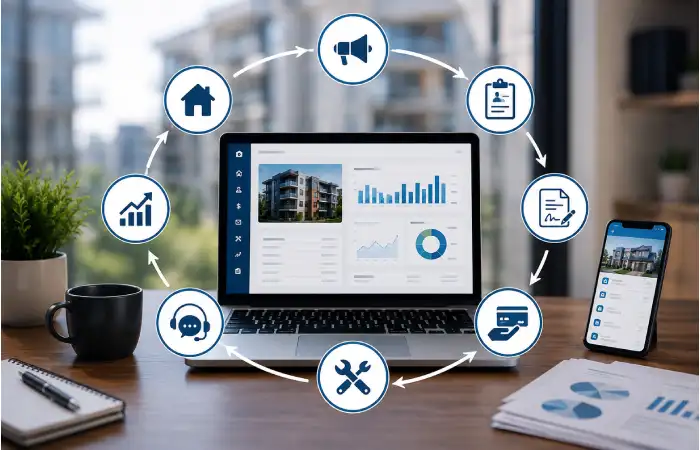
AppFolio works as a centralized, cloud-based system.
A property manager can use it to keep track of properties and units, leases, residents, financial transactions, maintenance activities, communications, and reports. Because the platform is cloud-based, authorized users can access information without depending on a traditional office-based software installation.
A typical workflow might look like this:
Property listed → prospective resident applies → lease is created → rent is collected → maintenance request is submitted → work is assigned → transaction is recorded → owner receives financial information.
The advantage is that these activities do not have to exist as completely separate processes.
That connected approach becomes particularly valuable as a portfolio grows. A manager overseeing a handful of properties may be able to coordinate everything manually. A company managing hundreds or thousands of units faces a very different challenge.
Key Features of AppFolio Property Management
1. Property Accounting and Reporting
Accounting is one of the most important parts of any property management operation.
Property management accounting refers to the process of recording, organizing, reconciling, and reporting financial transactions associated with properties, owners, residents, vendors, and management operations.
AppFolio includes property and trust accounting, reporting, automated reconciliation, invoice processing, and other financial capabilities. Its platform is designed to provide a centralized record of property-related financial activity.
This can help managers monitor income, expenses, invoices, payments, and financial performance without constantly transferring figures between systems.
For an owner, accurate reporting matters because property management is ultimately a financial business. A maintenance request may look like an operational issue, but the resulting invoice affects the property’s expenses and profitability.
2. Marketing and Leasing
Finding the right resident is another major responsibility.
Property leasing software is technology that helps managers organize the process of advertising vacancies, receiving leads, communicating with prospects, processing applications, and moving qualified prospects toward signed leases.
AppFolio provides marketing and leasing functionality intended to support the process from attracting prospects through leasing. Its higher-tier offerings also include tools such as Leasing CRM and Leasing Signals.
This is important because vacancies cost money.
A vacant apartment or rental home can generate zero rental income while still creating expenses. Better visibility into the leasing pipeline can therefore have a direct business impact.
3. Maintenance Management
Maintenance is often where property management becomes especially time-consuming.
A resident reports a broken appliance. A manager has to understand the problem, determine who should handle it, contact a vendor, schedule the work, follow up, document the outcome, and record the expense.
Maintenance management software organizes this process digitally.
AppFolio includes work-order management, inspections, unit turns, maintenance scheduling, and related workflow capabilities depending on the plan. The company also describes AI-powered maintenance workflows designed to help with activities such as intake, follow-up, vendor coordination, and resident feedback.
The real benefit is not simply creating a digital maintenance ticket. It is creating a more consistent process so fewer requests disappear into email threads or handwritten notes.
4. Resident and Owner Communication
Good communication can make a surprisingly large difference in property management.
Residents want quick answers. Owners want financial visibility. Vendors need clear instructions. Property managers need records of conversations.
AppFolio provides integrated communication and portal capabilities intended to bring these interactions into the broader property management workflow.
This creates a useful concept:
Centralized communication means that important information stays connected to the property or transaction instead of being scattered across unrelated conversations.
For growing teams, that can make it easier for one employee to understand what another employee has already done.
5. Online Payments
Digital payments have become an important part of modern property management.
Residents increasingly expect convenient ways to pay rent, while property managers want transactions to flow into their accounting processes with less manual work.
AppFolio offers online payment functionality for tenants, owners, and vendors as part of its broader ecosystem and available services.
This can reduce some of the administrative work associated with checks, manual payment entry, and payment tracking.
6. Automation and AI
One of the more interesting developments in AppFolio is its increasing use of AI and automation.
Workflow automation means using software to perform repetitive steps automatically according to predefined rules or triggers.
AppFolio’s newer platform incorporates Realm-X, including AI assistants, messages, flows, and agentic AI capabilities. The company says Realm-X Performers can independently observe, interpret, and act on signals from property-management data.
This represents a shift from software that simply stores information toward software that can help perform parts of the work.
However, automation should not be viewed as a replacement for human judgment. Property management involves residents, contracts, money, vendors, and real-world situations. Automation is most useful when it removes repetitive administrative work while managers remain responsible for important decisions.
AppFolio Property Management Pricing
Pricing is one area where potential buyers should look carefully.
AppFolio currently presents Core, Plus, and Max plans for property managers, with pricing dependent on the portfolio and selected services. The official pricing page says Core has a 50-unit minimum and requires a quote, while Plus and Max also have applicable minimums.
Historically published AppFolio plan information has shown per-unit monthly pricing, but buyers should verify current pricing directly because plans, minimums, features, and add-on services can change.
AppFolio Plans Compared
| Feature | Core | Plus | Max |
| Property accounting | ✓ | ✓ | ✓ |
| Marketing & leasing | ✓ | ✓ | ✓ |
| Work orders | ✓ | ✓ | ✓ |
| Advanced budgeting | — | ✓ | ✓ |
| Affordable housing | — | ✓ | ✓ |
| Student housing | — | ✓ | ✓ |
| Leasing CRM | — | — | ✓ |
| Leasing Signals | — | ✓ | ✓ |
| API access | — | Read-only | Read/write |
| Dedicated customer success | — | — | ✓ |
The exact package structure should always be confirmed with AppFolio before making a purchasing decision because the company continues to evolve its plans and services.
AppFoli Traditional Property Management Software
The biggest difference between AppFolio and older approaches is not necessarily one individual feature.
It is the connected nature of the platform.
| Area | Traditional approach | AppFolio approach |
| Accounting | Spreadsheets/separate software | Integrated property accounting |
| Maintenance | Emails and manual tracking | Digital work orders and workflows |
| Leasing | Multiple disconnected tools | Integrated leasing workflow |
| Communication | Email, phone, separate portals | Integrated communication |
| Reporting | Manual compilation | Centralized reporting |
| Automation | Limited | Extensive workflow automation |
| Data access | Often fragmented | Centralized cloud platform |
The advantage of a unified platform becomes more obvious when a company grows.
A small landlord may not care whether maintenance, accounting, and leasing are integrated. A professional management company with multiple employees and hundreds of units may care very much.
AppFolio vs. Buildium and DoorLoop
AppFolio is not the only property management platform available. Other well-known options include Buildium and DoorLoop.
The right comparison depends heavily on portfolio size, budget, property type, accounting requirements, integrations, and desired automation.
| Platform | Best suited for | Key strength |
| AppFolio | Growing and established property management companies | Broad, unified platform |
| Buildium | Residential managers and community associations | Property management and accounting |
| DoorLoop |
Small-to-mid-sized property managers |
Accessibility and straightforward workflows |
These should not be treated as universal rankings. A property manager with 60 units may have very different requirements from a company operating several thousand units.
The best software is ultimately the one that fits the organization’s workflow rather than the one with the longest fature list.
Benefits of AppFolio Property Management
A More Centralized Operation
One of AppFolio’s strongest advantages is its ability to bring multiple property management functions into a single environment.
That can reduce the number of times employees need to switch between different systems.
Better Visibility
When property information and financial activity are centralized, managers can get a clearer view of what is happening across the portfolio.
This is especially useful for owners and managers who need to make decisions based on current operational and financial information.
Reduced Administrative Work
Automation can remove repetitive tasks that otherwise consume employee time.
The goal isn’t simply to make employees work faster. Ideally, it allows them to spend more time on activities where human communication and judgment matter.
Scalability
AppFolio is designed for businesses that expect their portfolios and operational requirements to grow. Its Core, Plus, and Max structure provides different levels of functionality for different levels of complexity.
Potential Disadvantages of AppFolio
No property management platform is perfect.
Cost Can Matter
AppFolio may not make financial sense for every small landlord, particularly because its current Core offering has a 50-unit minimum.
Complexity
A powerful system can also mean a learning curve.
A company moving from spreadsheets to an integrated property management platform may need to spend time setting up workflows, training employees, importing information, and changing established habits.
Advanced Features May Require Higher Plans
Some capabilities, including Leasing CRM and read/write API access, are associated with higher-tier offerings.
This means buyers should not judge the platform solely by looking at the feature list. They should determine which features are included in the specific plan they are actually considering.
Who Should Use AppFolio?
AppFolio can be particularly attractive to:
- Professional property management companies
- Residential property managers
- Multifamily operators
- Single-family portfolio managers
- Commercial property managers
- Affordable housing operators
- Student housing managers
- Community association managers
- Growing real estate businesses
Its broad functionality makes the most sense when there are enough properties, residents, transactions, and employees for centralized software to create meaningful operational value.
For someone managing only a few rental properties personally, a simpler and less expensive solution may be more appropriate.
Is AppFolio Worth It?
Whether AppFolio is worth the investment depends on the economics of the portfolio.
A useful way to think about the decision is this:
How much time, money, and operational risk could the software save compared with what it costs?
If employees spend hours every week manually entering information, following up on maintenance, reconciling payments, preparing reports, or moving data between systems, an integrated platform may provide significant value.
On the other hand, if a landlord has a very small portfolio and very simple requirements, a comprehensive property management system could introduce more complexity than necessary.
Recent user-review sources generally show strong satisfaction with AppFolio, although individual experiences naturally vary by business size, implementation, and use case. G2 currently displays a 4.6/5 rating based on more than 1,000 reviews.
Final Thoughts
AppFolio Property Management is more than a rent-collection tool. It is designed as a broader operating platform for property management businesses, combining accounting, leasing, maintenance, communication, reporting, payments, integrations, and automation.
Its greatest strength is the way these functions can work together.
A maintenance request can become a work order. A vendor invoice can become part of the property’s financial record. A leasing lead can move through a structured pipeline. A resident can communicate digitally. A manager can then view the resulting activity through centralized data and reports.

Creative marketing enthusiast sharing practical insights on digital growth, branding, and online strategies. Passionate about helping businesses succeed with simple, effective, and result-driven marketing solutions.