
Instagram Advertising: Complete Guide to Instagram Ads
Last Updated: September 28, 2026
Search for Instagram ad costs and you’ll get a different number from every source, some five times higher than others. That’s not sloppy research, it’s because pricing isn’t fixed. Discussions around Instagram social media advertising, what it really is, what types of ad formats there are, how targeting now works, and why the cost should be quite so varied and how to measure whether it is actually working.
“Instagram advertising is the act of showing paid promoted posts, on Instagrams feed, stories, reels and the explore section. These ads are sold using Metas real-time bidding system of a set price.“
What is Instagram advertising?
Instagram advertising is when you are paying to target a particular post to someone who does not already follow you. It is managed through Metas ad system and not just through posts that people see naturally. It shows up in the places as regular posts do but it always has a “Sponsored” label. It can have things that regular posts cannot, like a button that tells people to take action or tags that show products.
Since Instagram ads run on Meta‘s ad platform the same ad account that runs your Instagram ads can run your Facebook ads. Both Facebook and Instagram advertisements use the same data of target audience and are rated within the same auction format.
What Instagram ad formats are available?
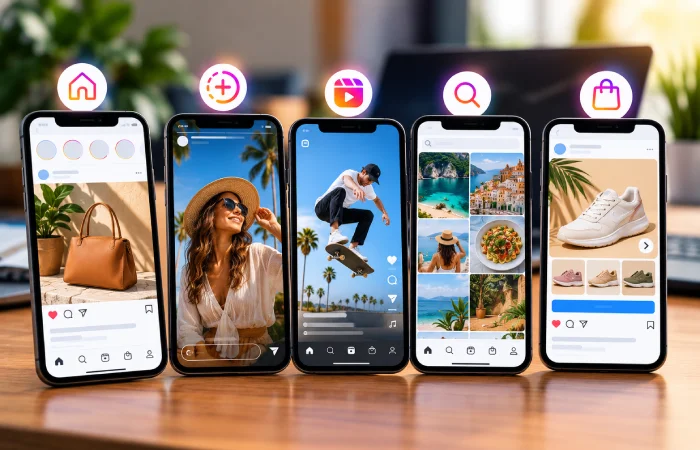
Feed ads.
Static images, single videos, or carousels that appear directly in the main scrolling feed, generally delivering the highest conversion rates of the available formats.
Story ads.
Full-screen, vertical ads that appear between users’ Stories, with completion rates that consistently run higher than other formats since they occupy the entire screen.
Reels ads.
Short-form vertical video placed within the Reels feed, generally the cheapest placement to buy since it competes for space in a format Meta is actively pushing.
Explore ads.
Ads shown while someone is actively browsing content outside their usual feed, reaching people in a discovery mindset rather than a following-catch-up one.
Carousel and Collection ads.
Multiple. A moving product display in one ad space, helpful for showing more, than one item or sharing a story through several scenes.
How does Instagram ad targeting work?

Targeting in 2026 works differently than Targeting did two years ago and many older guides have not caught up to the change.
Meta’s default for most campaign objectives is now Advantage+ Audience. According to Meta’s own Business Help Center, this system uses Meta’s AI to find your campaign’s audience, treating the inputs you provide, age range, interests, custom and lookalike audiences, as suggestions rather than strict filters. In practice, only location and minimum age function as hard constraints; everything else is a starting point the algorithm can expand beyond if it predicts better performance there.
That’s a real shift from the older model of picking a narrow interest stack and having your ad shown only to that group. Detailed targeting is still available in Ads Manager. Can still be useful especially, for new accounts that don’t have much conversion history.. It no longer acts as a strict filter the way it used to for most types of campaigns.
How much does Instagram advertising cost?

There is no one right number here and any rule that suggests otherwise is a gross oversimplification. The reported 2026 benchmarks for cost‑per‑click range from $0.40 to $2.00 depending on the source, industry and placement while the cost‑per‑1,000‑impressions usually falls, between $5 and $15.
That range exists because pricing isn’t fixed at all. Meta’s own explanation of the ad auction describes a system built to pair ads with the people most likely to be interested in them, not simply hand placement to whoever bids highest. Your actual cost depends on your bid, your ad’s predicted engagement, and its overall quality, all competing in real time against every other advertiser targeting a similar audience at that moment.
A few patterns hold up consistently across sources: Reels placements tend to run cheaper than Feed placements, stronger creative can meaningfully lower cost regardless of bid, and a practical daily minimum somewhere in the $50 to $100 range per ad set gives the algorithm enough data to optimize, well above Meta’s technical $1 minimum, which won’t generate usable results on its own.
How to measure Instagram ad results

Track cost-per-result against your actual goal, not a generic benchmark.
Cost-per-click matters for a traffic campaign. Cost-per-purchase or cost-per-lead matters far more for anything tied to revenue. So measure, against the metric that maps to what you’re trying to achieve.
Set up the Meta Pixel and Conversions API before you need the data, not after.
I feel like without conversion tracking installed you are optimizing blindly. Without conversion tracking you cannot reliably tell which ads are actually driving results versus which just look active.
Compare performance by placement, not just by campaign.
Feed, Stories, and Reels often perform differently enough within the same campaign that averaging them together hides which placement is actually doing the work.
Give a campaign real time before judging it.
Performance during Meta’s learning phase, typically the first several days of consistent delivery, is usually noisier and less representative than performance once delivery stabilizes.
Frequently asked questions
How much should I spend on Instagram ads to start?
A practical starting point is $50 to $100 per day, per ad set. This amount gives Metas algorithm data to exit its learning phase in a reasonable time. Spending far below that rarely generates enough volume for the system to optimize effectively.
What’s the best Instagram ad format?
There is no best format because the goal decides. Feed ads usually drive the conversion rates. Reels ads usually give the cost per view. Story ads usually keep viewers’ attention, for the message. The right choice depends on what the campaign’s really optimizing for.
Do I need to use Advantage+ Audience, or can I still target manually?
Manual detailed targeting still exists and can work, particularly for newer accounts without much conversion history yet. For most established accounts with steady conversion data, Advantage+ Audience is now Meta’s default and generally the stronger starting point.
Why do Instagram ad costs vary so much between sources?
Because pricing operates through a real-time auction that depends on bid, predicted engagement and ad quality of a fixed rate card actual costs can vary by industry, audience competition, creative quality and even the time of year. This is why reported benchmarks differ widely between different accounts and reports.
How long does it take to see results from Instagram ads?
Most campaigns take several days of consistent delivery before it clears Metas learning phase and begins generating meaningful performance data. That means results, especially, in the first day or two can be messy and not very reliable. Once delivery settles in the data becomes more consistent and easier to judge.
Where to start this week
Before you start comparing ad formats or deciding on a budget make sure the Meta Pixel and Conversions API are actually installed and working properly on your website. You need to confirm they are firing correctly. Without this step none of the choices—, like targeting, budget or ad format—will give you real results. This tracking is the foundation. It’s the step that many new advertisers forget. It’s the most important one.

Creative marketing enthusiast sharing practical insights on digital growth, branding, and online strategies. Passionate about helping businesses succeed with simple, effective, and result-driven marketing solutions.