Facebook Advertising: How Facebook Ads Work for Businesses
Last Updated: September 28, 2026
3 billion people use Facebook every month and for businesses that size is only useful if the targeting behind it actually works. Facebook ads run through Meta Ads Manager, where an auction. Not a simple bidding fight. Decides which ads each person sees. Understanding that system what it will cost in 2026. How to measure if it is paying off is the difference between treating Facebook ads as a guess and treating them as a channel you can plan budget for. For a look, at how Facebook fits with other paid social channels see this guide to social media advertising strategy.
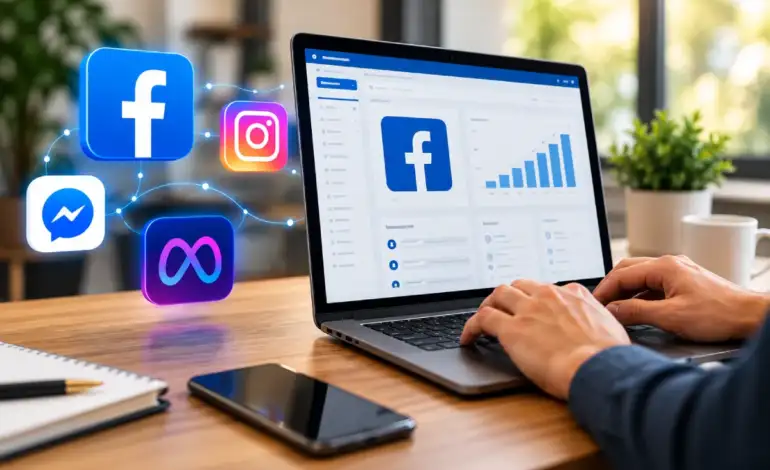
Facebook advertising is a paid marketing platform is known as Meta Ads Manager. It allows businesses to advertising on Facebook, Instagram and Messenger.To get started companies set an objective choose an audience and decide on a budget. Ads are then shown through an auction system that considers both the bid amount and how relevant the ad is, to the intended viewers.
What Is Facebook Advertising?
Facebook advertising is a paid promotion system that lives inside Meta Ads Manager. The same tool also shows ads, on Instagram, Messenger and the Audience Network. The tool helps a business build a campaign that focuses on one goal: awareness, leads or sales. After setting the goal the business chooses the audience to see the ad. Decides how much to spend.
The setup follows the same three decisions every time: objective, audience, and budget. Objective tells Meta what outcome to optimize delivery for. Audience narrows who is eligible to see the ad by using demographics, interests, behaviors or a business’s own customer data uploaded as a custom audience. Budget sets an lifetime spending cap, which Meta uses along with the auction to decide how often and to whom the ad is shown.
This structure is what makes Facebook advertising different from boosting a post. When you create campaigns in Ads Manager you get access, to objective-based optimization. You also get targeting options and performance reporting. These features are not available when you boost a post.
What Types of Facebook Ads Can You Run?
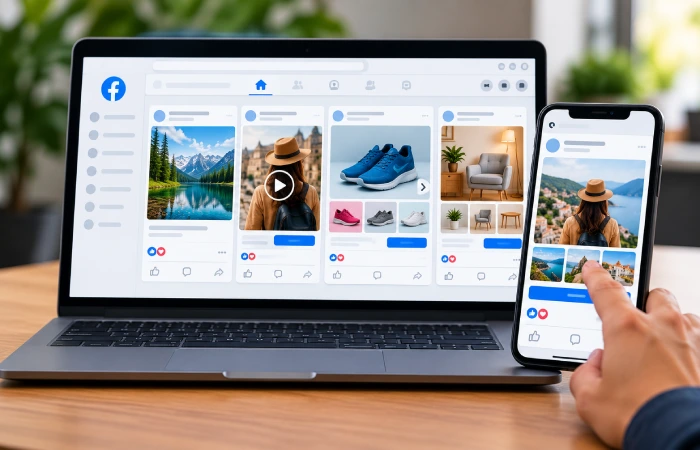
Meta offers ad formats. I find that the best Meta ad format depends on what the campaign wants to show or achieve:
- Image ads. A photo with headline and text. They are the format to set up and test quickly.
- Video ads. Better for brand storytelling or showing a product in use. Video ads support MP4, MOV or GIF files.
- Carousel ads. Images or videos in one ad. Carousel ads allow users to swipe through them making it useful, for showing products or steps.
- Collection ads — a cover image or video with product images displayed beneath it, built for mobile shopping browsing.
- Slideshow ads — lightweight, looping video-style ads built from static images, useful when video production isn’t practical.
- Messenger and Marketplace ads. Placements that put the ad directly inside Messenger conversations or Facebook Marketplace browsing.
Carousel ads tend to produce an average cost per click than single-image ads in 2026 benchmark data. This happens because the format leads to higher engagement, for each impression. Many businesses start with a mix of ad formats. They test both carousel and single-image ads. Then they move their budget toward the one that works best for their audience. This way they avoid putting all their money into one format from the beginning. They let performance decide what works best.
How Does Facebook Ad Targeting Work?

Facebook ad targeting works, by bringing audience selection and an automated auction system. When a campaign starts a business chooses targeting criteria. These can include location, age, gender, interests, behaviors or connections. It can also use a custom audience made from its customer list or website visitors. This is often called retargeting. The system then uses these details to show ads to the people at the right time.
But Targeting alone doesn’t decide who sees the ad. Every time someone in the audience opens Facebook, an auction runs among all advertisers targeting that person. Meta scores each competing ad on three factors: the advertisers bid, the estimated action rate (how likely that person’s to engage with or convert on the ad) and overall ad quality and relevance. The ad, with the combined score wins the impression. Not simply the highest bidder.
This is why an ad that is carefully aimed at the people and has a reasonable budget can keep doing better than an ad that is not aimed well and has a bigger budget: Metas system gives more to ads that’re relevant not just those that spend more. It’s also why choosing the audience on its own isn’t enough and works better when the ad looks interesting, to the people it is shown to.
How Much Do Facebook Ads Cost?
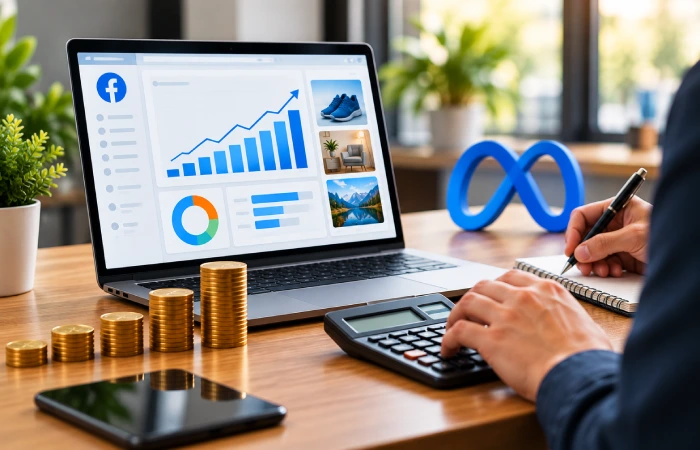
In 2026, Facebook ad costs vary based on the approach to pricing, by industry and according to campaign goals. The figures shared this year indicate range of just one single value. Traffic campaigns generally cost between $0.60 and $0.70 per click and lead‑generation campaigns will typically range from $1.90 to $2.00 per click. These rates are based on 2026 benchmark information providing details on hundreds of thousands of advertisers. Cost per 1,000 impressions, or CPM, averages between $8 and $16. Cost per lead is often, between $10 and $28. This varies by industry.
Industry drives most of the cost spread. Industry makes lower‑competition categories such as shopping, collectibles, sports and travel have CPCs under $0.50. Industry also shows that high‑value, high‑competition categories like services, insurance and B2B/SaaS have CPCs between $1.30 and $2.00 or more. Seasonality matters too. Costs in Q4 are usually 30–45% higher, than the rest of the year because advertisers fight for holiday shopping traffic.
For a starting budget, $5–$10 a day is workable for small-scale testing or a local campaign, but scaling meaningfully usually requires enough daily spend to generate around 50 optimization events per ad set per week — the volume Meta’s algorithm needs to exit the learning phase and start delivering efficiently.
How to Measure Facebook Ad Performance
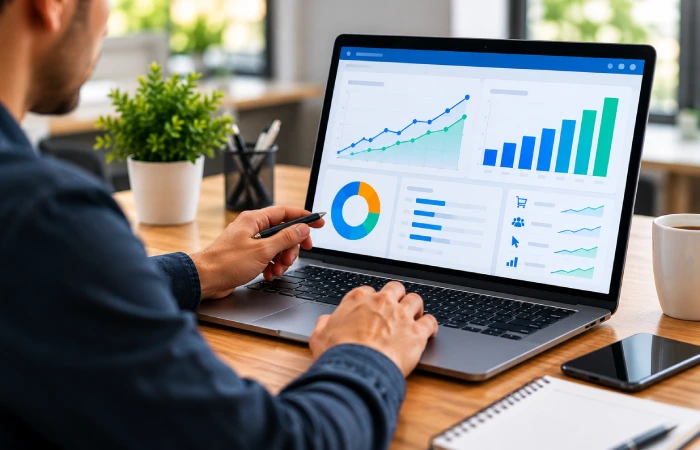
The core metric for measuring Facebook ad performance is return on ad spend or ROAS. This is calculated by taking the revenue generated from ads and dividing it by the total amount spent on those ads. For example if a campaign spends $5,000 and leads to $25,000 in sales that can be traced back, to the ads the ROAS is 5:1. That means for every dollar spent five dollars are returned in revenue.
To get a Return on Ad Spend you must first set up the Meta Pixel or the Conversions API on your website. These tools link every purchase. Lead back to the exact ad that generated it. After you have installed the pixel or API focus on Return, on Ad Spend along with three metrics. First look at cost the money spent. Second examine per acquisition the cost to win one customer or lead. Third check conversion rate, the share of clicks that turn into the desired action. Finally watch click‑through rate, the proportion of people who see the ad and actually click it.
Two performance issues are worth watching for specifically. Audience saturation shows up as a rising frequency and falling first-time impression ratio — a sign the same people are seeing the ad repeatedly with diminishing returns. Creative fatigue shows up in a declining click-through rate even before cost per result climbs, which is usually the earlier, more actionable warning sign.
FAQ
Is $5 a day enough to run Facebook ads?
Yes, for small-scale testing, local campaigns or building audience data $5 a day is a starting budget. It works best as a way to test audience signals. Then scale once a version of the ad shows performance.
How much should a small business spend on Facebook ads per day?
A useful baseline means you should aim for 50 optimization events each week for every ad set. That’s the amount Meta’s delivery algorithm usually needs to move past the learning phase and start optimizing. In practice, many small businesses start around $10–$20 a day and adjust based on cost per result.
What is a good ROAS for Facebook ads?
There is no universal target. It depends on profit margin and business model. Many eCommerce businesses treat a 3:1 to 4:1 ROAS as a baseline. Lead‑generation businesses often evaluate cost per lead, against customer lifetime value instead. ROAS helps decide spend.
How does the Facebook ad auction actually work?
Every time an ad is shown it starts an auction between advertisers. Meta looks at how much each advertiser’s willing to pay how likely people are to take action, on the ad and how good the ad is. The ad that has the total score wins the chance to be shown. That’s why an ad that is more relevant can win even if it has a bid.
What’s the cheapest Facebook ad format to run?
Carousel ads tend to produce the average cost per click in 2026 benchmark data. This happens because the multi-image format gets engagement for each impression compared to single-image ads. The way people interact with carousel ads is stronger which helps lower the cost, per click.
Facebook ad costs and auction dynamics change every months because advertiser competition changes. So think of any CPC or CPM number as a benchmark to test against. Do not think of it as a guarantee. The businesses that are getting the most out of the platform now are the ones who check their own cost-, per-result every week. They do not assume that years numbers still apply.

Creative marketing enthusiast sharing practical insights on digital growth, branding, and online strategies. Passionate about helping businesses succeed with simple, effective, and result-driven marketing solutions.