
Social Media Marketing for Small Business: Complete Guide
Last Updated: September 24, 2026
Most advice for business social media has not kept up with how people actually use these platforms in 2026. I have written this guide to give a social media marketing strategy for a small business. It shows which platforms a business should spend a small businesss limited time on, how a small business can build a strategy that a small business can actually execute low‑cost tactics that a small business can do without hiring an agency and how a small business can measure results, without paid analytics tools.
Business social media marketing Business social media marketing is the promotion of a business on social services Instagram TikTok Facebook to boost brand marketing, build relationships with its customer, and a relatively low budget.
Why is social media marketing important for small businesses?

It’s currently the advertising channel small business owners rate as most effective. In Intuit QuickBooks’ 2025 Small Business Advertising Trends Report, three in four surveyed small business owners said they advertise on social media, and that same group rated it the most effective channel they use, ahead of search engine advertising.
The reason it works for small businesses specifically is cost of entry. A small bakery in the neighborhood a bookkeeping company or a single consultant can share their services without paying anything. Still connect with people who are looking for what they provide. More and more customers now look at businesses right, on media platforms before they go to a website. This is a place where there is a chance for a small business to do some work and match the larger company that spends heavily on advertising.
Which social media platforms should a small business use?
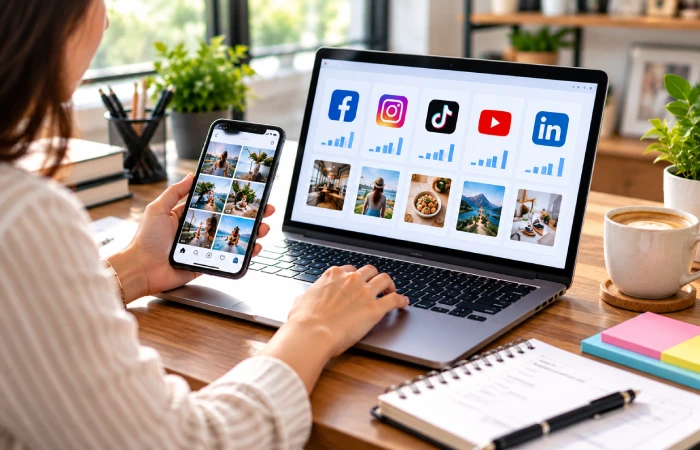
Choose your platforms based on where your actual customers spend their time not on which platform is getting the buzz, in the industry.
According to the 2026 Social Media Content Strategy Report from Sprout Social Facebook is still the number one platform for discovering products. 40% Of social media users say they find new products on Facebook. TikTok is next. The same report shows that people of all ages plan to spend the time on Facebook in 2026. This is time than they plan to spend on Instagram or YouTube. This is different, from where many brandsre focusing their efforts right now.
That does not mean every company should just use Facebook. A flower shop, an accounting business and a food prep company work with people who look at trust and ease in ways so the best mix of platforms depends on how your particular customers decide to buy. Choose one or two places where that match’s biggest instead of trying to do everything on five platforms with a small team.
How to create a small business social media strategy
A workable strategy for a small team starts with four decisions, made in this order:
Set one primary goal.
Awareness, leads, bookings and direct sale are all compelling objectives to optimize for individually but require different content and platform strategies. Alternatively rather than attempting to serve all of these objectives set your sights on one goal that is the most urgent right now.
Choose one or two platforms and commit.
Having depth on a single platform where your customers are is more effective than being “thin” on all the platforms where your competitors just happen to be.
Build an 80/20 content mix.
Approximately 80% of posts should be providing some form of value, help or entertainment while 20% should be directly promotional. A feed that’s entirely product pitches trains people to scroll past it.
Post on a schedule you can actually sustain.
Three to five posts consistently throughout the week are better than everyday posts that lose their attractiveness every three weeks. Consistency is the key that gains the trust that finally proceeds to a sale.
Low-cost social media marketing ideas for small businesses

Repost customer content.
Real photo/customer review, submitted with credit. beats manufactured brand content, and is free, other than through polite request.
Show the process, not just the product.
Behind-the-scenes content — how something is made, packed, or delivered — consistently performs well because it reads as authentic rather than staged, and current research shows consumers now rank human-generated content as their top priority over AI-generated posts.
Partner with micro-influencers on a barter basis. Trading a product or service for a post can bring real reach at low cost but it’s not without responsibility. The FTC has rules that must be followed. If a creator is getting a product or a discount from your business that’s considered a material connection. That means the creator must clearly disclose it. Don’t assume the creator will remember. Build the disclosure requirement into the agreement, from the start. Make it clear and upfront. This way you stay compliant. Avoid any trouble down the line
Repurpose one piece of content across formats.
A single how-, to video can become a Reel, a carousel of stills and a caption- post. The approach multiplies your output while keeping your production time unchanged.
How to measure social media results on a small budget

I think you do not need a paid analytics tool to measure what matters. Every platforms native business dashboard. Meta Business Suite, TikTok Analytics, LinkedIn Page analytics. Reports reach, engagement and click-throughs at no cost so you have an analytics tool, for free.
Track outcomes, not vanity metrics.
Likes and follower counts feel nice. They don’t usually mean real money.
Click traffic that brings people to your website, message traffic that you receive and booking or sales traffic that come from one post are what really matter. Those numbers show whether the channel is actually working or not.
Use free UTM tracking.
When you add an UTM parameter to the links, in your bio or posts you can see exactly which platform and which post sent a visitor to your site when you check the standard website analytics. The free UTM parameter works without any paid tool.
Review monthly, not daily.
I notice that the performance of a post can feel very noisy. When I look at a month of data a clear pattern begins to show up. I recommend setting a recurring 30‑minute check‑in to compare what worked with the one goal. After that use the results to adjust month’s content.
Frequently asked questions
How much should a small business spend on social media marketing?
There’s no fixed number, and many small businesses start at zero cost through organic posting alone. Once you add paid promotion, start with a small, fixed monthly test budget on your primary platform and scale it up only once you can see it’s driving the outcome you set as your goal.
How often should a small business post on social media?
Three to five times each week on the platform you pick is a steady speed that most small groups can keep going for a long time. Being consistent at that speed works better, than posting every day. Not keeping it up.
Which social media platform is best for a small business?
There’s no best platform. The right one depends on where your specific customers spend time. It also depends on how they evaluate businesses like yours. That’s why matching the platform choice to customer behavior matters more, than following general trends.
Can a small business do social media marketing without a budget?
Yes. Organic posting, customer content reposts and behind-the-scenes content all take time of money. A focused organic presence, on one or two platforms can actually produce results before any ad spend is even considered.
Do I need to disclose influencer partnerships on social media?
Absolutely, The FTC needs the essence of that relationship disclosed in your post every time a creator gets something of value for posting about your company (free product, discount, payment, etc).
Where to start this week
Choose the platform where the Sprouts 2026 data shows that your specific type of customer already spends the time. Commit to posting three times a week on that platform for the month. Only after that add a platform. The focus on one channel is key. A month of consistent posts on one channel will give you more understanding, than a month of random posts across five platforms.

Creative marketing enthusiast sharing practical insights on digital growth, branding, and online strategies. Passionate about helping businesses succeed with simple, effective, and result-driven marketing solutions.