
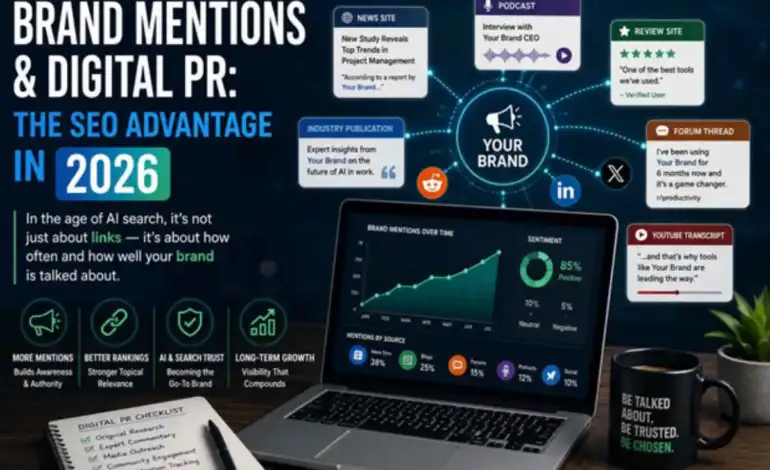
Brand Mentions & Digital PR: The SEO Advantage in 2026
Last Updated: September 15, 2026
Backlinks used to be the whole story in off-page SEO. They’re still important — but they’re no longer the only signal that matters. As AI-driven search tools like ChatGPT, Gemini, and Google’s AI Overviews synthesize answers instead of just listing links, they lean heavily on how often and how consistently a brand is talked about, not just linked to. That’s made brand mentions — and the digital PR work that generates them — a core part of modern SEO strategy, not a nice-to-have side project.
Unlinked Brand Mentions
A unlinked brand mention is just that your brand mentioned in an article, forum thread, review, or podcast transcript with no hyperlink. For years, these were treated as SEO dead weight — nice for awareness, useless for rankings.
That’s changed. Google has confirmed it can and does associate unlinked mentions with a brand’s entity profile, using natural language processing to read context, sentiment, and surrounding topics rather than relying purely on hyperlinks. For generative AI engines, this matters even more. These systems build their understanding of a brand from how it’s described across many independent sources — a mention on a review site, a comparison in a Reddit thread, a quote in a trade publication — and use that consensus to decide whether you’re worth citing in a synthesized answer.
This doesn’t mean links are obsolete. It means unlinked mentions now do a job links can’t: they establish that a brand exists, is discussed, and is trusted by people outside its own marketing channels. Six general types show up in the wild — linked, unlinked, implied (referencing a product without naming it outright), direct name-drops, visual mentions like logos, and earned mentions from organic word-of-mouth. All of them feed the same entity-recognition engine.
Digital PR Strategy
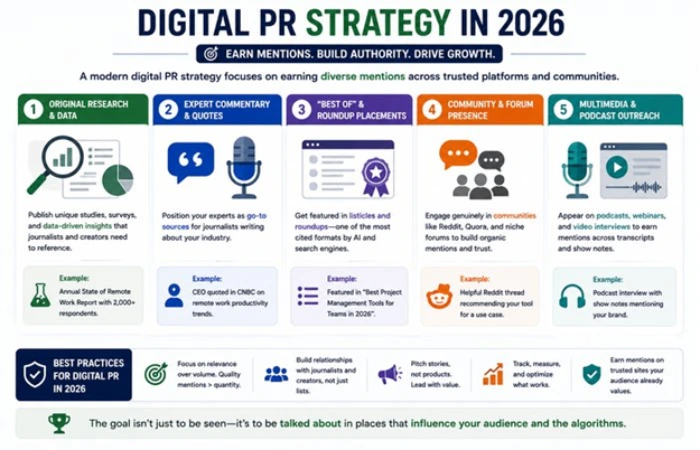
Digital PR is the way you produce these mentions intentionally rather than waiting for them to occur. We have migrated from capturing a handful of uber-DR Links to building a more nuanced profile, a healthy proportion of click-through-links and plain-text citations scattered on news sites, niche sites, podcasts, community sites, etc.
A working digital PR strategy in 2026 tends to center on a few repeatable levers:
- Original research and data surveys, proprietary studies and specialist figures provide them with something tangible to plug in. This is still one of the most reliable ways to earn coverage, because reporters need numbers, not opinions.
- Expert views and quotes making yourself the media’s ‘go to’ for journalists who will be writing in your industry will secure ongoing repeat appearances not just a one off spike.
- “Best of” and roundup placements listicle-style pieces (for example, “best project management tools,” or “top skincare brands for sensitive skin”) were among the format types most often mentioned by the search engines in AI, because they are well-structured, comparative and easily digestible for the models to distill and summarize.
- Community and forum activity Authentic activity on platforms such as Reddit or individual forums within your industry are the sort of cross-platform consensus search engines and AI systems rely upon as a trust factor.
The common thread across all of these is that mentions need to happen in places that are already trusted by the audience you’re trying to reach. A mention on a low-quality content farm does very little; a mention in a publication your customers actually read does a lot.
PR Link Building
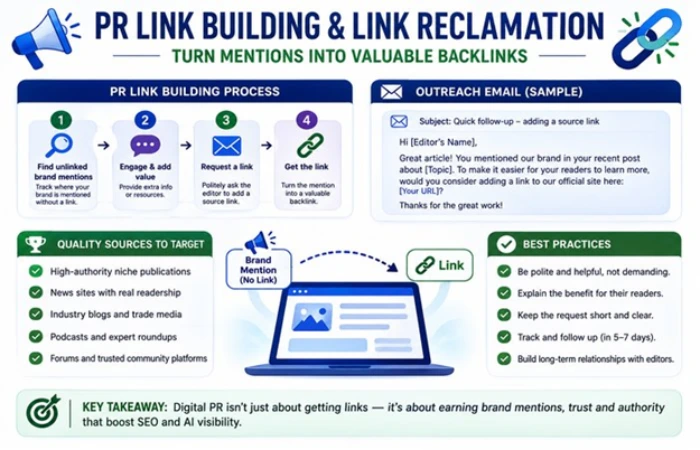
Digital PR and link building aren’t separate disciplines anymore — they’re two outcomes of the same outreach effort. When a piece of coverage includes a mention of your brand, the natural next step is securing a link alongside it, and that’s where PR link building comes in.
The most effective approach isn’t a mass email blast to every journalist who’s ever mentioned a competitor. It‘s selective: you locate placements on sites with existing real editorial standards and real traffic and then ask for a link where there isn‘t one not for a favor, but as providing a value add for the reader. When an article mentions your product, service, or research without linking to it, gently sharing that information with the editor is a fair, low-friction request. Many editors are happy when you frame the request as an opportunity to assist their readers in locating the original cited material, rather than as an attempt to “build links”:
This is also where quality control matters most. Not every unlinked mention is worth chasing. A mention buried in a low-traffic, unrelated blog isn’t worth outreach time. Prioritize sources with genuine authority in your niche, real readership, and editorial oversight — the same vetting standards that apply to any legitimate link-building effort.
Brand Mention Tracking
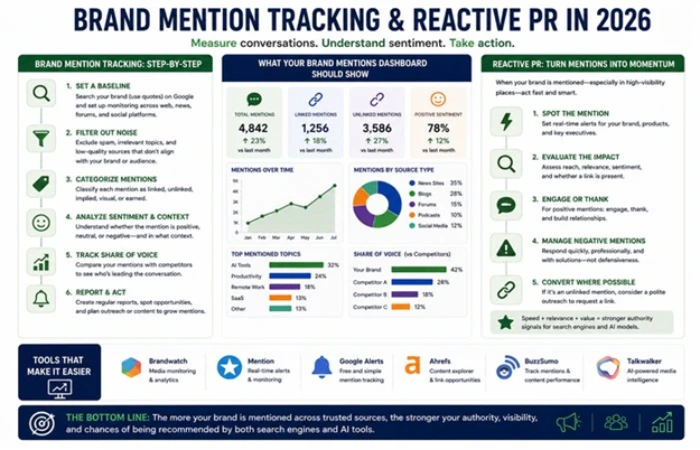
You can‘t create a mentions strategy if you‘re not aware of your starting point. Mentions tracking needs to monitor a few key categories: frequency of mentions, sources of mentions, links and links status and sentiment.
A practical tracking process looks like this:
- Set a baseline. Search your brand name (with quotes) across Google, and use a monitoring tool to catch mentions across news, blogs, forums, and social platforms.
- Filter out noise. Not every hit is real — some will be false positives, duplicate syndication, or irrelevant name collisions.
- Keep an eye on sentiment, not only mention count. A spike in mentions that is associated with negative sentiment (a bad review cycle, a product recall) is very different from a spike that is associated with positive coverage something that would show up the same if you only looked at raw mention count.
- Watch competitors too. Comparing your mention velocity against direct competitors shows whether you’re gaining or losing share of voice in your category.
- Monitor continually, not periodically, as mentions add up over time – one audit alone will not detect trends that only emerge after a few months.
Tools like Google Alerts offer a free starting point, while dedicated brand monitoring and AI-visibility platforms give more granular sentiment and citation-frequency data across both traditional search and generative engines.
Reactive PR SEO
Reactive PR flips the usual pitch-first model. Instead of proposing a story idea, you respond to journalists who are actively looking for sources — through platforms like Qwoted, or by monitoring relevant industry news cycles for moments where your expertise is directly relevant.
The benefit lies in speed and relevance. The right quote at the right time to a reporter working on a live story is much more likely to be picked up than a cold pitch lands in the inbox of hundreds. It will also generate more natural coverage, since the quote appears in a story a journalist was actually writing rather than one the journalist has had to re-shape around your product.
The catch is that reactive PR requires a process, not luck. Someone on your team needs to monitor requests daily, understand which ones are a genuine fit, and respond quickly with a real answer — not a sales pitch. Journalists can tell the difference immediately, and a pattern of generic, promotional responses will get your brand ignored on every future request.
Bringing It Together
Backlinks still carry structural weight in traditional search, but brand mentions have become the connective tissue between classic SEO and AI-driven visibility. The brands that will hold up best over the next few years are the ones treating digital PR, mention tracking, and link reclamation as one continuous system — not three separate to-do lists. Start by knowing where you’re mentioned today, then build a deliberate process to earn more of the right kind, in the right places, consistently.

Creative marketing enthusiast sharing practical insights on digital growth, branding, and online strategies. Passionate about helping businesses succeed with simple, effective, and result-driven marketing solutions.