15 Off-Page SEO Techniques That Actually Work in 2026
Last Updated: September 15, 2026
Backlinks used to be the whole game. Get enough of them, ideally from bigger sites than your competitor’s, and rankings followed. That still helps, but it’s no longer the full picture. Google’s AI Overviews, ChatGPT, and Perplexity now decide who gets cited based on signals that live off your website entirely, how often you’re talked about, not just linked to, and how consistently your brand shows up across sources an AI model would trust.
That doesn’t make links irrelevant. It means the tactics worth doing now overlap heavily with plain old reputation building, and the ones that don’t overlap (manipulative link schemes, expired-domain tricks) get flagged by detection systems faster than they used to. Below are 15 off page tactics to consider in 2026, categorized based on their intent to achieve.
Off-Page Optimization: Where the Work Happens
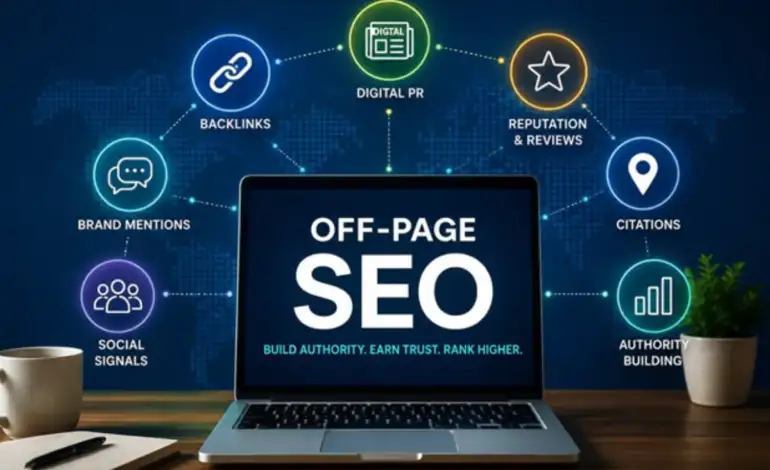
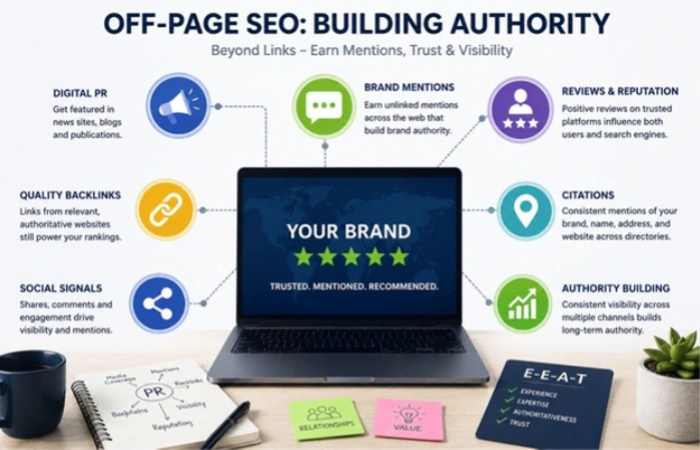
Off-page optimization is all the trust-building that happens elsewhere, such as coverage, take-up, referrals, reviews, citations and the links that generate them. Three tactics anchor most programs.
Digital PR. Sending newsworthy new data and survey, or comment from an industry expert to journalists rather than simply requesting the link. In a 2026 survey of 518 SEO professionals by Editorial.link, digital PR was rated the most powerful link-building tactic (for 48.6%) many times over traditional guest posting (16%). Journalists will never quote a favor, and often cold emails with squillions of words, so the number is often reached before the email is read.
Selective guest posting. Writing for sites with a real, relevant audience, not volume placements on domains nobody reads. The value now is less about the link itself and more about putting your thinking somewhere AI models and readers already trust. One well-placed piece on an industry publication your prospects actually follow beats ten placements on generic “business” blogs.
Niche edits. Getting a link inserted into an existing article that already ranks and gets traffic. Less costly and quicker than a guest post (you may not own the editorial context, as part of an owned ‘brand world,’ but you do have control of your own), and the link can disappear with the next update of the page. Should do this, but shouldn‘t forget about this.
Off-Site SEO Factors That Move Rankings in 2026
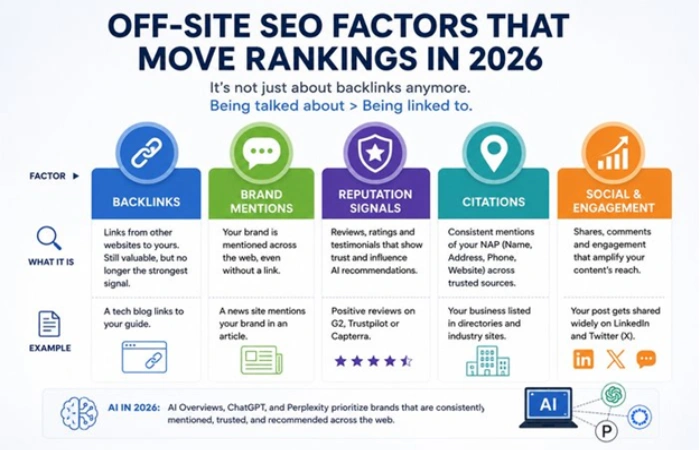
Backlinks still count but aren‘t the best off-page indicator anymore. Recently Ahrefs took a look at 75,000 brands and found that branded web mentions shows an 0.664 correlation with AI Overview visibility, versus an underwhelming 0.218 for backlinks around three times as important (correlations aren‘t causations). No longer likely to occur, being mentioned wins over being linked.
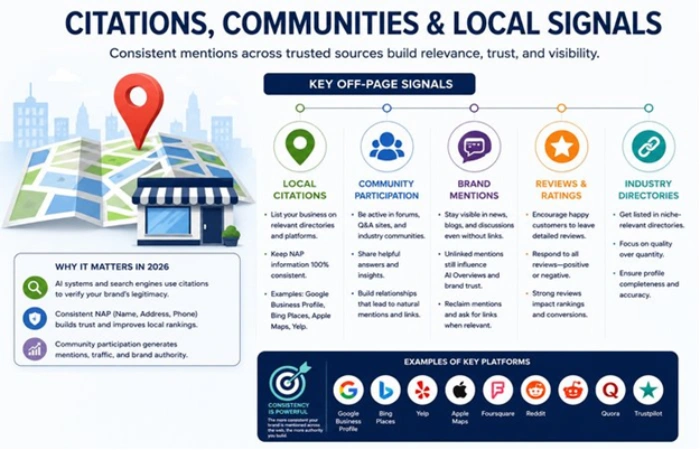
Unlinked mention reclamation. Search for places your brand is already named without a link, then ask for one. It’s a warmer ask than cold outreach, since the writer already knows who you are, and tends to convert accordingly. Google Alerts or a paid mention-tracking tool will surface these for you weekly.
Broken link building. Search for dead links on appropriate pages and suggest that your content be used to replace them. Tedious, low reply rate, but effective, as you are providing a solution to the webmasters genuine problem rather than asking for a favor.
Reputation signals. Presence and sentiment can be on G2, Trustpilot, Capterra, or industry-specific review sites, and all determine the strength of expression you get from AI when asked to recommend your brand. Several current, specific reviews will beat a mountain of outdated, generic reviews
Social distribution. Shares and comments aren’t a direct ranking factor, but they’re usually what generates the mentions and branded searches that are. Treat social less as a traffic channel and more as the thing that gets people talking about you elsewhere.
Authority Building SEO
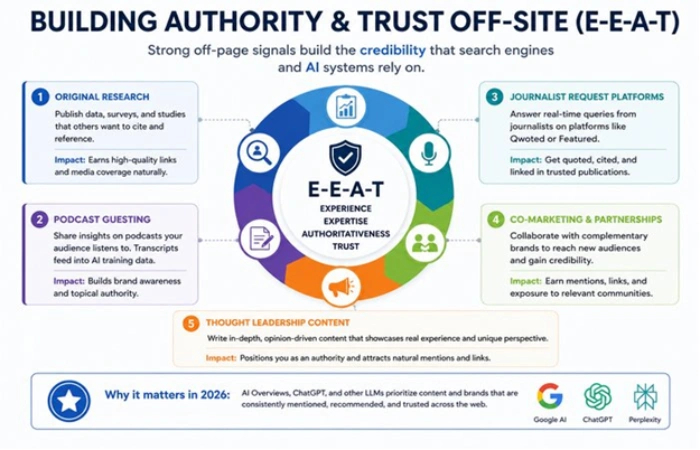
E-E-A-T isn’t a switch you flip. It’s a quality bar that everything else here either clears or doesn’t. Google’s John Mueller said back in 2021 that digital PR can be “just as critical” as technical SEO, a claim that’s aged well given where the data has landed since.
Original research. Surveys, proprietary data sets, industry studies that other people want to quote from. It‘s the raw material of the vast majority of high-profile digital PR campaigns, and it‘s refutable: one data set will sustain months of pitches, posts and subsequent editorial commentary.
Podcast guesting. Getting on shows your buyers already listen to builds a spoken-word footprint that transcripts feed straight into LLM training data, on top of the direct audience reach.
Journalist request platforms. Tools such as Qwoted or Featured put you in touch with reporters who are seeking sources on deadline with less effort than cold pitching. The upside is similar if your quote is specific and quotable.
Co-marketing with adjacent brands. Partnering with companies that share your audience but not your product, think a scheduling tool teaming up with a CRM, extends reach without paying for it and puts your name next to a brand your buyers already trust.
Domain Authority Increase: Do It the Right Way
Domain Authority and Domain Rating are third-party metrics, not Google ranking factors. Mueller has said as much directly. Chasing the number is a mistake; earning the mentions and links that happen to raise it isn’t.
Local citations and Google Business Profile. For any business with a physical footprint, consistent name, address, and phone details across directories still compound trust with Google and with AI-driven “near me” recommendations. Inconsistent NAP data is still one of the most common, most fixable local SEO problems out there.
Community participation. Real, non-marketing activity on Reddit and other niche sites is now being snatched and delivered as part of AI answers, even sometimes before the mainstream web results. This one cannot be convincingly faked; a profile that history-only links is regarded as spam by the community and by the algorithm.
A useful discipline either way: track cost per retained link, not cost per placement. A cheap link that disappears in a site update six months later was never actually cheap.
Off-Page SEO Tools Worth Using
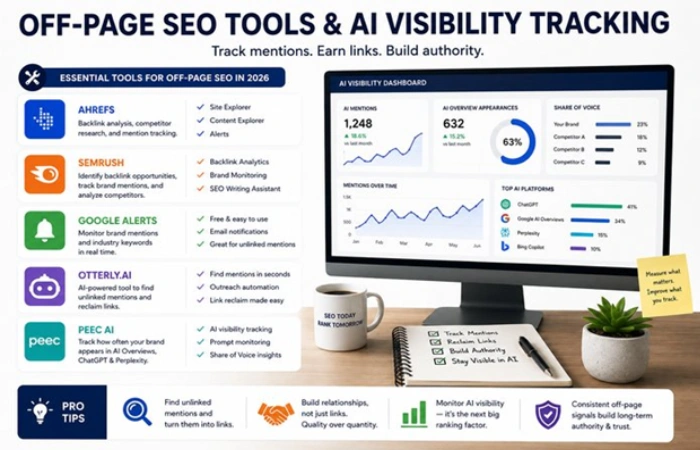
AI visibility trackers. Otterly and Peec AI monitor which brands ChatGPT and Perplexity actually cite for your category, which is the closest thing to a rankings report this new layer of search has right now.
Mention and link monitoring. Ahrefs, Semrush and free Google Alerts all turn up new mentions, alert you about lost links, and pick up on reputation issues before they become visible to the world. You still need to do the work, but they‘ll show you where to start.
Conclusion
None of these fifteen work alone, and none of them is a substitute for having said something interesting in the first place. Authority is carried most heavily by digital PR and original research, before the more quiet mention reclamation, reviews and community activity pile up in the background; the tools merely point you to your next destination.
Skip the shortcuts. Manipulative links and gray-hat tricks are flagged nearly immediately now, and resurrection takes longer. Choose two or three techniques from this list that realistically match your resources, implement them consistently over an entire quarter, and look at the AI visibility trackers before concluding that something isn‘t working.

Creative marketing enthusiast sharing practical insights on digital growth, branding, and online strategies. Passionate about helping businesses succeed with simple, effective, and result-driven marketing solutions.