
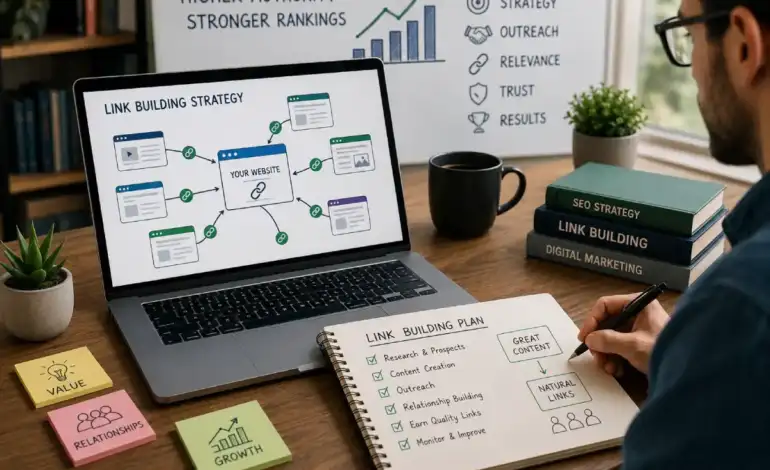
Link Building in 2026: The Complete Guide to Earning High-Quality Backlinks

Last Updated: September 18, 2026
A friend who runs a small D2C skincare brand asked me a version of this question last month: “I keep hearing I need backlinks, but nobody explains what that actually means or how to get them without paying some sketchy service on Fiverr.” That’s basically the whole problem with link building as a topic — it gets talked about like insider knowledge, when really it’s a fairly logical system once someone walks you through it without the jargon.
Link building, stripped down to its simplest form, is the process of getting other websites to link back to yours. Google has said for years that backlinks sit among its most important ranking signals, right up there with the quality of your actual content. But there’s a catch that trips up almost everyone starting out: it’s not a numbers game anymore, if it ever really was. A single link from a site your industry already respects can do more for your rankings than fifty links from random directories nobody’s ever heard of.
This guide is meant to work as a map, not a textbook. We’re going to walk through the five pillars that make up a real link building program — strategy, white-hat practice, what actually counts as a “high authority” link, outreach that doesn’t feel gross to send or receive, and cleaning up the toxic links that can quietly drag your site down. Each section gives you enough to act on today. Where a topic deserves a full deep-dive of its own, you’ll find a pointer to the dedicated guide.
What Link Building Actually Means
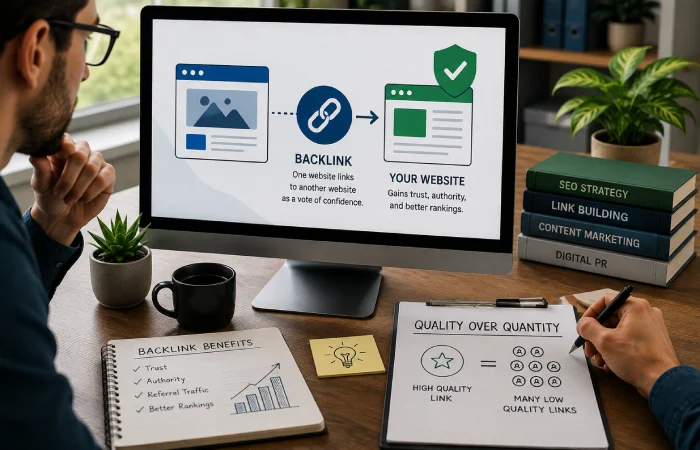
Think of a backlink as a citation. When a website links to a page on your site, it’s essentially saying, “this is worth reading, and I’m willing to put my own reputation next to it.” Search engines read that as a trust signal. Stack up enough of those citations from credible, relevant sources, and your site starts to look more trustworthy in the eyes of the algorithm — which, over time, tends to show up in rankings.
Here’s the part people skip past too quickly, though: not every citation carries the same weight. A link from a site that publishes serious, original reporting in your field means a lot more than a link buried in a footer of a directory that links to literally anything for five dollars. Google’s systems have gotten remarkably good at reading context — who’s linking to you, what that site normally covers, and whether the link even makes sense in the sentence it sits in. A backlink to a marketing agency’s blog post from a car-parts forum, for instance, just doesn’t read as natural, and the algorithm has learned to notice that.
So before you build anything, it helps to reframe the goal. You’re not “collecting links.” You’re earning citations from people who already have some credibility in a space you care about.
Link Building Strategies
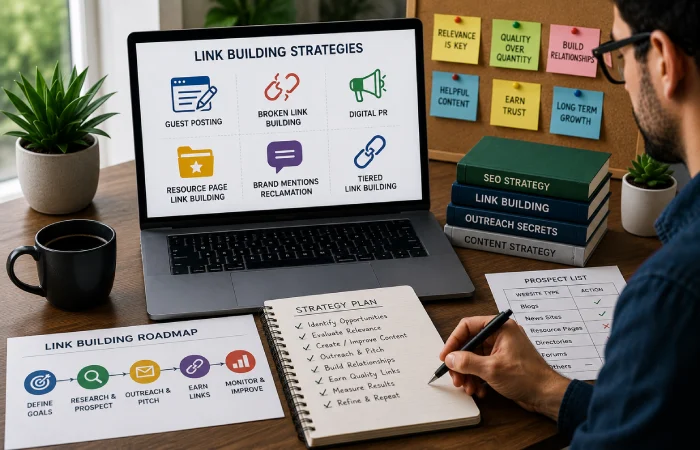
There’s no single correct way to build links — there’s a toolkit, and which tool you reach for depends on your budget, your niche, and honestly, how much patience you have.
A few approaches have proven themselves reliably over the last couple of years:
- Guest posting on blogs that already cover your niche, in exchange for a byline and a contextual link back to your site.
- Broken link building we find what from our point of view is an irrelevant page with dead links, then we replace those links by our content.
- Digital PR pitching a fresh data set, survey or a genuinely newsworthy angle to journalists and trade publications.
- Resource page link building, getting your site added to curated “best tools” or “useful resources” lists.
- Reclaiming unlinked brand mentions — turning a mention of your company that doesn’t link anywhere into a proper backlink.
- Tiered linkbuilding This involves building supporting links to links you already have to further solidify them.
Each of these has a different cost-to-value ratio, and for the sake of your own happiness, you should be honest about which will work for your circumstances. Guest posting and broken link building can be the easiest options for small teams without deep pockets, as they are primarily time commitments. Digital PR takes a little longer to kick in, as you‘ll be required to offer the press a truly interesting story or feature before they “bite” (for want of a better term), but one effectively pitched story to a high-traffic publication can generate far more worthwhile links than three or four months worth of “lesser” outreach.
The error I notice most regularly is an attempt to do all six less-than-perfect strategies at once when in reality what should be happening is selecting two that align with your self-awareness and capability and staying with them. Link building is a marathon not a race.
Interested in the complete list, including which of these to focus on based on the age and strength of your website? The dedicated strategies guide walks through each tactic step by step.
White Hat Link Building
“White hat” is just a way of saying you’re playing by the rules Google actually rewards, rather than trying to trick the system. It’s the opposite of buying links in bulk from a network, or dumping your URL into a hundred low-quality directories overnight. Both of those can trigger penalties, and recovering from a penalty is a slow, frustrating process — far slower than building links properly in the first place would have been.
A few principles tend to hold up across every white-hat approach:
- Build something really worth linking to: an original piece of research, a useful tool, an extensive guide or a beautifully crafted data visualization.
- Establish genuine contacts with editors, bloggers and journalists rather than firing the same canned pitch into five hundred inboxes.
- Utilize your anchor Text in a natural and diverse way. Reusing the exact targeted keyword every time looks like manipulation.
- Disclose sponsored placements properly, using the rel=”sponsored” attribute where it applies.
The real upside of staying white hat isn’t only that you avoid getting penalized — it’s that the links actually last. A link earned because your content genuinely deserved the citation tends to stay put for years. A link that was purchased or manipulated into existence has a habit of disappearing, or getting devalued, the moment Google’s systems catch up to the pattern.
What Counts as a High-Authority Backlink
Not every backlink moves the needle, and understanding what actually makes one “high authority” will save you a lot of wasted effort chasing the wrong metric.
Domain Authority and Domain Rating – the metric scores you will encounter in tools like Moz and Ahrefs – are a handy shorthand for overall link equity, but they don‘t tell the entire story, and blindly trusting them is one of the more frequent errors I come across. When considering the value of a link prospect, it‘s helpful to dig a little deeper than that short number and ask some follow-up questions:
- Is the linking site receiving any actual organic traffic or is this just a domain that technically exists, but in reality nobody ever goes to?
- Is the site’s content actually related to yours, topically?
- Does the site have clear editorial standards — or will it link to literally anyone who asks, or pays?
- Is it good content based on research and published on some form of schedule, or is it pretty flimsy and neglected?
As long as the topic relevancy and overlap is high enough, links from a relevant mid-size blog highly trusted in your specific niche can outperform links from a very large general-interest site. This relevance signal is even more significant as engines continue to improve at understanding how the world is broken down into associations between topics, concepts, and the credible sites that cover them.
Therefore, when choosing where your outreach efforts are best placed, evaluate the community, content and traffic first before judging on the DA or DR score as a measure of value. Use the authority as a backup for verification only.
Link Building Outreach
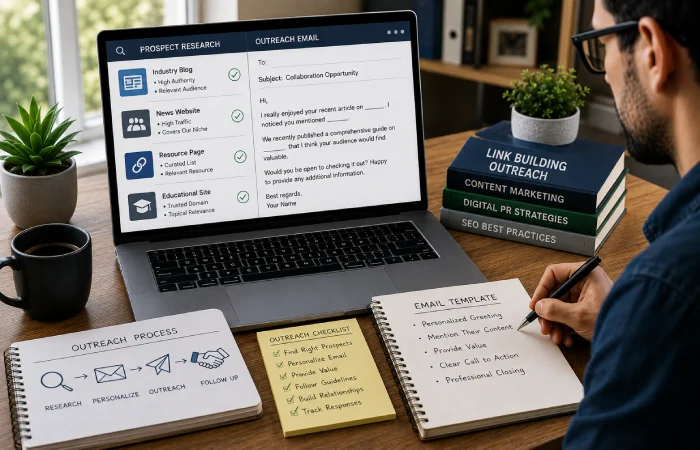
No matter how absolutely amazing the best piece of content you‘ve ever put out is going to be sitting there waiting for people to stumble across it on your site isn‘t going to earn you links. Outreach is how you actually put it in front of the people who have the ability to link to it.
Any good outreach follows a pattern, conscious or otherwise on the part of those doing it:
- Prepare thoroughly prior to pitching. Make yourself familiar with exactly what the site publishes, who‘s the boss and why your resource would be appropriate.
- Personalize the opening line. A generic “Hi, I love your blog!” gets deleted in about two seconds — reference something specific about their recent work instead.
- Lead With Value not a Request. Tell the person what about your resource is valuable to them first, then ask something of them.
- Follow up, but don‘t become a pest. Spread a few polite follow-ups up over a two-week period and you‘re fine. Anything more would be considered harassment.
- Track your response rate honestly. If fewer than one in ten pitches gets a reply, the problem is usually your targeting or your message — not that you simply need to send more emails.
Outreach in 2026 has gotten partly automated on the research and list-building side — tools can help you find the right contacts faster than manually searching. But at the end of the day, it still is a message that a busy editor will hear and say yes to. That hasn‘t changed I hope it never will.
Toxic Backlinks
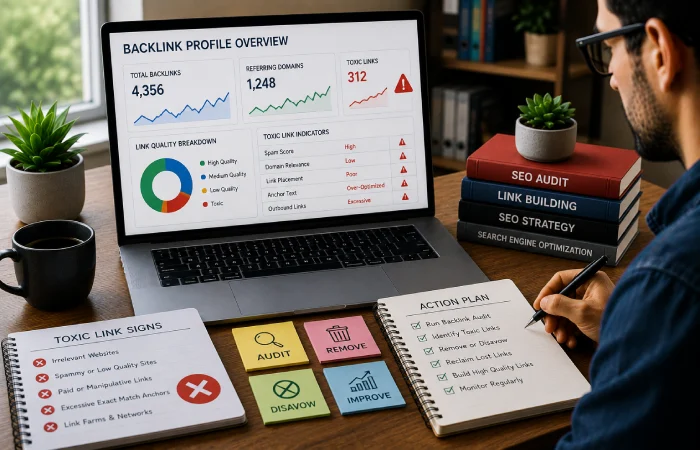
Not every link that points to your site is doing you a favor. Toxic backlinks usually come from spammy directories, link farms, compromised or hacked websites, or irrelevant foreign-language domains that attached themselves to your site without you ever asking for it — sometimes as part of a deliberate negative SEO attack from a competitor.
A few warning signs suggest your backlink profile might have a toxic-link problem worth investigating:
- A sudden spike in low-quality referring domains you don’t recognize appearing in your reports.
- Links coming from sites with essentially no traffic, thin or nonsensical content, or subject matter completely unrelated to yours — casino, pharma, or adult-content links showing up on a B2B software site is about as clear a red flag as it gets.
- Unnatural repetition of anchor texts which are full of relevancy (keyword-rich anchor text) of the same page continuously.
- An uncharacterized ranking decline that occurs suddenly and coincides with a batch of new, low quality backlinks showing up in Search Console.
The right response isn’t panic — it’s a process. Audit your backlinks regularly, identify which backlinks are really bad (and not only ugly), and only use Google‘s disavow tool with the links you could not remove directly and that represents a real, tangible threat to the site. Most sites don‘t even need to clean their backlinks too aggressively as Google‘s algorithms ignore many spammy links anyway. But practically every web property out there should get used to audit their backlink profile regularly.
A Regional Note: US vs. Indian Link Building
Strategy shifts a bit depending on where your audience and your outreach targets actually sit, and it’s worth calling that out directly since so many guides treat “link building” as if it looks identical everywhere.
In the US market, digital PR and data-driven content tend to perform especially well — journalists and bloggers there are actively hunting for original statistics and expert commentary to cite, and there’s a well-worn pipeline (HARO-style platforms and similar) built specifically for that exchange. Guest post costs on established US sites also tend to run noticeably higher than in other markets, which is worth budgeting for.
In the Indian market, directory and business-listing ecosystems — both industry-specific and location-specific — still carry genuine value alongside guest posting, which surprises some marketers who assume directories are universally dead. Relationship-based outreach through LinkedIn also tends to convert noticeably better than cold email alone. Pricing for guest posting is usually flexible, though the same relevance/real-traffic tests hold just as strictly as everywhere else – a cheap placement on an irrelevant site isn‘t a good link.
Frequently Asked Questions
Is link building still important in 2026?
Yes. Backlinks continue to be one of the primary ranking factors used by Google, but (at least according to John) not as much emphasis has been placed on high number of backlinks, but rather quality. Significantly, Google has moved the focus from sheer volume of inbound links to those that are most relevant.
How many backlinks do I actually need to rank?
There‘s no exact amount, and if someone tells you you should be getting a certain number, they‘re just estimating. Few very related, high-authority links can beat hundreds of less relevant ones; it‘s quality over quantity here.
What’s the real difference between Domain Authority and Domain Rating?
DA (from Moz) and DR (from Ahrefs) are third-party metrics measuring a site‘s link- based authority and involve their own formula, thus a blank site can have two different numbers depending on which metric you choose to use. Consider both as directions, not absolutes.
What exactly is a toxic backlink?
A toxic backlink is when you receive a link from a poor quality, spammy, or a totally unrelated website and this has a negative impact your rankings either by algorithmic devaluation or, less likely, a manual penalty by Google.
Should I disavow every low-quality link I find?
No, and that simply is an overreaction. Most of the time, Google will simply ignore such links, and they won‘t require any sort of response/lead to a penalty. Only use the disavow tool if the links are obviously manipulative, part of a manual effort with your site, or part of an active negative SEO campaign.
Is guest posting still safe for SEO?
Yes, as long as it’s done for genuine editorial fit and real audience value rather than purely to manufacture a link. Guest posting purely to game rankings — especially at scale through paid content networks — still carries real risk.
Common Mistakes Worth Avoiding
If you look at the various street-corner formations that occur over and over with link-building newbies, you‘ll notice a handful of common themes. As these often just need that simple bit of advice to be avoided, here they are, themselves:
- Chasing a link count instead of a relevance fit — ten irrelevant links do less for you than two genuinely on-topic ones.
- Bulk purchase of links from a marketplace that in spite of all the spinning actually appears exactly what it is to Google‘s spam systems.
- Using each link with an identical exact-match anchor text, which appears to be artificial.
- Completely leaving your backlink profile alone until rankings drop all of a sudden, instead of monitoring it periodically.
- Overscheduling outreach as a mere one-time email blast, not a relationship-building process.
None of these errors are irremediable on their own many sites overcome all of them. But avoiding them from the beginning saves you months of fixing things that should have been broken before, and that time is almost always better spent on the next good link than on fixing the last bad one.
Bringing It All Together
Link Building in 2026 is all about incentives for patience and relevancy instead of speed and quantity. And that is period one idea you should keep locked in your head if you skip over remaining nine parts from this guide. The strategies you choose, how carefully you stay within white-hat practice, which links you actually chase, how you pitch for them, and how well you protect the links you’ve already earned — none of that works in isolation. It’s one connected system, not five separate to-do lists.
If you’re just getting started, begin with the fundamentals in the strategies guide. If you already have a backlink profile you’re a little nervous about, start with the toxic backlinks guide instead and get a clear read on where you actually stand before building anything new on top of it. Either way, treat this page as your starting map — the real, tactical work happens in the guides it points you toward.

I’m Thomas — Editor & Admin of incmarketingplace, Blogger, and Senior SEO Analyst. writer at Inc Marketing Place, sharing insights on SEO, branding, content marketing, and online business growth. I focuses on creating practical and easy-to-understand content for marketers, entrepreneurs, and growing businesses