The Complete 2026 Guide to Ranking Higher

Last Updated: September 18, 2026
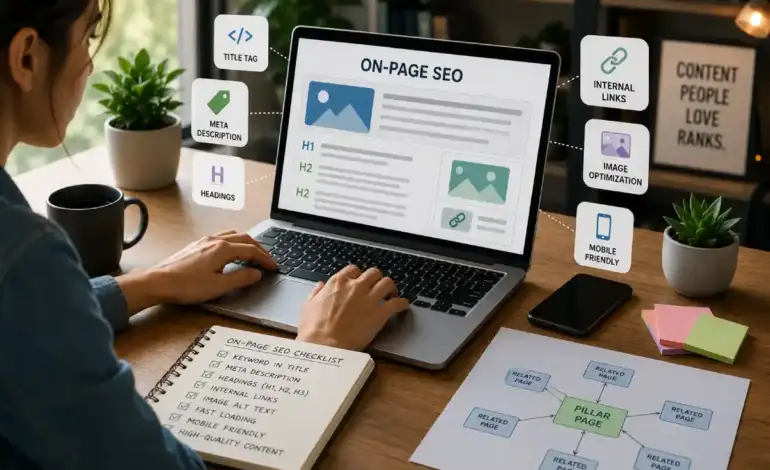
You publish a page. You wait. Weeks go by and it’s just… sitting there, buried on page four of Google, doing nothing. Sound familiar? Here’s the thing nobody tells you early enough: good content isn’t enough on its own. It never was. On-page SEO is what actually connects the dots between “I wrote something genuinely useful” and “people can find it.”
So what is on-page SEO, really? Strip away the jargon and it’s just this: everything you control directly on a page — your words, your title tag, your meta description, your headings, the links pointing to other pages on your own site. All of it. It’s the stuff you can open right now and fix, which is exactly why it’s worth mastering before you chase backlinks or worry about crawl budgets. Those matter too, but that’s technical and off-page SEO, and honestly a whole different conversation.
One thing before we dive in: this guide isn’t going to try to explain title tags, internal linking, and everything else in exhaustive detail all in one place. That would make for a bloated, skimmable-only mess that helps nobody. Instead, think of this as the map. We’ll walk through the five pieces that move the needle most — the checklist, the fundamentals, title tags, meta descriptions, and internal linking — give you enough to actually do something with today, and hand you off to a focused guide whenever you want to go deeper on any one of them. Alright, let’s get into it.
On-Page SEO Checklist
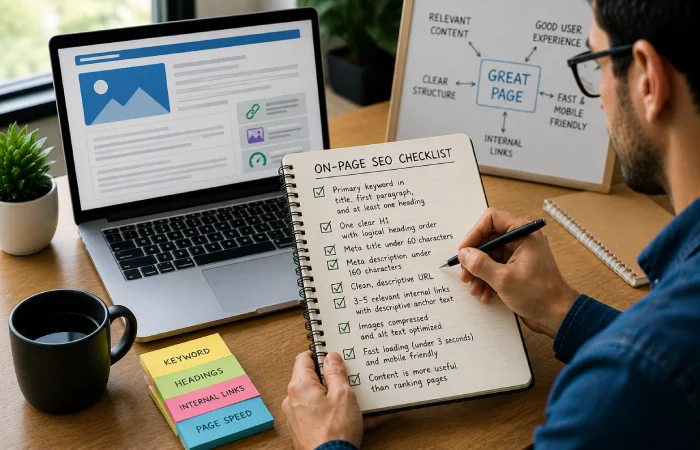
Before you touch a single headline, you need to know what “good” actually looks like. Consider this your pre-flight check before a page goes live, or your go-to audit list for older pages that just… aren’t pulling their weight anymore. On-page SEO isn’t one big lever you pull once — it’s a stack of small decisions that add up, and underperforming pages rarely have one glaring problem. Usually it’s five or six small leaks at once, which is exactly why a checklist you actually run beats a “we’ll get to it eventually” mindset.
So what does a solid checklist typically cover? Your primary keyword should show up in the title, the first paragraph, and at least one heading. You want one clear H1, with headings underneath it that actually follow a logical order — not just headers slapped in wherever. Keep the meta title under 60 characters and the meta description under 160. URLs should read like sentences, not random strings or stacked dates. Aim for 3–5 relevant internal links per page, using anchor text that actually describes where it’s sending someone. Images should be compressed and carry alt text that means something, not “image1.jpg.” And the page needs to load fast and work on mobile — under 3 seconds is the target. Above all, the content itself has to be genuinely more useful than whatever’s currently ranking, not just padded to look longer.
Say you’ve got a skincare blog and you’re going back through an old post called “Skincare Tips.” Run it through the checklist and you might find: no real H1 (it’s just styled text), a meta description that got auto-generated and cuts off mid-sentence, and not a single internal link to your other guides. None of that is hard to fix on its own. But stacked together? That’s probably why the page isn’t going anywhere.
A checklist is really what turns “on-page SEO” from a vague idea into something you and your team can actually run, page after page, without reinventing the process each time.
On-Page Optimization
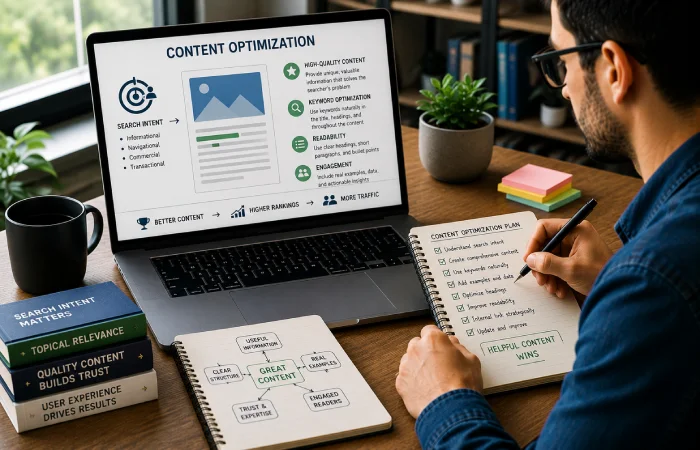
If the checklist tells you what to check, this is the why behind it — and honestly, the part that helps you decide what to fix first when you can’t do everything at once. Optimization starts with matching intent, not chasing keywords. That’s the piece most people get backwards. Content quality is arguably the biggest ranking factor right now, because search engines have gotten noticeably better at telling genuinely helpful pages apart from padded ones. And structure matters more than people think: clear headings and short paragraphs affect rankings, sure, but they also affect whether someone actually sticks around long enough to read what you wrote.
In practice, that means figuring out the intent behind your keyword before you write a single word — is this person trying to learn something, compare options, or buy? It means working your primary keyword in naturally, in the intro, a subheading, the conclusion, without forcing it into every paragraph (that’s a fast way to sound robotic, ironically). It means breaking up long stretches of text so people keep reading instead of bouncing, and throwing in real examples, actual numbers, first-hand experience wherever you can — usually that’s what separates a page that ranks from one that also converts. Keep your heading structure logical throughout, so both readers and search engines can follow along without getting lost.
Picture two pages both going after “best running shoes 2026.” One’s basically a rewritten spec sheet pulled from manufacturer sites. The other includes the writer’s actual mileage notes, a comparison table, and an honest trade-off or two — “great cushioning, but runs half a size small.” The second page almost always wins. Not because it’s longer. Because it’s actually useful.
Forget the rulebook mentality here. On-page optimization is really about building a page that earns its spot — the ranking follows from that, not the other way around.
SEO Title Tags
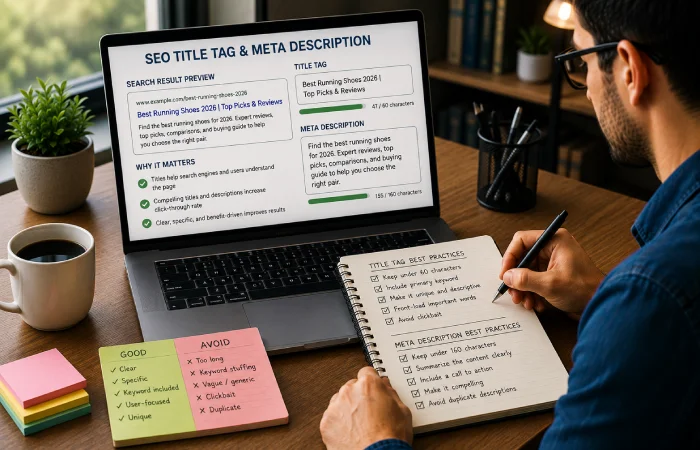
Your title tag is the first thing anyone sees, often before they’ve even clicked through to your site. Mess this up and it doesn’t matter how good the page behind it is — people will scroll right past. Keep it under roughly 60 characters, or Google will just cut it off mid-sentence. Your keyword should show up naturally, and ideally closer to the front. A title tag really has two jobs at once: tell search engines what the page is about, and give an actual human a reason to click.
What works in practice? Lead with the keyword or the benefit, not your brand name — save that for the end, if you include it at all. Every page needs a unique title; duplicates just confuse search engines about which page should actually rank. Numbers and years tend to help (“2026 Guide,” “12 Tips”) and can bump click-through rate a bit. And skip the vague stuff — “Home | Blog | Company” tells a searcher absolutely nothing about what they’ll find.
Take “SEO Tips” versus “On-Page SEO Checklist 2026: 20 Steps to Rank Higher.” No contest, really. The second one tells you exactly what you’re getting, includes the keyword, and gives you a reason to pick it over the other nine results on the page.
Short, specific, keyword-aware, written for a real person skimming ten blue links in about three seconds. That’s the whole job.
Meta Description Best Practices
Meta descriptions won’t move your ranking directly, not really — but they’re doing a lot of quiet work behind the scenes, deciding whether someone clicks your result or the one right below it. Aim for 150–160 characters; on mobile, where most searches happen now, closer to 105 is safer. Write one for every page instead of letting it auto-generate, because that almost always reads badly. The good ones state a clear benefit and end with a soft nudge toward clicking.
Lead with the value: what does the reader actually walk away with? Work your keyword in naturally — Google often bolds it in the results, which helps you stand out visually against everyone else on the page. Close with something like “See the full checklist” or “Explore the guide,” a light push rather than a hard sell. And skip filler like “Learn more about our services” — say something true and specific to this exact page instead.
“We offer SEO services for businesses of all sizes” tells a reader nothing. Try something more like: “See the exact on-page SEO checklist we use to rank client pages in the top 5 — no fluff, just steps you can apply today.” Same idea, actually earns the click.
Treat your meta description like ad copy you’re not paying for. Its only job is to earn the click.
Internal Linking Strategy
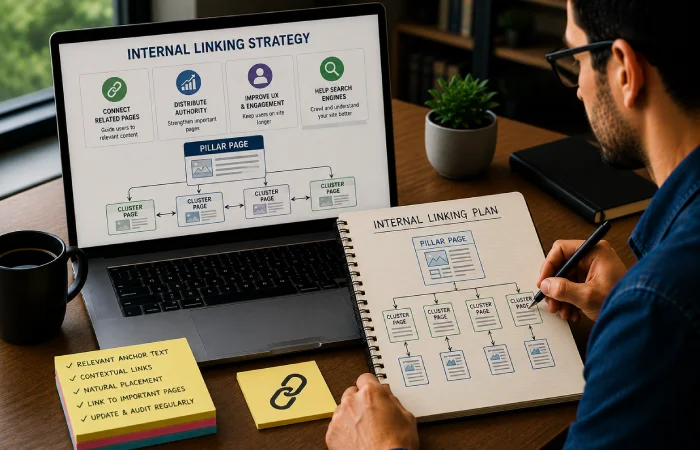
This is probably the most underrated piece of on-page SEO, and it’s the one competitors most often get wrong. Do it well and a single article stops being a dead end — it becomes part of a network that lifts every page around it. Internal links pass authority from your strongest pages to the ones that need help. The pillar-and-cluster setup — one hub, several deep-dive pages, all linked together — is still the most effective structure for building real topical authority. And 3–5 contextual links per article is a reasonable target; go much higher and you start diluting relevance and confusing readers.
In practice, that means using anchor text that actually describes the destination (“on-page SEO checklist,” never “click here”), linking from your best-performing pages toward the ones you’re trying to grow, and making sure nothing gets orphaned — a page with zero internal links pointing to it rarely gets crawled properly, let alone ranks. Keep anything important reachable within 2–3 clicks of your homepage.
This guide is the hub — it links out to five cluster articles: the checklist, the optimization basics, title tags, meta descriptions, and this one on internal linking. Each of those, in turn, links back here and sideways to the other related clusters. The result is a tight, genuinely connected web instead of a pile of posts that happen to share a topic.
Good internal linking isn’t just an SEO trick. It’s a map — one that helps actual readers find whatever they need next.
Common Mistakes to Avoid
A few things trip up even experienced writers. Keyword stuffing is the classic one — cramming your phrase into every other sentence doesn’t help anymore, it just reads badly and can flag your page as spammy. Duplicate or missing title tags are another quiet killer; every single page needs its own, written specifically for it. Ignoring the mobile experience is a bigger deal than it used to be, since most searches happen on a phone now, and a page that isn’t responsive is fighting an uphill battle no matter how good the writing is. Bolting internal links on at the end instead of planning them into the content hub from the start is another common one — it works far better when linking is part of the plan, not an afterthought. And probably the biggest mistake of all: writing for the algorithm instead of the reader. The pages that actually hold up over time are written for one specific person first, with the SEO structure layered on afterward, not the other way around.
Myth vs. Fact
| Myth | Fact |
| “Longer content always ranks better.” | Not really. Usefulness beats word count — a tight 1,200-word page can outrank a padded 3,000-word one. |
| “Meta descriptions directly boost rankings.” | Not directly. They influence click-through rate, which can help indirectly, but they’re not a ranking factor on their own. |
| “More internal links is always better.” | Past a point, no — it just dilutes relevance. 3–5 contextual links per article is a better target. |
| “You need to hit an exact keyword density.” | That’s outdated. Search engines look for natural, semantic relevance now, not a percentage. |
Future Trends to Watch in 2026
A few shifts worth keeping an eye on as the year goes on. AI Overviews and answer engines seem to favor well-structured, clearly-defined content — pages with tight definitions and scannable formatting are more likely to get pulled into those summaries. Entity-based search is nudging search engines away from exact-match keywords and toward whether your content actually covers the concepts a topic requires, not just the phrase itself. And experience signals — the “E-E-A-T” people keep talking about — matter more than they used to, especially for anything touching money, health, or safety. Real examples and genuine expertise carry weight that generic advice just doesn’t.
FAQs
What is on-page SEO?
On-page SEO is the practice of optimizing individual webpage elements — content, title tags, meta descriptions, headers, and internal links — that you directly control, to improve both rankings and user experience.
What’s the difference between on-page and technical SEO?
On-page SEO focuses on content and HTML elements within a page (titles, headings, keywords). Technical SEO covers the backend factors that affect crawling and indexing, like site speed, XML sitemaps, and mobile rendering.
How long should a title tag be?
Aim for under 60 characters so it doesn’t get truncated in search results.
How many internal links should one article have?
A general guideline is 3–5 contextual internal links per article — enough to guide readers without diluting relevance.
Does keyword density still matter for on-page SEO?
Not in the old sense. Modern search engines focus on natural language and topical relevance rather than a specific keyword percentage.
What should I fix first if my page isn’t ranking?
Start with search intent match, then title tag and meta description, then internal linking — those four changes tend to move the needle fastest.
Final Conclusion
On-page SEO was never a run-it-once-and-forget-it checklist. It’s more of an ongoing habit — matching intent, writing something genuinely worth reading, and structuring your site so every page pulls its weight for the others. Get the fundamentals right — a clean checklist, intent-matched content, sharp title tags, meta descriptions people actually click, and internal linking that holds together — and you’re already ahead of most of what’s currently ranking.
Not sure where to start? Pick whichever cluster matches the thing you’re most stuck on right now and work through that one first. This hub will keep growing as each guide goes live, so it’s worth bookmarking and coming back to as you build out the rest of your on-page SEO system.

I’m Thomas — Editor & Admin of incmarketingplace, Blogger, and Senior SEO Analyst. writer at Inc Marketing Place, sharing insights on SEO, branding, content marketing, and online business growth. I focuses on creating practical and easy-to-understand content for marketers, entrepreneurs, and growing businesses