

brand identity: Definition, Elements, Importance & How to Build One

Last Updated: September 18, 2026
Your brand identity extends to far more than a name, logo, or an appealing color scheme. Every encounter a person has with a business helps to shape their opinion about it. How a business sounds, how it looks, how it designs its products, how it expresses itself online, and how it treats its customers, all combine into one overarching image. This comes into play with brand identity.
Having a good brand identity can instill a brand with a sort of “personality.” This will make it clear what the business has to offer, and it will ensure your audience knows what to identify in the company. Whether the business is an online shop, tiny local entity, a tech start-up, or a massive corporation, it’s worthwhile having something recognizable with which your organization can easily communicate with others.
What Is Brand Identity?

Branding is made up of visual and strategic decisions and an overall style of communication that defines your business and what it stands for. Simply said, brand identity is how your business wants to see itself. This comprises the business name, logo design, branding fonts, use of colour, your website design, packaging, the language you use as a business, your tone of voice, photography styles, and ultimately your company personality.
For instance, a business trying to project itself as having an up-to-the- minute and revolutionary image could make use of straightforward typography, simplistic graphic designs, ambitious language, and trendy pictures.
However, an enterprise that wants to come through as welcoming and aged could go for delicate photographs, comfortable and friendly, and oral content.
Brand Identity cannot happen by accident or chance. Instead, it arises from several specific choices working together.
Why Is Brand Identity Important?
A customer might come across many businesses that sell nearly identical products or services. If the offerings look virtually the same, name recognition will help make the business or store memorable.
In more detail, here’s how brand identity helps a business:
It Creates Recognition
The more that images, language, colors, fonts, and design stay consistent, the easier a company becomes recognizable. At one point, customers will know an organization by its branding before they even read the name. This recognition becomes critical in markets saturated with businesses vying for attention, from the internet to the physical storefront-and of course, everything in between.
It Builds Trust
Continuity often portrays a firm as both mature and reliable. If a company uses extremely different visuals and copy on every aspect of its communications, a potential customer can become quite confused as to what the company is actually all about.
A stable brand name means that a business knows who it is.
It Creates Differentiation
It’s possible to reverse-engineer or make a copy of a company’s products. This makes it much harder for a competitor to copy a solid brand identity. A Brand identity can consist of personality, values, story, design, and the total customer experience. This offers a unique advantage to companies trying to outsmart the competition outside of their current pricing structure.
It Supports Marketing
When the business already knows what it should look and feel like, this gives the marketers an advantage and makes the job a lot easier. They can come to a meeting ready to make work without having to invent a new advertisement from nothing. This gives consistency and saves time.
Brand Identity vs. Brand Image
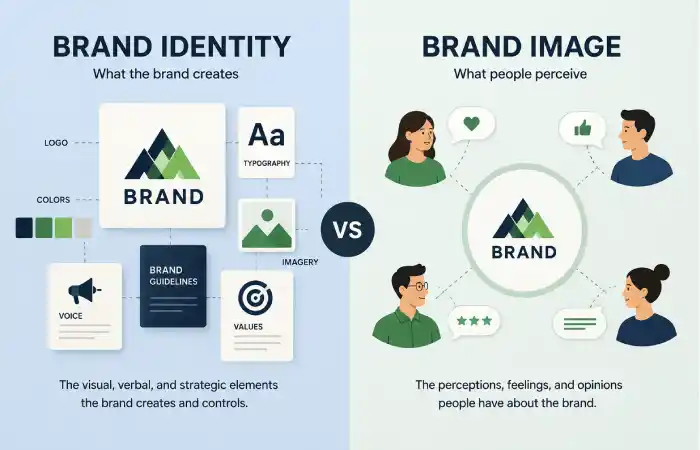
Brand identity and brand image although linked represent different aspects. The brand identity is the perception of what a company is trying to create and communicate. Whereas the brand image represents how the perception from the customer is in reality.
As an example, a company aims to be perceived as affordable and as a friendly firm.
Nevertheless, if customers consistently receive poor-quality service that takes forever to deliver, and their products are rather pricey, the impression on consumers might be far from the identity they aimed for. Thus, it would not suffice to only present an appealing identity, but the firms act has to correspond to the message they want to send.
Brand Identity vs. Brand Awareness vs. Branding
These concepts are often confused.
| Concept | Meaning | Main Focus |
| Brand identity | How a company presents and defines itself | Expression |
| Brand image | How customers perceive the company | Perception |
| Brand awareness | How familiar customers are with the brand | Recognition |
| Branding | The broader process of shaping and managing a brand | Strategy |
Branding is the larger process. Brand identity is one of the most visible and important parts of that process.
Key Elements of Brand Identity
A strong brand identity is made up of several connected elements. Each one should support the same overall idea.
1. Brand Name
Customer, Brand, Design, and Brand Name in the Customer Experience: The customer’s experience of a brand often starts with the brand name. 8 Good brands have names that fit their business and audience and are memorable across online spaces, product packaging, and marketing. The right naming can be a company’s most treasured asset.
2. Logo
Your logo is supposed to be the identifier of your business – not your brand. The most efficient logos are those that clearly identify the business, and they are easily recognisable and applicable in whatever form they may take – as you are going to need to be able to use them anywhere from a website to a product to social media outlets! A logo does not necessarily need to show every aspect of your business.
3. Brand Colors
The overall emotional impact of the brand can also be related to color choice. Most brands have a primary color palette, as well as secondary colors to cover backgrounds, text, buttons, packaging, and general promotional collateral. What matters most, however, is the repetition. Using a completely different color combination each time you develop a new campaign will hurt your recognition.
4. Typography
Typography is the typefaces and typographic style that a company employs. Professional identity guidelines will often stipulate the styles of: headlines; body copy; captions; numerals. This typography should enhance legibility as well as convey the relevant personality. A tech company may want clean, modern typography; an expensive brand would probably need more sophisticated type treatments.
5. Brand Voice
Brand voice describes the consistent personality behind written communication.
A brand might sound:
- Friendly and conversational
- Professional and authoritative
- Playful and energetic
- Elegant and sophisticated
- Educational and reassuring
The voice should remain recognizable whether the company is writing a website page, social media caption, email, advertisement, or product description.
How to Build a Strong Brand Identity
Creating a brand identity requires more than choosing a logo and colors. It begins with understanding the business itself.
Start With Strategy
Before designing anything, define the company’s purpose.
Ask:
- What does the business offer?
- Who is the ideal customer?
- What problem does it solve?
- What makes it different?
- What values guide the company?
- How should customers feel after interacting with it?
These questions provide the foundation for the visual and verbal identity.
Understand the Target Audience
The brand must mean something to those whom the organization is looking to attract. By knowing why they buy the product or service to meet their requirements, desires, and needs, and why they choose one product from that category. The objective is not to appeal to everyone but rather to appeal to a particular target customer segment. A more specific identity is far better than a dispersed identity.
Study Competitors
Researching your competition shows you what else already exists. Examine their brand identity – colors, logo, brand voice, website design, product Packaging and branding, your competitor’s website, and how they communicate with their customers. We are not trying to reproduce your competitors – instead, you will notice where there are ways you can create the next level of difference.
Define the Personality
Imagine the brand as a person.
Would it be serious or relaxed? Bold or understated? Traditional or experimental? Warm or highly professional?
Defining personality makes later decisions easier because design and communication can be judged against the same character.
Create Visual Guidelines
Once the direction is established, document the rules.
A basic brand guideline may include:
- Logo usage
- Color codes
- Typography
- Image style
- Iconography
- Layout principles
- Social media design
- Tone of voice
- Examples of correct and incorrect usage
This document helps everyone represent the brand consistently.
Common Brand Identity Mistakes
Even businesses that invest heavily in branding can make avoidable mistakes.
Changing the Identity Too Frequently
The identity of your brand becomes challenging when you change logos, colours, or messaging from one moment to another. Evolution is good, but changes you make now and then need a logical rationale.
Focusing Only on the Logo
A beautiful logo cannot compensate for poor customer service, unclear messaging, or an inconsistent experience.
The logo is only one piece of the identity.
Copying Competitors
When a business excessively copies another brand’s messaging, it can seem unoriginal and uninspired. While it’s common and acceptable to seek inspiration from others, the key is to offer something that sets you apart from the crowd.
Trying to Please Everyone
When a brand has no distinguishable personality, it can quickly be forgotten. Good brands tend to make specific choices about what they stand for and which audiences to target.
Ignoring the Customer Experience
Brand identity isn’t restricted to your website and marketing collateral alone. Your customers experience the brand through customer support, the quality of your goods, delivery, the website, the customer service personnel, and after-sales help as well. When this experience isn’t in alignment with what you communicate, trust can surely take a beating.
Brand Identity in the Digital Age
Digital media has undoubtedly made brand consistency harder. Today’s businesses can have a brand presence on the web, on Instagram and other social channels like YouTube, as well as on LinkedIn, through email, through search engine results, within mobile apps and online marketplaces, and in advertising. Though technical specifications vary, brand consistency across various platforms should be maintained in identity.
It should maintain a consistent identity; for instance, the brand’s logo should be the same brand identity, though the dimensions will be in relation to the platform.
Social posts do not have to be in the same formats, though not in relation of the same brand’s voice. Achieving that consistency can create problems.
Brand Identity Comparison: Strong vs. Weak
| Area | Strong Brand Identity | Weak Brand Identity |
| Visual design | Consistent and recognizable | Frequently changes |
| Messaging | Clear and focused | Confusing or generic |
| Voice | Distinct personality | Inconsistent tone |
| Customer experience | Supports brand promise | Contradicts marketing |
| Differentiation | Clearly communicates uniqueness | Looks similar to competitors |
| Guidelines | Documented and easy to follow | Little or no direction |
How to Maintain Brand Consistency
Brand creation is the initial phase. Upkeep of the brand requires diligence. Marketers must continuously assess marketing materials, web pages, ads, social posts, and other customer-centric communications.
All staff and outside agencies must become familiar with the brand guidelines; a standardized reference system limits incongruities when content is created by several people.
Nevertheless, stability should not breed stagnation; even a brand can grow and change from the foundation.
The Long-Term Value of Brand Identity
When designed for long-term consideration, a powerful identity is a formidable asset – it has time to build trust. Customers will increasingly recognise the language and feel the values, which can then lead to preference, trust and loyalty. The most resilient identities rarely feel the loudest; quite often, they are the clearest: they know where they stand, express it consistently and act the part.
Final Thoughts
Brand identity is an organization’s expression and personality. It integrates your communication language, messaging, stories, design, and all aspects of the customer journey to forge a familiar identity. A strong identity can answer the fundamental three questions: who are you, what you stand for, and why remember.
The answer is represented in everything the company does.
When strategy, design, communication, and the experience provided can be synergized as one, the brand can evolve past a logo to something with which a customer can recognize, learn, and engage.

I’m Thomas — Editor & Admin of incmarketingplace, Blogger, and Senior SEO Analyst. writer at Inc Marketing Place, sharing insights on SEO, branding, content marketing, and online business growth. I focuses on creating practical and easy-to-understand content for marketers, entrepreneurs, and growing businesses