

vuraiyaasmaa tidalharb: Meaning, Definition, Features & Complete Guide
Last Updated: August 19, 2026
If you’ve recently searched for the phrase “vuraiyaasmaa tidalharb,” you’ve likely seen that identifying this phrase in a standard dictionary or authoritative reference guide appears to be virtually impossible; it is not readily recognizable as a common term within science, geography, business, academia, or any other traditional area of study.
However, you’ve undoubtedly also observed web pages from 2025 and 2026 that mention Vuraiyaasmaa Tidalharb in the context of tidal and coastal environments, climate change, and interactions between human-centered and natural forces. Since the context isn’t uniform or consistent, readers of this document need to distinguish between the feasible and the enigmatic.
This document will provide a closer look at the phrase, detail the possible explanations currently surfacing on the Internet, and introduce a working context in which the definition should not be taken as proven fact.
What Does Vuraiyaasmaa Tidalharb Mean?
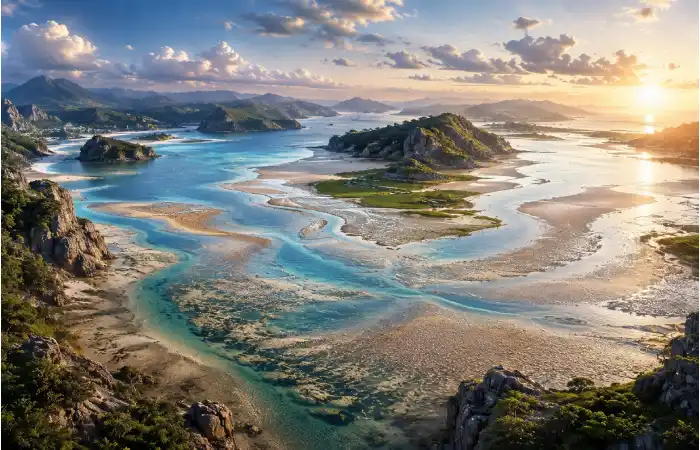
Vuraiyaasmaa Tidalharb is an unusual phrase with no clearly documented, universally accepted definition.
Current online references generally place it into one of three broad interpretations:
- A tidal or coastal environment
- A theoretical framework involving environmental and human influences
- A broader idea associated with adaptation, changing conditions, and natural cycles
In 2026, one of the articles defined it as ‘a shallow, intertidal coastal tidal basin characterized by alternating phases of inundation, strong currents, periods of sediment transport and exposure on foreshores, and mobile and non-mobile marine fauna.’
Another uses the phase metaphorically and describes it as ‘a type of understanding of emotion, psychology and environmental forces that is used to inform and to guide decisions.’
Given these disparate uses, it seems that the most secure definition available is:
Vuraiyaasmaa Tidalharb is a mysterious and developing term currently used online to encompass phenomena related to tidal regimes, dynamic environments, adjustment, and variation. The initial interpretation of the term and its authoritative source remain unknown.
That distinction matters. A term appearing on several websites does not automatically mean it is an officially recognized scientific concept.
Why Is Vuraiyaasmaa Tidalharb Difficult to Identify?
The biggest problem is that you can’t be sure where it came from.
Nobody agrees about whether someone is credited with the saying, or when or where it came from, or whether there is even such a thing now that has ownership within one discipline. Online searching brings up a range of interpretations.
One website even goes so far as to say Vuraiyaasmaa Tidalharb is a coastal phenomenon whilst other websites talk about it in terms of concept response to change.
This means anybody looking up the term needs to tread carefully.
They should not be told that it definitely relates to a certain name, famous harbor, widely accepted scientific theory, or technology.
Vuraiyaasmaa Tidalharb as a Tidal Concept
The most literal translation of the phrase can be found online in relation to tidal systems.
A tidal system, on the other hand is a portion of coastline that has a rhythmic water-level fluctuation that is directly affected by seawater’s motion, with the effect being on shorelines, sedimentation patterns, marine populations and navigation as well as human usage of space.
A coastal tidal system can experience:
- Rising and falling water levels
- Incoming and outgoing currents
- Sediment movement
- Exposed mudflats during low tide
- Changing marine habitats
- Periodic changes in navigation conditions
One online description of Vuraiyaasmaa Tidalharb specifically emphasizes strong tidal currents, exposed intertidal zones, sediment-rich areas, biodiversity, and seasonal fishing activity.
However, these characteristics describe tidal environments generally and should not automatically be interpreted as verified characteristics of a real location called Vuraiyaasmaa Tidalharb.
The Science Behind Tidal Systems
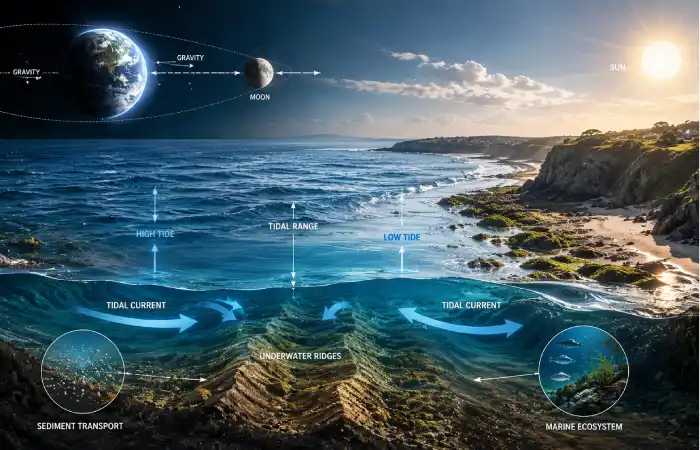
Understanding ordinary tidal science helps put the phrase into perspective.
Tides are primarily produced by gravitational interactions involving the Moon and the Sun and the Earth’s oceans. The shape of a coastline can then influence how those tidal movements appear locally.
A narrow inlet, estuary, bay, or harbor can behave differently from an open coastline.
For instance, when water moves into a confined coastal area, the shape and depth of the basin can influence:
- Water velocity
- Tidal range
- Sediment deposition
- Shoreline exposure
- Navigation conditions
- Habitat distribution
This is why tidal environments can look dramatically different within a single day.
At high tide, an area may look like a broad waterway. Several hours later, portions of the seabed may be visible.
Main Characteristics Associated With the Term
Because there is no standardized definition, the following characteristics should be regarded as interpretive rather than officially established facts.
| Aspect | Common interpretation |
| Core theme | Tidal and environmental change |
| Natural process | Movement of seawater |
| Water behavior | Rising, falling, incoming and outgoing flow |
| Ecological importance | Possible support for intertidal habitats |
| Human connection | Fishing, navigation and coastal activity |
| Environmental concern | Pollution, habitat degradation and climate change |
| Definition status | Unclear / not formally established |
This is one of those keywords where context matters more than a dictionary-style definition.
Vuraiyaasmaa Tidalharb and Coastal Ecosystems
If the phrase is being used to describe a tidal ecosystem, biodiversity becomes an important part of the discussion.
Intertidal environments can provide feeding and shelter areas for fish, shellfish, birds, microorganisms, and other organisms. Changes in water levels can expose different parts of the habitat at different times.
Sediment also plays an important role.
Mud, sand, organic material, and nutrients can be moved by tidal currents. This constant movement creates an environment that is never completely static.
That is one reason coastal ecosystems can be both productive and fragile.
Pollution, coastal construction, excessive fishing, habitat destruction, and climate-related changes can disturb the balance.
One online source discussing the phrase specifically connects such environments with pollution, habitat degradation, and climate change.
Vuraiyaasmaa Tidalharb as a Framework for Change
There is another interpretation that moves away from geography.
One article presents Vuraiyaasmaa Tidalharb as a practical idea centered on awareness followed by deliberate action. In that interpretation, “tidal” is almost metaphorical: conditions rise and fall, and people need to recognize those changes before responding.
This interpretation can be summarized as:
Observe → Understand → Decide → Act → Adjust
The basic idea is simple.
We act in response to changes in our environment; but before that, we need to take it in-we process what’s occurring; establish what counts; and make a decision about what we should do. This idea applies to countless practical contexts, although it’s not a standard “framework” in psychology itself.
Vuraiyaasmaa Tidalharb vs. Traditional Tidal Harbor
If you encounter the term in a coastal context, it helps to distinguish the unusual phrase from the general concept of a tidal harbor.
| Feature | Vuraiyaasmaa Tidalharb* | Conventional tidal harbor |
| Definition | Unclear / emerging usage | Established geographical concept |
| Water movement | Described as tidal | Tidal |
| Navigation | Potentially tide-dependent | Often tide-dependent |
| Ecosystem | Frequently emphasized online | Depends on location |
| Scientific recognition | Not clearly established | Well-established |
| Source consistency | Low | High |
*The first column reflects descriptions found online rather than an authoritative scientific classification.
The comparison makes one point clear: a conventional tidal harbor is a recognized geographical concept, while Vuraiyaasmaa Tidalharb is not currently supported by the same level of documentation.
Why People May Be Searching for the Term
Unusual keywords often become searchable because they appear in articles, social media posts, autogenerated pages, niche websites, or interconnected content networks.
That seems relevant here.
Several websites published articles using the exact phrase during 2026, but their definitions vary considerably.
This can create a strange situation: a phrase begins appearing online, and later readers assume it must already have a recognized meaning.
It is therefore useful to distinguish online usage from established terminology.
A search result is evidence that someone used a phrase. It is not, by itself, evidence that the phrase represents an accepted scientific discovery.
Possible Environmental Importance
If Vuraiyaasmaa Tidalharb is intended to refer to a tidal ecosystem, several environmental themes become relevant.
1. Biodiversity
Tidal habitats can support a variety of organisms because changing water levels create multiple ecological zones.
2. Nutrient Movement
Tidal currents can transport nutrients and organic material through coastal environments.
3. Sediment Transport
Water movement continuously shifts sand, mud, and other sediments.
4. Coastal Protection
Wetlands, tidal flats, marshes, and related coastal habitats can contribute to natural coastal resilience.
5. Human Livelihoods
Fishing, tourism, transport, and other activities can depend heavily on coastal conditions.
These are established characteristics of tidal and coastal environments, rather than proof of a unique Vuraiyaasmaa Tidalharb site.
Challenges Associated With Tidal Environments
A changing coastline brings both opportunities and difficulties.
Strong currents can make navigation complicated. Sediment can accumulate in channels. Storms can alter shorelines quickly. Pollution can damage habitats. Rising sea levels can create additional pressure on coastal communities.
Climate change adds another layer of uncertainty.
A coastal system that remained relatively stable for generations can experience new pressures when sea levels, storm intensity, temperature, or precipitation patterns change.
This is why coastal management increasingly focuses on resilience rather than simply trying to control nature.
Is Vuraiyaasmaa Tidalharb a Real Place?
There is currently not enough reliable evidence to confidently identify Vuraiyaasmaa Tidalharb as a formally recognized geographical location.
Some online pages describe it as though it were a specific coastal basin or harbor, but the available descriptions do not establish a clear location, official geographic record, coordinates, or authoritative institutional source.
So if you encounter a claim that Vuraiyaasmaa Tidalharb is a particular harbor, it is sensible to verify that claim against authoritative geographic or governmental records before treating it as factual.
Is Vuraiyaasmaa Tidalharb a Scientific Theory?
There is no accepted record found in the sources that claims that Vuraiyaasmaa Tidalharb is a theory.
Several websites mention terms related to tidal activity, energy, and how tidal activity and its characteristics affect ecology and the environment, using scientific terminology. Nevertheless, the topic to which Vuraiyaasmaa Tidalharb relates is true science, and theseencompassnsist of the physics of tides, hydrodynamics, marine biolocoastal and the coasts. But the terminology Vuraiyaasmaa Tidalharb does not really establish itself as standard within the sciences so far.
How to Research the Term Properly
If you want to investigate Vuraiyaasmaa Tidalharb further, start with reliable sources rather than relying exclusively on blogs.
A useful research process is:
- Search academic databases for the exact phrase.
- Check geographic databases if it is claimed to be a location.
- Look for government coastal or marine records.
- Search scientific publications for related terminology.
- Compare the earliest available references.
- Check whether different websites are simply repeating the same original claim.
This method helps separate genuine information from content that has been copied or rewritten across multiple websites.
Final Thoughts
Vuraiyaasmaa Tidalharb is a brilliant example of how you could potentially see this unknown phrase gain traction in online circles before the initial impetus for, meaning, or origin of Vuraiyaasmaa Tidalharb has had a chance to become clarified. As of writing, Vuraiyaasmaa Tidalharb would be relevant in topics such as: Tidal, coast, environment, ecological change and, in a couple of articles, adaptation, education and awareness. However, these should not be conflated with an already ascertained terminology.
Also Read: https://www.incmarketingplace.com

Creative marketing enthusiast sharing practical insights on digital growth, branding, and online strategies. Passionate about helping businesses succeed with simple, effective, and result-driven marketing solutions.