

profitable intraday trading advice 66unblockedgames com: Tips & Strategies
Last Updated: August 17, 2026
Day trading appears easy on the surface: Just get your hands on a stock going higher and higher, then unload it after the profits start piling up. The truth is that even after days of preparing for trading opportunities with risk mitigation and technical analysis, only true professionals can remain calm amid truly surprising market moves.
Some of the most frequently searched terms online, such as “profitable intraday trading advice 66unblockedgames.com“, indicate that individuals are eager to discover clear-cut methods for successful day trading. Let me set that straight – there’s no such single “secret formula”.
Even the SEBI cautions investors against believing everything they read online, following unsubstantiated tips, and so on. An even better route is to actually understand what intraday trading is about and develop a scalable strategy that is defined based on your risk tolerance.
What Is Intraday Trading?

Intraday trading involves the buying and selling of a security within a single trading session. Whereas an investor might hold an equity for months or years, an intraday trader typically seeks to profit from short-term price fluctuations. For example, an intraday trader might buy an equity once it clears a resistance level, only to sell it later that day upon a price increase.
Alternatively, a trader might initiate a short position on an equity when it breaks through a support level, and cover on the price decline it is expected to follow.
The trader does not simply have to predict whether the equity price will rise or fall. Instead, the trader must find a position to take when reward outweighs the money put at risk. This distinction is a critical one. A trader can be incorrect many times and still be profitable if their losses are disciplined.
One large losing position will destroy many winning trades.
Why Is Intraday Trading Difficult?
Markets react to everything- news, economic data, corporate news, institutional trades, liquidity, sentiment, and tens of thousands of individual decisions. Thus, the price can, and sometimes does, move counter to a trader’s views. Securities Market Material, from SEBI, states there are market risks, liquidity risks, volatility risks, and various other risks faced in the trading markets.
Intraday trading poses psychological challenges, especially.
Seeing your stock lose ground could make you exit at the wrong time, too early, and often the best time for the swing to complete. Conversely, an intraday spike could lure you into a stock just as most of the potential gain is exhausted. This is perhaps why discipline is a greater skill for success at trading than a multitude of indicators.
The Basic Principles of Profitable Intraday Trading
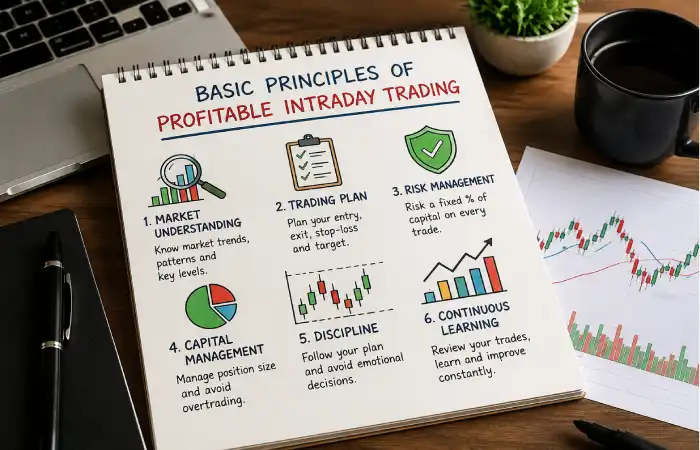
There is no single strategy that works in every market. However, several principles can make the trading process more structured.
1. Trade Liquid Instruments
Liquidity is how easy it is to buy and sell an asset at a price not too far from current values. The most liquid stocks are typically very liquid, and they have more buyers and sellers. It is often easier to get in and out of positions, and it may not affect the bid-ask spread that much.
For an investor new to this area, extremely thin stocks may not be as good to learn on as stocks traded heavily.
It is important not to pick a stock due to price action-big price moves on a poorly liquid stock result in some problematic exits and entries.
2. Have a Trading Plan Before Entering
A trading plan answers basic questions before money is placed at risk:
- What is the setup?
- Where will I enter?
- Where is the stop-loss?
- What is the expected target?
- How much can I lose?
- What will make me abandon the trade?
- What will I do if the market moves sideways?
Writing these decisions down reduces the temptation to invent a new plan after entering a position.
A simple plan is often better than a complicated one that cannot be followed consistently.
3. Understand Risk-Reward Ratio
Risk-to-reward ratio the ratio of how much an individual is willing to risk in a trade to the profit one might have. Consider this: if an individual risks £ 500 on a trade, with a potential profit of £ 1000. The ratio is 1:2.
It does not mean that the trade wins €1, 000 but it implies that the desired potential pay-off is twice the amount set out to risk.
Good risk-to-reward ratios can prolong the life of trading strategies even when some trades do fail, but it is not necessarily all that important to have a high ratio for a trade, as probability also plays a part in achieving the target.
Intraday Trading Strategies Beginners Can Understand
There are many approaches to the way traders operate; in general, the most effective one to employ can be clearly defined, testable, and adhered to without having to rely on your own emotional input.
Breakout Trading
Many different ways of approaching how traders operate exist; for the general case, the best way to approach it can be easily defined, tested, and followed without the need for your own input from emotional feelings.
Momentum Trading
Momentum trading focuses on assets showing strong directional movement.
A momentum trader may look for:
- Strong price movement
- Increased trading volume
- A clear market trend
- News or events affecting sentiment
- Continuation after a temporary pullback
Momentum can disappear quickly, however. Entering after an extended move without a defined exit plan can expose a trader to a sharp reversal.
Pullback Trading
A Pullback- is when the prevailing trend pauses for an interruption. Suppose you’re trying to trade a stock that’s going higher in a predictable trend. Buy: following the stock goes on a run, you may look to wait for the stock to dip on a pullback into prior price support before placing a position. You’re looking to buy the trend.
Support and Resistance Trading
Support is a price area where buying interest has historically helped prevent or slow a decline.
Resistance is an area where selling pressure has historically limited an upward movement.
These are not magical price barriers. They are zones where market participants have previously reacted.
Understanding these areas can help traders determine where a trade idea might become invalid.
Comparison Table: Common Intraday Approaches
| Trading approach | Main idea | Suitable market condition | Main risk |
| Breakout | Trade a move beyond support or resistance | Strong directional movement | False breakout |
| Momentum | Follow strong price movement | High-volume trending market | Sudden reversal |
| Pullback | Enter after temporary retracement | Established trend | Trend may fail |
| Scalping | Capture very small price movements | Highly liquid, active market | High transaction frequency |
| Support/Resistance | Trade reactions around key levels | Range-bound or structured markets | Levels can break unexpectedly |
No strategy in this table guarantees profit. A strategy should be evaluated through historical testing, paper trading, and controlled real-world execution.
Risk Management: The Part Traders Should Take Seriously
If there is one section that deserves more attention than another indicator, it is risk management.
Risk management means deciding in advance how much money can be lost if a trade does not work.
A trader might establish a maximum loss per trade and a separate maximum loss for the entire day. Once that limit is reached, trading stops.
This prevents a bad morning from turning into a disastrous afternoon.
Position Sizing
Position sizing determines how many shares or contracts a trader should take.
A simple conceptual formula is:
Position Size = Maximum Acceptable Trade Risk ÷ Risk Per Unit
For example, suppose a trader is willing to risk ₹1,000 and the distance between the entry and stop-loss represents ₹20 per share.
The theoretical position size would be:
₹1,000 ÷ ₹20 = 50 shares
Actual position sizing should also account for brokerage, taxes, slippage, liquidity, leverage, and the rules of the trading product.
Stop-Loss
A stop-loss is an instruction or predefined exit point intended to limit a losing position.
It should not be placed randomly simply because a certain percentage sounds attractive. The stop should make sense in relation to the trading setup.
Most importantly, moving a stop farther away simply because the trade is losing changes the original risk calculation.
Avoid the Leverage Trap
Leverage allows traders to control a position larger than the cash they have immediately available.
It can increase purchasing power, but it also magnifies the consequences of adverse price movements.
This is one reason beginners should be particularly careful with leveraged products.
Recent Indian data also illustrates why caution matters. Government data reported in August 2026 showed that retail investors continued to incur substantial losses in equity derivatives, despite losses declining year over year.
More capital exposure does not automatically create more skill.
The Psychology of Intraday Trading
Trading psychology is sometimes overlooked because charts appear more technical and impressive. Yet emotions can quietly destroy an otherwise reasonable strategy.
Fear
Fear may cause a trader to close a profitable position too quickly or avoid a valid setup after experiencing several losses.
Greed
Greed can encourage traders to increase position size after a winning streak or remain in a trade because they want an even larger profit.
Revenge Trading
Revenge trading occurs when a trader attempts to recover a previous loss through impulsive new trades.
This is especially dangerous because the trader is no longer following the original strategy.
Use a losing trade as information, not an offense that must be answered right away.
What Should You Do Before the Market Opens?
Preparation can make the trading session much calmer.
Before trading begins, consider reviewing:
- The broader market trend.
- Important economic or corporate announcements.
- Stocks showing unusual volume.
- Major support and resistance levels.
- Potential entry and exit areas.
- Your maximum daily risk.
- The setups you are actually prepared to trade.
You do not need a watchlist containing dozens of stocks.
Following a smaller number of familiar instruments can make it easier to understand their normal price behaviour.
Common Intraday Trading Mistakes
Many beginners make similar mistakes.
Trading Without a Stop
A small losing trade can become a large loss when the trader refuses to accept that the original idea was wrong.
Overtrading
More trades do not automatically mean more opportunities.
Sometimes the best trading decision is to do nothing.
Chasing the Market
If a stock has already made a dramatic move, entering simply because you are afraid of missing out can produce poor risk-reward conditions.
Following Random Tips
Social media, chatting groups, influencers and blogs may contain valuable knowledge but these unconfirmed tips must not be regarded as assured calls by traders. SEBI advises investors to not act on unsolicited advice but rather reflect upon their goals and risk tolerance.
Ignoring Trading Costs
A strategy that seems profitable at a high level but could be much different at the back-end after accounting for brokerage fees, taxes, exchanges’ charges, spreads and slippage.
How to Improve as an Intraday Trader
Improving at trading is a lifetime endeavour and definitely not a one-week program. Begin with a single or two well-defined trading methods. Follow past charts and write what occurred whenever those setups appeared.
Then use paper trading or another simulated environment to practice execution without immediately risking significant capital.
A trading journal can be especially useful. Record:
- Date and time
- Instrument
- Entry price
- Exit price
- Stop-loss
- Target
- Reason for entry
- Reason for exit
- Result
- Emotional state
- What could have been done better
After several weeks, patterns begin to appear.
You may discover that your best trades occur during particular market conditions, while certain setups repeatedly produce losses.
That information is far more valuable than simply counting winning trades.
A Simple Intraday Trading Framework
| Stage | What to do |
| Preparation | Study market conditions and create a watchlist |
| Setup | Wait for a clearly defined trading pattern |
| Entry | Enter only when predetermined conditions are met |
| Protection | Set an appropriate stop-loss |
| Target | Define a realistic profit objective |
| Management | Avoid emotional changes to the plan |
| Review | Record and analyze the trade afterward |
The framework is intentionally simple. Complexity is not the same thing as effectiveness.
Final Thoughts
The biggest lesson behind profitable intraday trading advice at 66unblockedgames.com is that successful trading should not be treated like a shortcut to easy money. Intraday trading is a high-risk activity that requires knowledge, preparation, discipline, and realistic expectations.
There will be winning trades. There will also be losing trades. The goal is not to eliminate losses completely. That is impossible. The goal is to control losses, identify repeatable opportunities, and make decisions based on a clearly defined process.

Creative marketing enthusiast sharing practical insights on digital growth, branding, and online strategies. Passionate about helping businesses succeed with simple, effective, and result-driven marketing solutions.