
Social Media Marketing Consulting: Grow Your Brand in 2026

Last Updated: September 18, 2026
You’re Posting. Nothing’s Happening. That’s a Strategy Problem, Not a Content Problem.
I’ve had this conversation more times than I can count.
A business owner told me they‘re posting three, four, five times a week. Good graphics. Decent captions. Hashtags researched. And after six months? A few hundred followers, a handful of likes on each post, and zero leads that are actually attributable to social media.
They want to know what they’re doing wrong. Usually the answer isn’t the content. The content is fine. What’s missing is everything that should come before the content — the audience clarity, the platform rationale, the actual plan. Without that foundation, all the posting in the world is just noise.
That’s what social media marketing consulting exists to solve. Not to post for you. To figure out why your posting isn’t working — and build something that does.
What comes next is an honest description of how consulting works, which specializations really are worth it, what it‘s costing in the US today, and how to determine if you even need it at all.
What Consulting Actually Is (And Why It’s Not the Same as Management)

This distinction always causes people trouble, so put that one aside at first.
Management is anyone doing the work writing posts, scheduling posts, responding to comments, generating that monthly report. It keeps your channels alive. It’s necessary. But it’s operational, not strategic.
Consulting is the layer of think on top of all that. It is the layer where someone settles down and really think about whom we are communicating with, on which channels, using what type of contents, and for which objectives? Without that layer, management is just motion without direction.
A lot of businesses hire a social media manager before they’ve ever answered those questions. Then they wonder why six months of consistent posting hasn’t moved anything. The problem isn’t the manager. It’s that they were given a car and no destination.
What a consultant actually does week to week
It varies by phase. Early on, it’s heavy on discovery and analysis — auditing what you’ve done, studying your competitors, mapping where your actual buyers spend time. Then it shifts to strategy-building: a written plan with real goals, platform priorities, content direction, and success metrics that mean something.
After that, depending on the engagement, they’re either guiding your team through execution or running it themselves. Either way, they’re checking the data regularly and adjusting based on what it shows — not waiting until the quarterly review to notice something isn’t working.
Costs in the US currently run from roughly $500 to $5,000 per month, depending on seniority and scope. Senior consultants and specialists — particularly those with a strong paid social or LinkedIn background — often charge $150 to $250 an hour, sometimes above that.
The Social Media Strategist: The Person You Probably Should Have Hired First

Here’s a pattern I’ve seen play out over and over. Business decides to get serious about social. They hire someone to create content and manage the channels. Content goes out. Three months later, nothing has changed. They assume the person isn’t good enough and look for someone else.
But swap out one content creator for another, and you’ll get the same result. Because the problem was never the content. It was that nobody built the strategy first.
A social media strategist is the person who should come before the content creator. Their whole job is to answer the questions that make content worth creating: Who are we genuinely trying to reach? What do they care about? Which platforms are they actually on? What does the content need to do — educate, convert, build trust, something else?
Once those questions have real answers, creating content becomes dramatically easier. And it actually works.
What you get at the end of a strategy engagement
Not a vague deck of observations. A usable document: written audience personas based on actual research, a platform selection with clear reasoning behind each choice, a content pillar framework that gives whoever’s creating content a structure to work inside, and KPIs connected to business outcomes rather than impressions.
And — this is the part most businesses don’t expect — a list of things to stop doing. Platforms to deprioritize. Content formats that aren’t pulling their weight. Assumptions that don’t hold up when you look at the data.
One example worth sharing
A B2B software company came in after two years of steady Instagram effort. Solid content, respectable engagement rate, almost no pipeline influence. The strategist pulled the data on where their buyers — IT directors and operations managers at mid-sized companies — actually spent their time online. LinkedIn. Overwhelmingly LinkedIn. Instagram barely registered. They shifted the focus. Ninety days later, inbound lead volume had doubled. The content team was the same. The budget was the same. The only thing that changed was the platform.
Instagram Marketing Consultant: For When the Platform Is Core to How You Grow

Instagram still works. But not for everyone, and not the way it did a few years ago.
The algorithm has moved hard towards video Reels especially and discovery mechanics have been altered dramatically. Hashtags are less relevant than before. Keyword optimization in captions and alt text matters more. Instagram has also expanded its search and discovery capabilities, with Instagram’s official creator guidance emphasizing searchable content, relevance, and audience engagement signals as important factors for visibility. The ‘quality of engagement’ became more of a signal than ‘quantity of engagement’. Too many businesses still run a 2021 playbook and get 2021 results and in 2026 terms, that really just doesn‘t add up.
An Instagram marketing consultant knows the current platform. Not the general idea of it — the actual current mechanics, what’s being rewarded, what’s being suppressed, and what’s working in specific niches right now.
The specifics they focus on
- Working out the right content format mix for your audience — the ratio of Reels to carousels to static to Stories isn’t the same for every brand
- Profile positioning — treating your profile as a conversion page, not just a portfolio
- Keyword and discovery strategy that reflects how Instagram’s search actually works in 2026
- Ad setup and management for brands ready to back organic content with paid amplification
- Community-building through Stories, broadcast channels, and collaboration — the parts that drive retention, not just reach
If Instagram truly is the place that customers really find you, a dedicated professional who lives on the platform is worth many times more than a generalist having a conversation in five channels at the same time. The depth of platform knowledge is just different.
LinkedIn Marketing Expert: The B2B Channel That Most Companies Are Getting Wrong
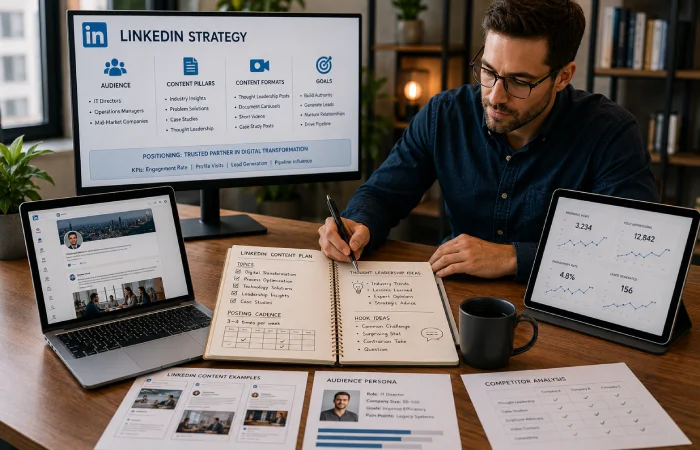
LinkedIn is the most underused high-value platform in B2B right now. Not because businesses aren’t on it — most are. Because most of them are using it like a company bulletin board and wondering why nobody’s engaging.
Job announcements. Award posts. Generic industry statistics. The occasional blog share. None of it creates the kind of connection that makes decision-makers want to reach out.
What actually works on LinkedIn is harder to produce and easier to ignore: genuine expert opinion, specific and useful insights, professional storytelling that makes the reader feel like they learned something or saw something from a new angle. And here’s the part that surprises most companies — that content almost always performs better when it comes from individual executives than from the company page. People connect with people. They follow companies out of obligation. That observation aligns with LinkedIn’s own B2B Institute research, which consistently shows that trust, expertise, and personal credibility play a major role in influencing professional buying decisions.
What a LinkedIn expert builds for you
- An executive content program — turning your leadership team into visible, credible voices in the industry
- A company page strategy that builds an audience actually worth having
- LinkedIn Ads campaigns targeting decision-makers by title, seniority, company size, and industry
- Newsletter and document post strategies for consistent organic reach
- Employee advocacy — getting your team sharing content in a way that feels natural, not forced
LinkedIn specialists sit at the higher end of the consulting rate range, and for good reason. The sales cycles they’re influencing are longer, the deal sizes are usually bigger, and the strategy is more nuanced than most social channels. Agencies in major US cities typically charge $60 to $190 per hour for social strategy. LinkedIn specialists with a real B2B track record usually land at the top of that or above it.
That’s real money. It’s also cheap compared to a pipeline that’s been stalling for a year because nobody’s building authority where the buyers are.
Social Media Growth Strategy: What Separates Businesses That Scale From Ones That Stall

There’s a version of “having a social media strategy” that’s really just having a content calendar. And it’s not the same thing.
A content calendar tells you what to post and when. A growth strategy tells you why you’re posting it, who it’s for, what it’s supposed to do for them, and how you’ll know if it’s working. One is a scheduling tool. The other is a business system.
The businesses that build real momentum on social — actual follower growth, actual engagement, actual revenue influence — almost all have that second thing. They know exactly what each content pillar is supposed to accomplish. They know which formats are working and why. They know when to push harder on something and when to cut it.
| What the system includes | Why it matters |
| Defined content pillars | Gives your audience something consistent to expect and return for — randomness kills retention |
| A non-negotiable posting cadence | Algorithms deprioritize inconsistent accounts — regularity is a ranking signal, not just a discipline thing |
| Engagement protocols | Responding to comments and DMs signals the algorithm and builds actual community — silence kills both |
| Cross-platform distribution | Most content can be repurposed across formats; not doing this means leaving reach on the table |
| Monthly data reviews | Growth without measurement is just hope — reviews turn guesses into decisions |
What good consulting fixes
Usually it’s not one big thing. It’s five or six small things that compound. No CTA on posts. Comments sitting unanswered for days. Video being avoided because it’s uncomfortable to produce. Every platform getting the same content copy-pasted across it. Follower count being optimized for when engaged audience quality is what actually drives reach.
Fix those together and the results look dramatic. But it’s not magic — it’s just what happens when you stop leaving obvious performance on the table.
Read More: digital marketing consulting
Social Media Management Services: The Execution Layer That Keeps Everything Moving

Strategy without execution is a document that sits in a folder. Management is what turns it into something that actually runs.
Day to day, social media management is unglamorous work. Writing copy that sounds like the brand but isn’t boring. Building graphics. Scheduling at the right times. Responding to the comment that came in at 11pm. Pulling the numbers at the end of the month and writing something honest about what they mean.
It’s not complicated. But it’s relentless, and most business owners who try to do it themselves eventually realize it’s eating time they don’t have — or it quietly falls apart under pressure.
Current pricing in the US market
| Tier | Monthly Range | What’s Included |
| Basic | $750 – $1,500 | 1–2 platforms, 3–5 posts per week, monthly report |
| Standard | $1,500 – $3,000 | 2–3 platforms, daily community management, bi-weekly reporting |
| Premium | $3,000 – $7,000+ | 3–5 platforms, paid ad management, analytics, regular strategy calls |
One thing I’d suggest thinking through before signing anything: do you need strategy first, or are you ready to go straight into managed execution? A lot of businesses skip the strategy phase to move faster. It almost always costs more in the long run — because you end up managing an active social presence that isn’t pointed at anything useful.
A focused consulting engagement to get the plan right takes four to six weeks. Every month of managed services after that runs more effectively because of it.
Do You Actually Need This Right Now? Be Honest.
Not every business needs a consultant at the same point. Some are genuinely ready to go straight to managed services. Some need the strategy layer first. Some have the strategy and just need someone to execute it. And some — though this is rarer than people admit — aren’t ready for any of it yet because the business itself needs to be clearer first.
Here’s a rough map:
| Your current situation | Where to start |
| No real strategy exists | Consulting engagement before anything else |
| Strategy exists, execution is the gap | Managed services with the existing plan |
| Want to run it internally with guidance | Consulting for training and a structured handoff |
| One platform needs depth you don’t have | Platform specialist — Instagram, LinkedIn, TikTok |
| Want the whole thing off your plate | Full-service agency |
Honest signals that consulting is overdue
- Three-plus months of regular posting with flat or declining follower counts
- Engagement that looks okay on paper but produces zero actual leads or sales
- No real clarity on which platform matters most for your specific buyers
- Competitors consistently showing up in feeds where you’re invisible
- A social media manager asking you for strategic direction you don’t have to give
One of those? Worth a conversation with a consultant. Three or more? Stop delaying.
Here’s What This Actually Comes Down To
Every business I’ve seen get real, consistent results from social media has had the same thing underneath it: a proper social media marketing strategy that was built before the content machine started running. Not after. Before.
The ones that struggle — and there are a lot of them — usually skipped that part. They went straight to posting because posting is visible and strategy is invisible. And six months later they’re frustrated and wondering if social media even works.
It works. It just doesn’t work without the thinking behind it.
The cluster articles linked throughout this guide go deeper into every specialization — the strategist role, Instagram consulting, LinkedIn, growth systems, management services. Start with whichever one matches where your biggest gap is. Build the strategy. Then build the content. That order matters more than most people realize.
Questions People Actually Ask
What does a social media marketing consultant do that a manager doesn’t?
The manager gets things done. The consultant thinks. Any manager without a consultant is similar to a Builder without an Architect they may be quick and care about what they do but you‘ll never quite get what you want. The consultant‘s job is to make sure you know what you want before you grab the tool.
What’s the realistic cost range for consulting in the US right now?
Freelancers doing general strategy work typically run $35 to $150 an hour. Platform specialists and senior strategists are usually $100 to $250, sometimes beyond that for people with a very specific and proven track record. Monthly retainer fees could be as little as $500 for initial strategic guidance to $10,000 and higher (when consulting and full management is included in the offer).
How long before any of this actually shows results?
Time is required for organic growth and even then, it takes realistically 3 to 6 months for consistent movement. Paid social can generate results in weeks if the targeting and creative is well optimized. Anyone claiming large results in organic within 30 days is either overreaching or has an extraordinary situation. The consultant’s job in the short term is to stop the bleeding and build the foundation. The growth comes after that.
Is LinkedIn really worth the investment for B2B?
Yes. Consistently. It’s the only social platform where you can reliably reach decision-makers by job title, seniority, company, and industry in a context where they’re actively thinking about their professional world. The organic reach on personal content from executives is also genuinely good right now — better than almost any other platform for B2B purposes. The problem is the content has to be actually worth reading, which is a lot more effort than most companies are willing to give.
Should I hire a consultant before or after hiring a social media manager?
Before, ideally. The strategy your consultant produces becomes the brief your manager works from. If you hire a manager first, you’ll spend months either developing strategy on the fly — which is inefficient — or just posting without one, which is a waste. Get the plan, then hire the executor.
What’s the difference between hiring a consultant and hiring an agency?
A consultant typically delivers strategy and guidance — the thinking — and you implement. An agency delivers both thinking and execution under one roof, usually at a higher cost but with less management overhead on your end. Neither is universally better. It depends on whether you have someone internally who can own the execution, and whether you want a single vendor handling everything.

I’m Thomas — Editor & Admin of incmarketingplace, Blogger, and Senior SEO Analyst. writer at Inc Marketing Place, sharing insights on SEO, branding, content marketing, and online business growth. I focuses on creating practical and easy-to-understand content for marketers, entrepreneurs, and growing businesses