
AI Digital Marketing: Tools, Trends & Strategies (2026)

Last Updated: September 18, 2026
I’ve been in digital marketing long enough to have lived through ‘content is king,’ the pivot to video, the death of organic reach, and now — apparently — the AI revolution that’s going to make human marketers obsolete by Q3. Every few years the industry finds a new thing to collectively panic about.
Here’s my honest take after spending the last 18 months actually testing AI tools across real campaigns: some of this stuff is genuinely game-changing, some of it is marginally useful, and a lot of it is just old features with a new label slapped on.
This guide covers the five areas where AI digital marketing is making a real difference right now. Not theoretical. Not ‘in the future.’ Right now, with tools you can sign up for today. Each section gives you a working understanding plus a link to a deeper guide when you’re ready.
AI Marketing Tools — Just Pick One and Actually Use It
Walk into any marketing team in 2026 and you’ll find the same thing: a Notion doc called ‘AI tools to explore’ with 23 items in it, six free trial subscriptions that nobody renewed, and everyone still doing half their work manually because nobody committed to learning anything properly.
The tool problem in AI marketing isn’t access. It’s focus. So before I give you a break down, here‘s the most useful piece of advice I can give you: pick one scale, stick with it for 30 days and track what it feels like. That’ll do more for you than reading 14 comparison articles.
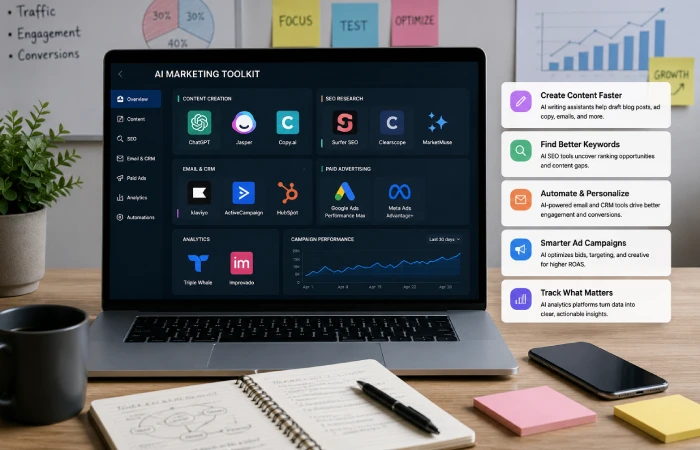
That said, here’s how the landscape actually breaks down:
- Writing and content: ChatGPT, Jasper, Copy.ai. Good for drafting, rescripting, email sequences, ad copying. Not for hitting publish directly — for getting from blank page to something workable, fast.
- SEO research: Surfer SEO, Clearscope, MarketMuse. These have gotten legitimately good at finding gaps competitors missed. If you‘re doing content writing without any of the above, then you‘re probably leaving some simple keyword opportunities on the table.
- Email & CRM: Klaviyo ai, ActiveCampaign, and HubSpot Most have access to these ai features and aren‘t using. Predictive send time, behavioral triggers, smart segmentation — worth 20 minutes to turn on.
- Paid ads: Google Performance Max and Meta Advantage+ are running their own AI optimization with your budget whether you like it or not. Better to understand the levers than be surprised by the outputs.
- Analytics: Triple Whale if you’re e-commerce, Improvado if multi-channel attribution is keeping you up at night.
Interesting data point from HubSpot’s 2026 State of Marketing report: the most popular AI tools among marketers are visual ones — smart image editors at 45%, video generators at 44%, AI video editing at 42%. More people are using AI for social graphics than for strategy. We don‘t exactly know what to do with this info. seems relevant.
ChatGPT for Marketing — You’re Probably Using 15% of What It Can Do
44% of content marketers say ChatGPT is their primary AI tool, according to Ahrefs. And when I actually ask those marketers how they use it, most say ‘writing blog posts’ and then sort of trail off. Which is fine, but it’s a bit like having a band saw and using it exclusively to cut butter.
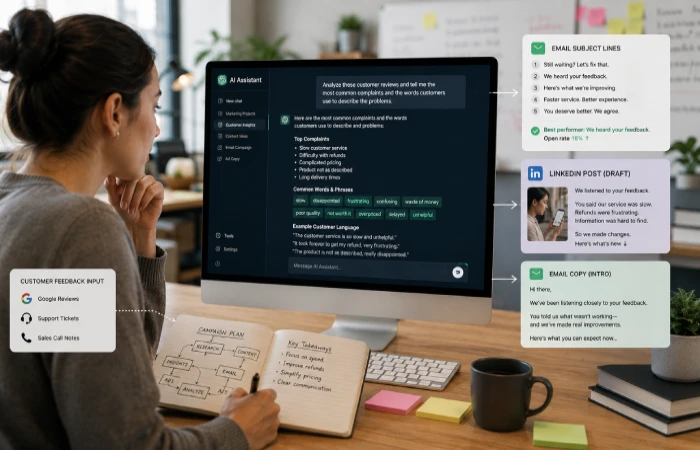
The real time saving use cases what I‘ve seen actually make a measurable difference with in the teams I‘ve worked with are:
- Customer language mining: Pate in 40 or 50 Google reviews, support tickets, or sales call notes and ask it to identify the most common complaints and the words users used to communicate them. That language goes straight into your copy. Conversion rates actually respond to this in a way that’s hard to explain but easy to test.
- Subject line volume: Write eight to ten email subject line variations, A/B test, feed results back. One brand I worked with specifically used ChatGPT just for subject line testing — not blog posts, not landing pages, just subject lines — and hit 18% better open rates over three months. Not because the AI wrote brilliant lines. Because they were finally testing enough volume to find what worked.
- Content repurposing: A 1500-word blog article is turned into a LinkedIn carousel, a tweet thread, and an email introduction in roughly 15 minutes using decent prompts.The research is already done. You’re reformatting. This is personally where I reclaim the most hours in a week.
- First-draft briefs and SOPs: Ask it to turn your messy campaign notes into a structured brief. Ask it to document a process your team keeps reinventing. Unsexy use case. Real time savings.
What it won’t do well, and I want to be clear about this because most AI marketing content skips past it: ChatGPT doesn’t know your customers. It doesn’t know what bombed last quarter. It has no genuine expertise in your specific niche. The second you publish something unedited that a real subject matter expert would clock as shallow, you’ve damaged credibility that takes months to rebuild. Use it as a starting point, not an endpoint.
AI Content Marketing — The Brands Winning Are Publishing Less, Not More
There was a period — late 2023 through most of 2024 — where a certain type of marketing agency was selling ‘AI content at scale’ as the path to SEO domination. Publish 40 articles a month. Cover every keyword variant. Watch traffic compound. Some of those sites are very quietly in the middle of a content cleanup right now after Google’s March 2026 core update.
The approach that’s actually holding up looks nothing like that. Here’s what I see working:
- Use AI for research, not writing. Finding keyword gaps your competitors missed, mapping content clusters, identifying questions nobody’s answering well — this is where AI tools genuinely outperform manual research. Hours of work in minutes.
- Generate an outline, then immediately deviate from it. The AI outline gives you a scaffold based on what’s already ranking. Your job is to add the angle, the case study, the opinion, the data point nobody else has. That’s what makes a piece rankable and shareable.
- Write or heavily edit the actual content. Not optional. Google E-E-A-T system Experience (in depth knowledge), Expertise, Authoritativeness, Trustworthiness rewards real knowledge. Google’s own guidance on creating helpful, people-first content reinforces this approach, emphasizing experience, expertise, authoritativeness, and trustworthiness over content production methods alone (Google Search Central’s guidance on helpful content). You can’t manufacture that with a language model. A human editor who actually knows the topic can.
- Run through Surfer or Clearscope before publishing. On-page optimization takes 15 minutes and makes a real difference.
- Repurpose the finished piece into shorter formats. Don’t let a well-researched article live exclusively on your blog.
Real example that stuck with me: a SaaS company I got to see the numbers on cut their content output from 20 posts a month down to 8. They added genuine customer data to each piece. Had their product team review for accuracy. Organic traffic went up 34% in six months. Less content. More authority. That’s the actual playbook right now.
Worth noting : According to Adobe‘s 2026 data, among brands 75% are currently using generative AI as part of their content strategy. What that number doesn’t tell you is how many of them are doing it well versus just doing it. There’s an enormous gap between those two categories.
Also Read : digital marketing consulting
Marketing Automation — Boring Name, Best ROI

Nobody’s going viral about their abandoned cart sequence. No one’s posting a LinkedIn thought piece about behavioral trigger logic. Automation is genuinely the least exciting area of AI marketing to talk about and probably the one with the clearest, most consistent returns.
Gartner says 80% of marketing processes are already automated or AI-augmented at some level. If yours aren’t, you’re spending human time on things a properly configured tool would handle better and keep running 24 hours a day.
Where to actually start, in rough order of impact and ease of setup:
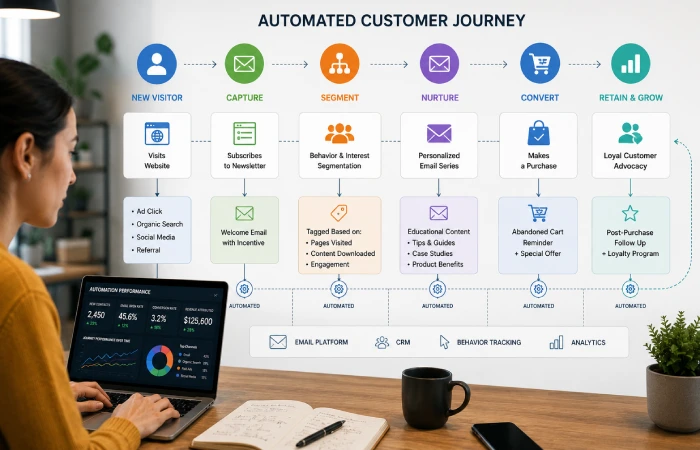
- Welcome and onboarding sequences. If someone signs up for your list or creates an account and gets one generic email, you’re leaving a significant amount of money on the table. A three to five email sequence based on what they signed up for, with branches based on open and click behavior, takes about a day to build and runs forever.
- Abandoned cart or lead follow-up. Someone showed buying intent and didn’t finish. That’s your warmest possible audience. Automated follow-up within one to two hours — done well, personalized to what they looked at — consistently outperforms anything manual.
- Re-engagement. A chunk of your email list hasn’t opened anything in 90 days. An AI tool identifies them. An automated sequence tries to win them back or removes them cleanly. Either outcome beats letting dead weight drag down deliverability.
| Channel | What AI Actually Automates | Where to Start |
| Behavioral sequences, predictive send time, smart segmentation | Klaviyo or ActiveCampaign | |
| Social | Scheduling, performance alerts, comment monitoring | Buffer AI or Sprout Social |
| Paid Ads | Bid optimization, creative rotation, budget pacing | Google Performance Max |
| Lead Nurture | Scoring, CRM updates, sales handoff triggers | HubSpot or Salesforce Einstein |
| Reporting | Weekly dashboards, anomaly detection, attribution | Improvado or Triple Whale |
The $444 return per $1 spent on automation figure that gets quoted everywhere — I believe the directional point even if the exact number is from commissioned research. What I’d add is this: automation multiplies whatever you put into it. Clean data and a clear customer journey? Automation makes it better. Messy CRM and overlapping audiences? Automation makes that worse faster. Spend two hours cleaning your list before you touch any automation setup. You’ll thank yourself later.
The Bigger Picture — What AI Is Actually Doing to Marketing

Most coverage of AI in marketing is tool coverage. Here‘s this app, here‘s that feature, here‘s how to save three hours a week on captions. Useful as all hell, but misses the track structure of what‘s really happening.
The real shift is about time compression. Marketing feedback loops used to take months. Run a campaign in January, analyze in February, adjust in March. AI has collapsed that to days or hours in some cases. That’s not a marginal improvement — it changes how fast you can learn, test, and iterate. Teams that understand this are running experiments their competitors can’t keep pace with.
Search behavior is changing in ways that SEO strategies haven’t fully caught up to yet. Traditional organic search volume is projected down 25% by end of 2026. Not because people search less, but because AI tools — Google’s AI Overviews, ChatGPT Search, Perplexity — are answering more queries without sending clicks anywhere. The goal isn’t just ranking anymore. It’s being the source AI tools cite when someone asks a question in your space. Different content strategy entirely. More specific, more structured, built around demonstrating genuine expertise rather than keyword density.
This shift is closely tied to the rise of AI-powered search experiences, including Google’s AI search experiences, which increasingly generate direct answers and summaries from authoritative sources rather than relying solely on traditional search result clicks.
Personalization has crossed a threshold. Adobe’s numbers put it at 75% of consumers being more likely to buy from brands that personalize the experience, and 67% now expect it. You physically cannot deliver that at scale with manual segmentation and one-size-fits-all campaigns. This is where AI stops being a nice-to-have.
And the human-AI balance question — I’ll give you a direct answer since most articles won’t. The brands struggling right now are almost always in one of two camps: ignored AI and are falling behind, or handed everything to AI and are drowning in mediocre output they have to fix. The ones doing well figured out what AI handles and what humans handle. Speed, volume, pattern recognition — AI. Strategy, voice, expertise, judgment calls, relationships — human. That division isn’t complicated. It takes discipline to maintain it.
Real number to hold onto : Salesforce conducted a survey of close to 4,500 global marketers for their 2026 State of Marketing. 75% now use at least one form of AI. The gap between using AI and using it well is where most of the competitive opportunity lives right now.
Is This Worth It for Smaller Businesses?
Short version: yes. Longer version: not in the way the LinkedIn thought leaders make it sound.
The elaborate tech stacks and dedicated AI teams and enterprise contracts you see covered in marketing publications — that’s not where most small businesses should be looking. Most of the accessible ROI for lean teams is in free or sub-$50/month tools used consistently.
Realistic starting stack:
- ChatGPT — free or $20/month. Content drafts, subject line testing, customer review analysis, repurposing. You can get a meaningful week’s worth of value out of this in your first afternoon.
- Canva AI — free tier is legitimately good now. Social graphics, ad creatives, quick design iteration. Saves real hours.
- Klaviyo or Mailchimp — $20 to $45/month. Most people are already paying for these. The AI features inside them — predictive segmentation, smart send times — are worth turning on this week.
- Google Performance Max — set your budget, set your goals, let the algorithm handle targeting. Worth testing against manual campaigns.
- HubSpot free CRM – lead capturing, limited automation, some AI-driven email capabilities. The free level is actually very useful in itself, not just a trial hook.
Total: under $100/month. The limiting factor isn’t budget. It’s picking something and being consistent enough to see the results, which requires more discipline than most teams expect going in.
FAQs
Q: What actually is AI digital marketing?
Utilising more automated, ‘AI enabled’ technology to make campaigns more effective writing content more quickly, automating boring jobs, targeting audience more precisely, getting real time insights to find out what’s working and what’s not. The specific tools vary. The goal is always the same: better results without proportionally more work.
Q: Where should a beginner start?
ChatGPT for content (free or $20/month), Your current email platform‘s suggested AI features (most have them now), and Google Performance Max if you advertise paid search. These three cover the most high-ROI things, and cost me almost nothing to start.
Q: Will AI replace marketing jobs?
Some of them, probably. Specifically the ones that were always repetitive and didn’t require much judgment — bulk content production, manual A/B test management, basic reporting. Jobs that need some strategic thinking, creative direction, real professional experience or client interaction isn‘t going anywhere. Realistically for most marketers, AI will do the boring stuff and you do the stuff that counts.
Q: How do marketers actually use ChatGPT day to day?
Most often: Copywriting / editing (most frequently), generating test variations of email subject lines, harvesting/repurposing long copy into shorter variations, using customer reviews to copy language, producing first draft briefs and SOPs. Less often, but successfully: Competitive research summaries, FAQ-creation from support tickets, ad copy test variations.
Q: What’s GEO and why does it keep coming up?
Generative Engine Optimization getting your content to be cited by AI search engines such as ChatGPT, Google‘s AI Overviews and Perplexity, not ranked in your typical search. As AI-driven searchstrieschely answer more and more questions without revenue coming from clicks, this, being cited in those answers, is seriously more valuable than a position-two Google organics ranking.
Q: What does AI marketing actually cost for a small business?
Less than most people assume. ChatGPT is free or $20/month. Most email platforms with AI features start around $20 to $45/month. Google and Meta’s AI ad tools run on whatever budget you set. A working AI-enabled marketing set of a small team should be less than $100/month. The larger expense is time.
Q: Does Google penalize AI content?
Google penalizes unhelpful content. This is one of the places where they haven‘t been able to waver much – quality of the content, not necessarily the content creation. Edits, well-crafted and actionable AI-generated content would suffice. Poorly produced, mass-generated, “thin content”, without true value will be eliminated. The production method matters far less than what ends up on the page.
The Bottom Line
AI digital marketing is real. The tools work. The ROI is there — especially in automation, content research, and campaign testing — when you use them with a clear goal and some patience.
What it isn’t: a magic fix, a replacement for a coherent strategy, or something you need a massive budget to access. The businesses I’ve seen actually move the needle with AI did a few things right. They identified specific problems first, then found tools to solve them. They measured changes. They kept humans in the loop for anything requiring genuine expertise. And they didn’t chase every new tool that came out — they went deep on a few things rather than shallow on everything.
That’s a boring formula. It’s also the one that works.
This page links out to five deeper guides — one for each major topic covered above. Start wherever your biggest current headache is. You don’t have to do everything at once. Nobody does.
One thing well. Then the next thing.

I’m Thomas — Editor & Admin of incmarketingplace, Blogger, and Senior SEO Analyst. writer at Inc Marketing Place, sharing insights on SEO, branding, content marketing, and online business growth. I focuses on creating practical and easy-to-understand content for marketers, entrepreneurs, and growing businesses