
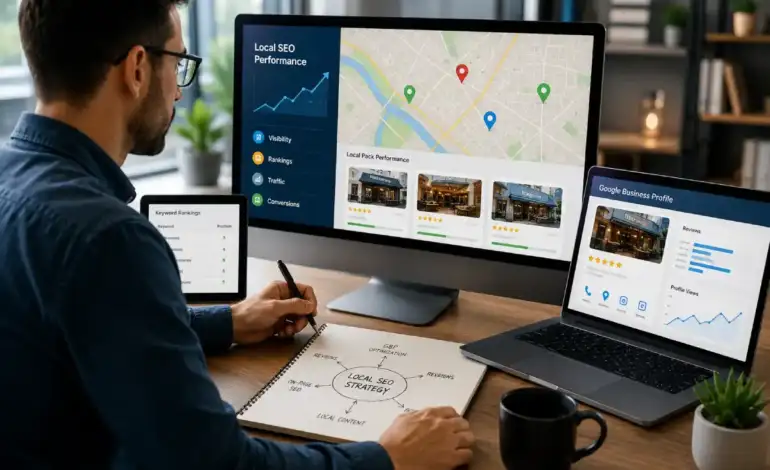
Local SEO Consulting: Grow Your Business in Local Search

Last Updated: September 18, 2026
Quick Summary
Local SEO consulting helps your business show up when nearby customers search for your services on Google. A local SEO consultant audits your website, optimizes your Google Business Profile, builds local citations, and improves your Google Maps rankings — so you get more calls, foot traffic, and revenue
Here‘s what most business owners don’t find out until it’s too late your competitor a few blocks away isn’t always outperforming you because he‘s better. Sometimes he‘s just more visible on Google. And visibility, for local searches, is everything.
Of course think about the last time you needed a plumber, a dentist or a good taco place quickly. You may have entered something in Google, looked at the top three businesses on the map, and then chosen one. That is how your prospective clients are searching for you. But the real question is: Are you showing up or are you invisible?
That‘s exactly when local SEO consulting comes into play. Almost 46% of all Google searches have local intent, and 75% of those who perform a local search will visit a store within 24 hours. According to Google’s research on local search behavior and store visits, consumers frequently use nearby searches to make immediate purchasing decisions, making local visibility a critical revenue driver. They are not just numbers; these are your lost revenues walking out your door every day you are not on page one.
So What Actually Is Local SEO Consulting?
The local SEO consulting is not the “push-a-button” type. It involves a systematic process where an expert with the knowledge of local search audits the reasons why your business is not ranked and then plans on fixing these issues.
Which includes your Google Business Profile, your address on the internet, your website messaging that describes the area you serve, and whether your Google Trust is high enough to recommend you. A great local SEO consultant connects the dots between all of these into a strategy tailored to your market.
What is the difference between SEO and local SEO? Well, the big difference is Local SEO is targeted specifically by location. You‘re not trying to be highly ranked worldwide. Local SEO makes sure your business is the first name people in your zip code see when they‘re searching for what you do. That requires a completely different approach than chasing national keywords.
Industry Perspective : “Local SEO in 2026 is about owning the answer, not just the ranking.” — eSEOspace
What Local SEO Services Actually Cover
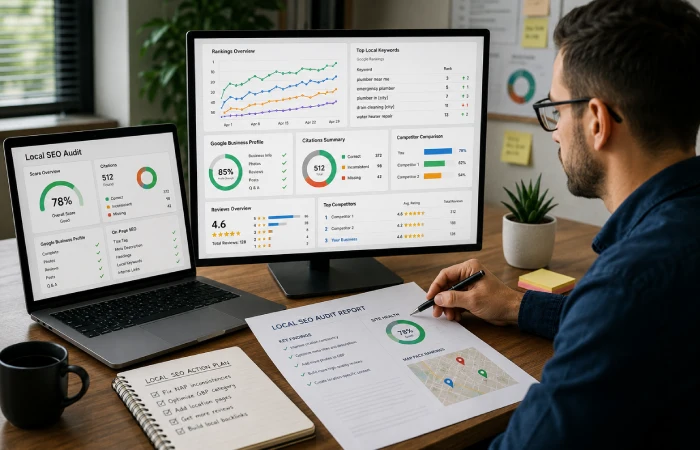
Ask five different agencies what’s included in their local SEO services and you’ll get five different answers. Which is certainly one of the biggest frustrations in this industry and so let me clearly explain to you what a good local SEO campaign looks like.
It starts with an audit — a real one, not a generic report auto-generated in 30 seconds. You need someone actually looking at your current rankings, your Google Business Profile health, whether your phone number is listed correctly on 40 different directories, and what your closest competitors are doing that you’re not.
From there, keyword research isn’t about finding the highest-volume national terms. It’s about understanding exactly how people in your neighborhood search for businesses like yours. “Emergency plumber Austin TX” and “plumber near me” require different strategies.
Citation building is the least glamorous part of local SEO that most business owners don‘t even think of! If you have your address listed in a bunch of variations across Yelp, Apple Maps, and 30 other directories, Google gets a little confused. That confusion costs you rankings.
Then there’s your Google Business Profile, review management, local content, and ongoing tracking. We cover all of these in more depth across the cluster articles linked throughout this page — because each one deserves a proper treatment, not a three-sentence summary.
How do the numbers add up? 75% of local businesses state that local SEO provides higher quality leads than paid advertising. Not more traffic — more qualified leads. That’s the difference between someone clicking your ad by accident and someone actively searching for exactly what you sell.
Google Maps SEO: The Three Spots Everyone’s Fighting For
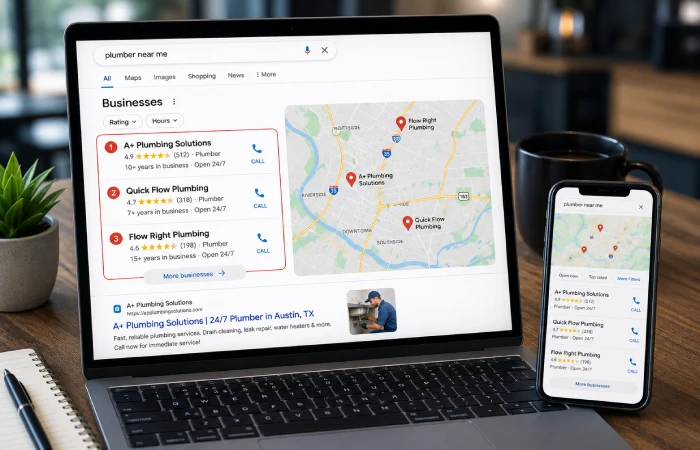
Open Google right now and search for any local service. You’ll see it — a map with three business listings sitting right below the ads, above the regular organic results. That’s the Local Pack, and it gets the majority of clicks for most local searches.
Ranking in these 3 positions is no accident. Google explains in its official local ranking factors documentation that relevance, distance, and prominence are the primary signals used to determine local search and Google Maps rankings. There is a specific set of signals that Google‘s local ranking algorithm weighs, and the businesses that are the loudest in every single signal finish the best.
| Ranking Factor | Impact Level |
| Primary GBP category | Very High |
| Proximity to searcher | Very High |
| Keywords in business title | High |
| Review quantity & rating | High |
| NAP consistency across web | Medium-High |
| Website on-page signals | Medium |
Proximity matters a lot — more than most people want to hear. If someone searches five miles from your shop, you’re fighting a harder battle than the competitor around the corner from them. But proximity is fixed. What you can control is everything else on that list.
One thing that trips up a lot of business owners: they pick the wrong primary category on their GBP. A restaurant that has registered itself with “Food & Drink” and not particular cuisine type have already lost some of the power of ranking. These information will be more important than you‘d think.
Consistency also wins over time. The businesses in the Local Pack aren’t usually there because of one brilliant move. They’re there because they’ve been posting updates, responding to reviews, and keeping their information accurate for months or years.
Do You Really Need to Hire a Local SEO Consultant?
Short answer: it depends on how competitive your market is and how much time you actually have.
We’ve seen plenty of small business owners who handle their own local SEO pretty well. They claim their GBP, they ask customers for reviews, they keep their information updated. In a low-competition market, that’s sometimes enough.
But most markets aren’t low-competition anymore. If you’re a dentist in a mid-sized city, a personal injury attorney, a home services company in a suburb of any major metro — you’re competing against businesses that are either paying an agency or have someone on staff doing this full time. Going at it alone with thirty minutes a week isn’t going to cut it.
A good consultant doesn’t just know what to do. They know what to do in your specific market, with your specific competitive landscape. That local knowledge makes a genuine difference. Someone who’s optimized businesses in Houston is going to approach a Houston campaign differently than someone applying generic tactics from a template.
94% of high-performing brands have a dedicated local marketing strategy. The 6% who don’t tend to be in markets where they have no real competition. For everyone else, having a real strategy — not just a checklist — separates the businesses that grow from the ones that stay stuck.
Local Search Optimization Goes Deeper Than Most People Think
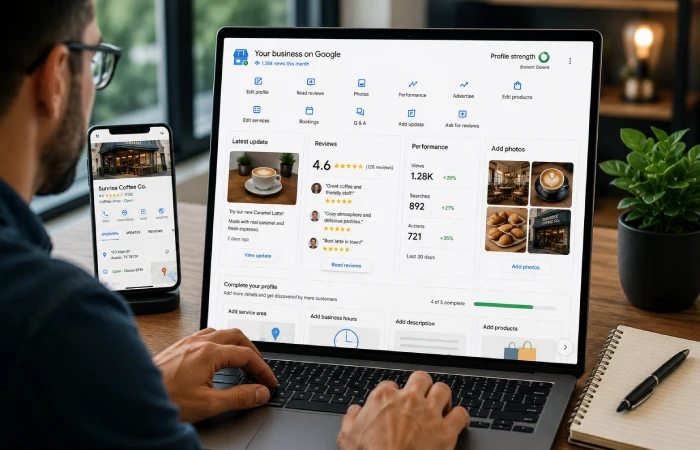
Here’s a scenario we see all the time. A business owner claims their Google Business Profile, adds some photos, and then wonders why they’re still not ranking three months later. The GBP is step one. Local search optimization is everything that comes after.
Your website needs to actually speak Google’s language when it comes to local relevance. That means having dedicated pages for each service you offer (not one giant “Services” page), using location-specific language naturally throughout your content, and implementing schema markup so Google can pull structured data about your business into search results.
Local backlinks matter too, and they’re different from regular backlinks. A mention in the Austin Business Journal, a listing on your city’s chamber of commerce website, a feature on a neighborhood blog — these carry more local ranking weight than a generic link from some national directory nobody reads.
And don’t forget mobile. 57% of local searches happen on phones and tablets. If your site loads slowly or breaks on a small screen, you’re losing the click even if you earned the ranking.
Your Google Business Profile Is Doing More Work Than You Realize
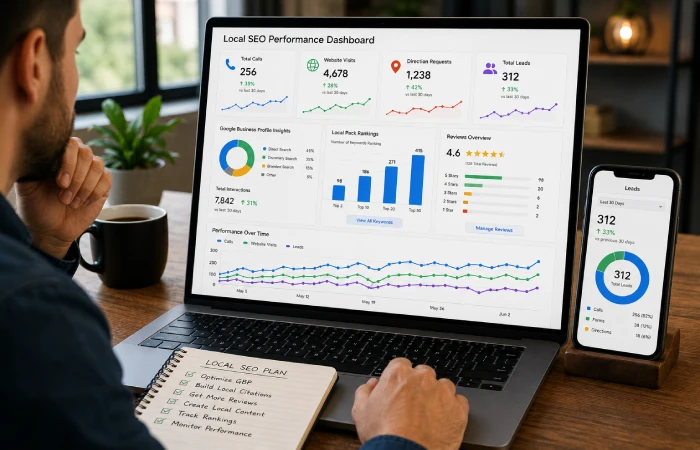
Walk me through this: someone searches for your type of business, they find your Google Business Profile, they see one blurry photo from 2021, no recent reviews, no posts, and the hours say “Temporarily closed” even though you’re open. What do they do? They click the next result.
This happens constantly. GBP actions — calls, direction requests, website clicks — are up 41% year-over-year, which tells you people are absolutely using these profiles to make decisions. An optimized profile converts that attention into actual customers.
The review piece is where a lot of businesses drop the ball in a really fixable way. Google also recommends actively managing profiles through its Google Business Profile best practices, emphasizing accurate business information, customer engagement, and ongoing profile updates to improve visibility and customer trust.68% of consumers won’t seriously consider a business with less than a 4-star rating. And 89% say they’re more likely to choose a business that responds to its reviews — even the negative ones — versus one that stays silent. Responding takes five minutes. Not responding costs you customers.
There’s also an angle most consultants aren’t talking about yet: AI search. Tools like ChatGPT and Perplexity are increasingly being used to find local businesses, and they pull data directly from GBP listings. If your profile is incomplete or has conflicting information, you’re going to be invisible there too — and that channel is growing fast.
A properly optimized GBP covers these fundamentals:
- Business name, address, and phone number that match everywhere else on the web
- The right primary category — not just the closest one, the most specific accurate one
- A description that reads like a human wrote it, with natural references to your location and services
- Real photos, updated at least monthly
- Regular posts — offers, updates, seasonal content
- Every question in the Q&A section answered by you before a stranger answers it incorrectly
- Review responses that are genuine, not copy-paste templates
What Kind of ROI Should You Actually Expect?
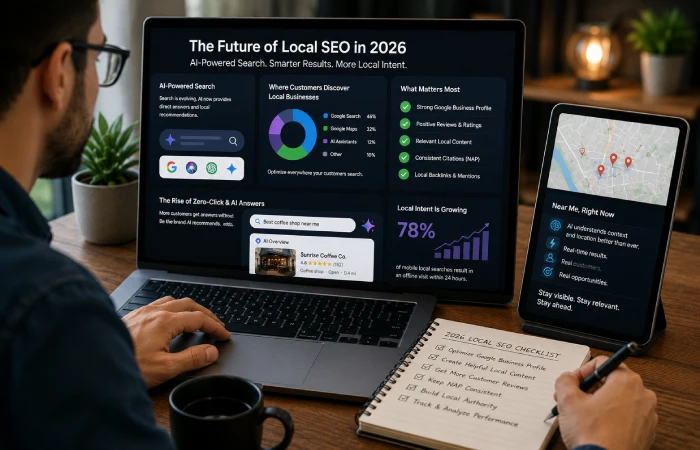
We’ll be honest: local SEO is not fast. Anyone who promises you page-one rankings in two weeks is either lying or planning to do something that’ll get your site penalized.
What you should realistically expect is this: in the first month or two, a good consultant is auditing, fixing foundational issues, and setting up proper tracking. You’re not going to see dramatic ranking jumps during this phase — but skipping it is exactly why so many local SEO campaigns fail down the road.
By month three or four, you’ll typically see GBP performance improving — more views, more clicks to your website or directions. Organic ranking movement usually follows a few weeks behind that. By month six, if the work has been done properly, you should have a clear picture of what’s working and compounding gains in visibility.
The numbers back up the patience required. Businesses that stick with local SEO see an average return of 2.5x their investment. That’s not unicorn-level performance — that’s the realistic average across industries. And unlike paid ads, the traffic doesn’t disappear the moment you stop paying for it.
The Mistakes That Kill Local SEO Campaigns
| Mistake | Why It Hurts | Fix |
| Inconsistent NAP across directories | Creates trust issues with Google’s local algorithm | Run a citation audit, clean up mismatches |
| Never responding to reviews | Signals low engagement; hurts conversion rate | Set a weekly reminder to respond to every review |
| One generic “Services” page | Can’t rank for individual service + location combos | Create dedicated pages per service and city |
| Stuffing keywords into GBP description | Looks spammy; can trigger suppression | Write naturally — describe what you actually do |
| Ignoring GBP posts entirely | Misses a direct engagement signal to Google | Schedule one post per week, minimum |
| Treating SEO as a one-time project | Rankings decay as competitors keep working | Budget for ongoing monthly optimization |
What’s Different About Local SEO in 2026
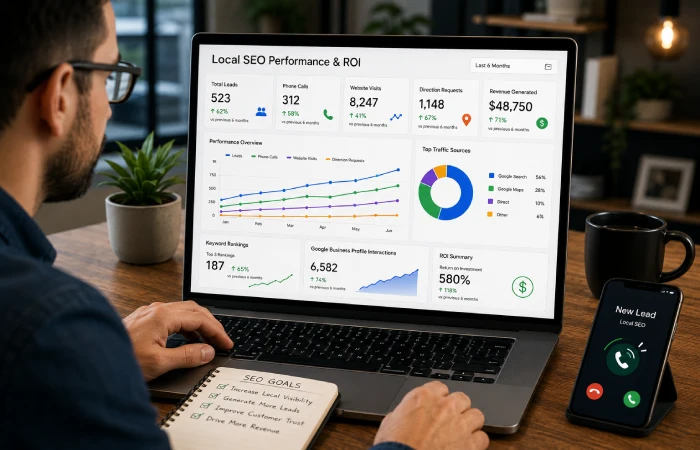
A few years ago, local SEO was mostly about getting your GBP claimed and your citations consistent. That foundation still matters — but the game has gotten more complex.
AI search is the biggest shift. About 45% of consumers now use tools like ChatGPT or Perplexity to find local business recommendations. Here’s the problem: only 68% of business contact information on those platforms matches what’s on Google Business Profiles. If your info is inconsistent or missing, you lose visibility in AI-driven results at the same time you’re trying to show up in traditional Google search.
Reviews have also become a dual signal in a way they weren’t before. They influence your map pack rankings directly, but they also influence whether someone converts after they find you. Research now shows that every 10 new reviews increases conversion rate by 2.8%, and responding to even 25% of your reviews improves conversion by over 4%. Most businesses aren’t doing either of these things consistently — which means the opportunity is wide open for those who do.
Why INC Marketing Place
We’ve worked with enough local businesses to know that what works for a law firm in Chicago isn’t what works for a HVAC company in Phoenix. Local SEO is hyperlocal by definition — the strategy has to match the market.
Our approach starts with understanding your specific competitive landscape before we recommend anything. We’re not going to hand you a generic 12-point package and call it a strategy. Monthly reporting with real metrics. Transparent communication about what‘s working, and what we‘re changing, and a team that actually answers the phone.
If you‘re not displaying the way you need to, we‘d sincerely love to show you why and how.
Call to Action : Get a Free Local SEO Audit → www.incmarketingplace.com
Wrapping Up
Local SEO consulting isn’t complicated to understand — it just requires consistent, strategic work over time. Show up correctly across the web, earn trust through reviews, keep your GBP active, and build the kind of local relevance that Google rewards with rankings.
The businesses that dominate local search in their markets aren’t always the biggest or the oldest. They’re usually just the most consistent. When you work with the right local SEO consultant, that consistency becomes a competitive edge that builds upon itself month after month.
FAQs
Q: What does a local SEO consultant actually do day-to-day?
More than most people expect. More than you probably anticipate. After the audit and the setup, a good consultants will be watching your rankings and your competitors ratings weekly, adjusting your GBP for what is getting hit, reporting new citation issues as they arise and keeping your content relevant to the way your audience is searching in your area. This is not a project; it is an ongoing effort.
Q: How long before I see real results from local SEO?
Honest answer: give it three to six months before judging. GBP improvements often show up faster — sometimes within four to eight weeks you’ll see more profile views and actions. Organic ranking movement takes longer because it’s built on accumulated trust signals. A red flag: if somebody tells you they can get you there in 2 weeks.
Q: What does local SEO consulting typically cost?
Retainers often are $500/month all the way to (more often) $3,000/month depending on what niche you are in the local competitive markets what services are included and how many locations you have. Avoid cheap, cheap prices as this kind of SEO really takes some real time investment. An easy-to-understand approach is to have any consultant tell you specifically what they do each month for the money.
Q: I already have a website. Do I still need local SEO work?
Generally yes. Just having a website does not mean you have a locally optimized one. Most business websites we audit are missing location-specific landing pages, proper schema markup, and content that actually signals local relevance to Google. A website that’s not locally optimized is essentially invisible in local search, no matter how nice it looks.
Q: Can I realistically do this myself?
For the basics, yes — especially in low-competition markets. Claiming your GBP, getting consistent citations, asking for reviews. But once you’re in a competitive space, the time investment and technical knowledge required goes up fast. Most business owners who attempt a DIY local SEO campaign in competitive markets quickly realize it‘s pointless, or do just enough to keep their heads above water.
Q: Does local SEO help with AI search results like ChatGPT?
Yes, and the need for a solid local seo presence is only growing. AI pulls business data from everywhere including your GBP, your website, any other citations you have, etc. A healthy local SEO presence consistent NAP everywhere, great reviews, and relevant local content gets you included in AI-based local suggestions, not just Google.

I’m Thomas — Editor & Admin of incmarketingplace, Blogger, and Senior SEO Analyst. writer at Inc Marketing Place, sharing insights on SEO, branding, content marketing, and online business growth. I focuses on creating practical and easy-to-understand content for marketers, entrepreneurs, and growing businesses