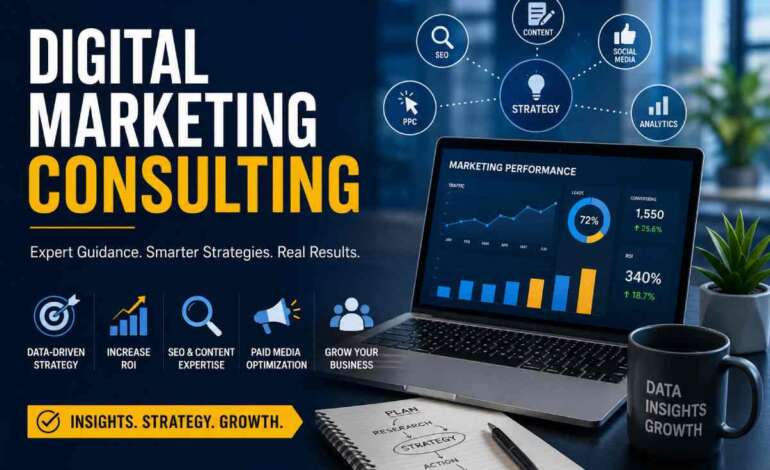
Digital Marketing Consulting: The Ultimate Guide for Business Growth

Last Updated: September 18, 2026
Spent any time lately wondering whether hiring a digital marketing consultant would actually move the needle for your business, or whether it’s just money going out the door? That’s the question this guide answers. No fluff. What their doing, its cost, what it can, and most people don‘t understand.
Three years ago you could post consistently, run some Google Ads, do basic SEO and see decent results. That’s not really the case anymore. Algorithms change constantly, ad costs are brutal in most industries, and what worked in 2022 can actively hurt you now. That’s not scare tactics — it’s just where things are. More businesses are bringing outside help in because nobody has time to keep up with all of this while also running a company.
| $800B+
Global digital ad spend in 2026 |
$36.65B
Marketing consulting market size 2026 |
748%
Median SEO ROI (2026) |
What Is Digital Marketing Consulting?
Hire someone external, give them access to your analytics and ad accounts, and have them tell you what they find. That’s the core of it. A good consultant will go through everything — your Google Ads spend, your SEO, your content, your email list, your social — and come back with an honest picture of where the money’s going and what it’s actually producing.
Your in-house marketer is probably flat out just keeping things running. Scheduling posts, pulling reports, managing campaigns. There’s no time for them to stop and ask whether any of it is actually working. A consultant’s entire job is that question. And because they’re not on your payroll permanently, they’ll tell you the uncomfortable stuff your staff won’t.
Think about why you go to a doctor rather than diagnosing yourself on Google. Not because you’re not intelligent — you clearly are — but because a doctor has seen this a hundred times and knows what it actually looks like. Digital marketing consultants are the same. Pattern recognition built up over years of doing it across dozens of businesses.
What Makes Consulting Different?
| Factor | Consultant | In-House Marketer | Agency |
| Primary role | Strategy + diagnosis | Day-to-day execution | Managed execution |
| Perspective | External, objective | Internal, vested | External, account-focused |
| Specialty | Cross-channel expertise | Often generalised | Channel-specific |
| Cost model | Hourly or retainer | Salary + benefits | Monthly retainer |
| Best used for | Gaps, audits, growth planning | Steady-state execution | Scaling proven channels |
Why Businesses Need Marketing Consultants
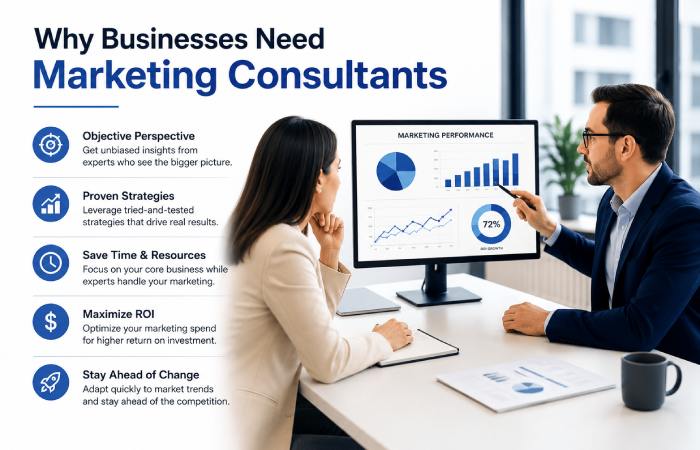
Look at what’s actually happening in digital marketing right now:
- Google’s AI Overviews now appear in 31% of search results, redistributing clicks away from traditional rankings (First Page Sage, 2026)
- 60% of Google searches now generate zero clicks to any external website — the answer appears directly on the results page (Search Engine Land, 2025)
- 66% of marketers now use AI tools daily to steer strategic decisions
- Global digital marketing industry spend is projected to top $800 billion in 2026 (Oberlo)
- Only 38% of marketers integrate measurement of traditional and digital tactics into a unified ROI approach (Nielsen, 2024)
| The Most Important Stat
Walk into most marketing meetings and ask “which channel actually generated the most revenue last quarter” and watch people go quiet. Most teams genuinely don’t know. They have hunches. They have vanity metrics. But revenue attribution? Usually a mess. That’s normally the first thing a consultant fixes, because everything else depends on it. |
5 Business Situations That Demand a Consultant
- Growth has gone flat and your team has run out of explanations. When you’re inside a business every day you stop seeing certain things. Someone coming in cold usually spots it pretty quickly.
- There’s a product launch or market expansion coming and you’d rather not have it be the expensive lesson. Getting the go-to-market strategy right from the start costs a fraction of fixing it after.
- Revenue is growing but the marketing function is struggling to scale with it. Better to sort the foundations now than try to rebuild the plane while it’s flying.
- You need deep expertise in something specific — technical SEO, paid social, email automation — but a full-time hire for one skill set doesn’t make financial sense.
- Budget is going out and you can’t account for where it’s going. Finding the leak is almost always faster than adding more spend.
Types of Digital Marketing Consulting Services
When someone tells you that they are a digital marketing consultant that can mean many things. It’s a broad label. The actual work varies enormously depending on what you need. Here’s what the main service areas actually involve.
SEO Consulting
SEO consulting is fundamentally about search visibility — making sure that when someone types a relevant query into Google, your website shows up. It sounds simple. It’s not. A proper SEO engagement covers:
- Page speed (Technical SEO), Core Web Vitals, Crawlability, Site architecture
- On- page SEO Keyword mapping, Content optimisation, Internal linking, E-E-A-T
- Off page SEO – link building strategy, digital PR, authority building
- Content strategy — topic clusters, keyword gaps, content calendar
- AI Search Optimisation — positioning content to appear in Google’s AI Overviews
SEO ROI by Industry — 2026 Data
| Industry | SEO ROI (2026) | Break-even Timeline |
| Medical Devices | 1,183% | 6–9 months |
| Higher Education | 994% | 7–10 months |
| Oil & Gas | 906% | 6–9 months |
| Industrial IoT (B2B) | 866% | 7–9 months |
| Manufacturing | 813% | 7–10 months |
| Financial Services | 700–800% | 7–9 months |
| E-commerce | 317% | 9–12 months |
| Beginner Tip — SEO
New to all this? Ignore the noise about advanced SEO for now. Three things that will actually move the needle when you’re starting from scratch: site speed under 2.5 seconds, one page per topic (not four pages saying roughly the same thing), and a properly filled-out Google Business Profile if you serve any local area. Get those sorted first. |
PPC Consulting
PPC consulting means paid search — primarily Google Ads. Most businesses that run Google Ads have never had a proper expert look at the account. The campaign structure is a mess, conversion tracking is broken or missing, and the bidding strategy was set up by someone following a tutorial from 2019. A PPC consultant goes through all of that and fixes it. The impact on cost per lead is usually significant.
| PPC Metric | 2026 Benchmark |
| PPC average ROI | 2:1 to 4:1 |
| Brands who consider PPC a key driver | 74% |
| SMBs actively running PPC campaigns | 65% (gap = opportunity) |
| Cost per lead (PPC) | $181 |
| Cost per lead (SEO, for comparison) | $31 |
| Conversion rate (PPC) | 3.75% |
| Conversion rate (SEO, for comparison) | 14.6% |
| Beginner Tip — PPC
If I had to pick one thing that wastes more Google Ads budget than anything else, it’s this: broad match keywords and no negative keyword list. What that means in practice is your ads for “accounting software” end up showing to someone searching for “accounting degree” or “free accounting template.” You’re paying for every one of those clicks. I’ve seen businesses lose $3,000 a month on this alone. |
Social Media Consulting
A lot of businesses are very active on social media and getting absolutely nothing from it. Lots of posts, decent engagement occasionally, zero link to actual revenue. Social media consulting is about changing that equation — working out which platforms your actual buyers use, what content makes them take action, and whether any of it is worth paying to promote.
| Platform / Activity | Average ROI | Best For |
| Paid Social (overall) | 1.5:1 to 3:1 | Awareness, remarketing |
| Leads paid social ROI | B2C, product brands | |
| High B2B intent | Lead generation, B2B | |
| Influencer Marketing | 5.78:1 average | Awareness, B2C |
| Video Content | 82% report positive ROI | Engagement, trust |
| Omnichannel (strong) | 89% customer retention | Full-funnel strategy |
| Important — Social Media 2026
Platform algorithms have been throttling organic reach for years. On Facebook a post might reach 3–5% of your followers. LinkedIn is better but still patchy. The honest reality is that purely organic social is a slow burn with diminishing returns. A consultant will be straight with you about this and help you figure out a sensible mix of organic content and targeted paid spend. |
Content Marketing Strategy
Most businesses have published a lot of content over the years with no real architecture behind it. Blog posts that don’t rank for anything, videos that nobody finds, guides that never get shared. Content strategy consulting starts by auditing what you already have, then building a proper framework: keyword priorities, content formats, publishing frequency, and — crucially — how to actually measure whether the content is doing something useful.
- Topic cluster mapping — pillar pages + supporting articles (like this guide)
- Content gap analysis — keywords competitors rank for that you do not
- Editorial calendar – what to publish and when and where
- Content repurposing an article to blog, video, podcast, social.
- E-E-A-T implementation authoritativeness built into each document
| Content Marketing Stat | 2026 Data |
| Global content marketing revenue (2026) | $107 billion (Statista) |
| Marketers who say content improved effectiveness | 61% (CMI 2025–26) |
| Businesses using video as primary tool | 91% |
| Companies publishing 16+ posts/month | 3.5x more traffic (HubSpot) |
| People who prefer short video for learning | 63% |
AI in Digital Marketing
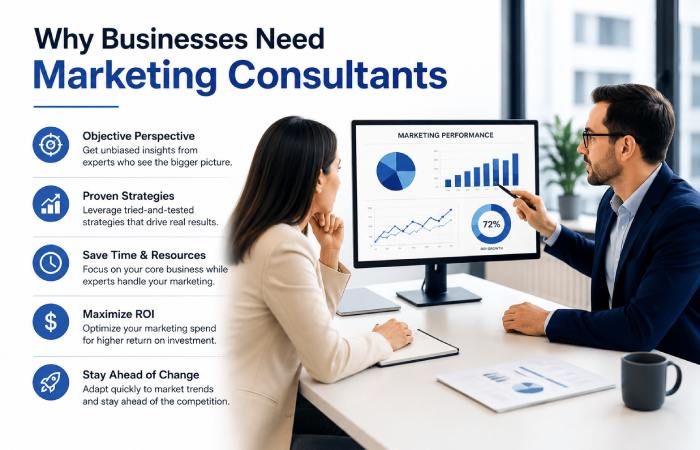
Every week there’s a new AI tool that’s supposedly going to transform your marketing. Almost none of them will. AI consulting cuts through all of that and focuses on what actually matters for your business specifically — whether that’s using AI for content drafts, automated reporting, predictive bidding, or something else entirely. The tool list matters less than having a clear sense of where AI genuinely helps versus where it creates more work.
| AI Marketing Metric | 2026 Data | Source |
| Marketers using AI tools daily | 66% | WebandCrafts 2026 |
| Fortune 1000 using AI-driven campaigns | 91% | DemandSage 2026 |
| Monthly generative AI users globally | 2.42 billion | ALM Corp 2026 |
| AI Overviews appearing in search results | 31% of queries | First Page Sage 2026 |
| Predictive analytics market CAGR (2021–26) | 23.2% | Loop Ex Digital |
| Marketers using AI for content creation | 76% | Insider Intelligence |
| Critical for 2026 — AI Overviews
Something that’s changed significantly in the last year or so: Google’s AI-generated summaries now appear at the very top of a huge chunk of search results. When that box appears, a lot of users never scroll past it. If your content isn’t written in a way that directly answers the question being asked, you can rank #1 in organic and still get almost no traffic from it. Any SEO consultant worth hiring is factoring this in. |
4. 2026 Digital Marketing ROI: Full Data & Benchmarks
Beyond strategy, one of the genuinely useful things a consultant brings is industry benchmarks. Is a 3% conversion rate on your landing page good or bad? Depends entirely on your sector. In some industries 3% is strong. In others the average is 12% and you’re leaving a lot on the table. Without that context you have no real way to prioritise where to focus.
Channel-by-Channel ROI Comparison (2026)
| Marketing Channel | Avg ROI | Cost Per Lead | Time to Results | Best For |
| Email Marketing | $36–$42 per $1 | Low | Immediate | Retention, nurture |
| SEO / Organic Search | 748% median | $31 | 6–12 months | Long-term growth |
| Content Marketing | 5:1 to 10:1 | Moderate | 3–6 months | Awareness + authority |
| Influencer Marketing | 5.78:1 avg | Varies | 1–3 months | Awareness, B2C |
| PPC / Paid Search | 2:1 to 4:1 | $181 | Immediate | High-intent demand |
| Paid Social | 1.5:1 to 3:1 | Moderate | Weeks | Awareness, remarketing |
| Video Marketing | 82% positive ROI | Moderate | Weeks–months | Engagement, trust |
Digital Marketing Consulting Market Size (2026)
| Market Metric | 2026 Data |
| Global marketing consulting market size | $36.65 billion |
| Forecast by 2031 | $45.52 billion |
| CAGR (2026–2031) | 4.42% |
| Market share of digital marketing consulting | 31.12% of consulting market |
| Digital marketing services standalone market | $70.1 billion (2025) |
| Total global digital ad spend (2026) | $800+ billion |
Sources: Mordor Intelligence 2026, MRFR 2025, Oberlo 2025
5. How to Choose the Right Digital Marketing Consultant
Not all consultants are good. Some are genuinely excellent. Some will take your money, provide you with monthly reports of jargon and deliver you nothing of any quantifiable value. The difference should be apparent in the sales process if you are aware of what you want.
5 Questions to Ask Before Hiring
- And can I see case studies? (for businesses of my type)
- How do you intend to measure success and report about it? (kpis & tools)
- Where is first 30 and 90 days heading? (discloses proven process)
- Who is actually going to do the work? (senior vs. junior delivery)
- What happens at the end of the engagement? –capability transfer, not dependency
| Red Flags | Green Flags |
| Guaranteed #1 Google rankings | Asks for analytics access before proposing |
| Vague deliverables, no clear KPIs | Talks in revenue and pipeline terms |
| No documented case studies | Provides clear scope of work upfront |
| Long lock-in contracts, no performance clauses | References specific tools and methodologies |
| Promising SEO results in 30 days | Shares examples of clients turned down |
Digital Marketing Consulting Costs (2026)
| Engagement Type | 2026 Price Range | Best For |
| One-time audit / strategy session | $1,500 – $5,000 | Quick diagnosis, starting point |
| Project-based strategy | $5,000 – $25,000 | New launch, channel buildout |
| Monthly advisory retainer | $2,500 – $15,000/mo | Ongoing strategy guidance |
| Full consulting + execution | $10,000 – $50,000/mo | Growth-stage businesses |
| Enterprise (Bain, BCG, etc.) | $50,000 – $500,000+ | Large-scale transformation |
| Business Size | Typical Monthly Spend | Expected ROI Timeline |
| Small business / Startup | $1,500 – $5,000 | 6–12 months |
| Mid-market ($2M–$50M revenue) | $5,000 – $20,000 | 3–9 months |
| Enterprise ($50M+ revenue) | $20,000 – $100,000+ | 3–6 months |
| Pricing Insight (2026)
AI tooling has changed the cost structure at most agencies. Content production and automated reporting are cheaper — meaningfully cheaper, 20–35% by some estimates. But none of that applies to the actual strategic thinking, the technical work, or the conversion optimisation. Those rates have held or gone up. What this means practically: if you’re paying for content volume, you might be able to negotiate better terms. If you’re paying for strategy, the rate is what the rate is. |
Consultant vs. Agency: Full Comparison
| Factor | Independent Consultant | Boutique Agency | Large Agency | Enterprise Firm |
| Cost | $ | $$ | $$$ | $$$$ |
| Strategy depth | ★★★★★ | ★★★★☆ | ★★★☆☆ | ★★★★★ |
| Execution capacity | ★★☆☆☆ | ★★★★☆ | ★★★★★ | ★★★★☆ |
| Personalisation | ★★★★★ | ★★★★☆ | ★★★☆☆ | ★★★☆☆ |
| Response speed | ★★★★★ | ★★★★☆ | ★★★☆☆ | ★★☆☆☆ |
| Best for | Audits, strategy, upskilling | SMB growth | Scaling execution | Transformation |
| Our Recommendation
The simplest way I’ve heard it framed: hire a consultant to figure out the what and the why, hire an agency to do the doing. Two like that are running at the same time – where the consultant is setting the direction and the agency is running the show – will often be manageable at the mid-market as long as the consultant and agency are not getting in each other‘s way. |
Common Mistakes to Avoid
Mistake 1: Starting Without Baseline Data
Get your baseline data before anyone starts. Current traffic, lead volume, what channels are sending customers, conversion rates, average deal size — whatever you can pull together. It probably takes an hour in Google Analytics and your CRM. The reason this matters: three months from now, if there’s no baseline, you’re having a very subjective conversation about whether anything improved. That never ends well.
Mistake 2: Expecting Overnight Results
The percentage of businesses that cancel an SEO engagement at month two because “we‘re not seeing results” is truly heartbreaking. SEO takes 6 to 9 months. Not because consultants are dragging it out — because that’s how long Google takes to index, crawl, reassess and rerank. Paid ads are different; you see movement fast. SEO and content are slow burns. Going in knowing that saves a lot of frustration.
Mistake 3: Treating Consulting as a Replacement for Internal Effort
Some business owners hire a consultant and then basically step back and wait. That doesn’t work. The consultant can’t implement anything without access to your team, your platforms, your content, your customer data. The best engagements are ones where your people are genuinely involved — asking questions, pushing back, learning alongside. The expertise is in the consultant; your organization has the context and moves the bricks.
Mistake 4: Focusing on Vanity Metrics
If your monthly report is full of impressions, follower growth, and engagement rate — push back. Those numbers feel good but none of them appear on a P&L. The metrics that actually tell you whether the consulting engagement is doing anything: qualified leads, cost per acquisition, pipeline attributed to digital, and ideally revenue. If those aren’t being tracked from day one, set that up before anything else.
Mistake 5: Skipping the Audit Phase
“Can we just skip the audit and get to the recommendations?” is something consultants hear a lot. The answer should always be no. The audit isn’t admin — it’s the whole point of bringing someone in. Without it, you’re paying for advice based on assumptions rather than what’s actually happening in your accounts. The things the audit reveals are almost always the things that explain why previous efforts didn’t work.
Mistake 6: Hiring on Price Alone
Cheap consulting has a way of being extraordinarily expensive when you add up the cost of following bad advice. A consultant who charges $500/month and recommends a generic strategy copied from a template is going to cost you five or ten times that in wasted ad spend and missed opportunities. The consulting fee is often the smallest number in the equation. What they lead you to spend — or waste — is the real cost.
Troubleshooting: When Your Consulting Engagement Is Not Working
Before cancelling an engagement that doesn’t seem to be working, run through this. The issue is often not where you think it is:
| Problem Signal | Likely Cause | Fix |
| Strategy is sound, no results | Execution is weak internally or at agency level | Audit execution quality and resourcing |
| Traffic growing but no leads | Wrong audience targeted, broken conversion path | CRO audit + persona review |
| No results after 8 weeks | Unrealistic timeline expectations (SEO) | Recalibrate timeline, not strategy |
| No communication from consultant | Lack of structured check-ins | Set weekly or bi-weekly cadence |
| KPIs not being tracked | Analytics not set up properly at start | GA4 audit + attribution fix |
FAQ — Digital Marketing Consulting
Add FAQPage JSON-LD schema to your page head using these questions and answers. Google uses this to generate rich results in search.
Q: What does a digital marketing consultant do?
The first thing any consultant should do is ask for access — Analytics, Ads, Search Console, whatever you have. Then they audit it. What’s actually happening versus what you think is happening is often pretty different. They will then formulate a plan and deliver it or wait and remain with your team to help you execute this if that is how the engagement has been agreed.
Q: How much does digital marketing consulting cost?
Prices are all over the place. For an independent consultant providing a one-time audit, the range is around $1,500 and upwards, depending on thoroughness up to around $5,000 for a comprehensive examination. Monthly retainers for ongoing work may be anywhere from $2,500 (small business) to $5,000-20,000 (medium sized business). When you go to the uber-consultants, the starter packages are approximately $50,000, and the sky‘s the limit.
Q: How long does it take to see results?
Paid channels (Google Ads, Meta) will show movement within 2-4 weeks. SEO is slow — expect 6 months minimum before meaningful rankings move, and 9 to 12 months before you really see the return. Content marketing sits in between. If you target several channels at the same time you should see some results in three months, but the whole process will take longer.
Q: What is the ROI of digital marketing consulting?
The ROI data looks impressive on paper. First Page Sage reports median SEO ROI at 748% in 2026. Email marketing benchmarks at $36 to $42 per dollar spent. PPC runs 2:1 to 4:1 on average. Realistically your results depend on the market you’re in, what shape your current setup is in, and whether the strategy actually gets executed properly. The numbers are achievable — they’re just not automatic.
Q: Should I hire a consultant or an agency?
Different tools for different jobs. A consultant is the right choice for when you want someone truly objective to analyze your situation in order to diagnose the problem and recommend the major next steps. An agency is the right tool when the strategy is understood but you need a team to implement it repeatedly over time.Plenty of businesses run both at the same time — there’s no reason you have to pick one.
Q: What qualifications should a digital marketing consultant have?
Certification is a foundation but not a destination: certified in Google Ads, Meta Blueprint, HubSpot- pleasing, but what is more relevant is if they are able to provide you with concrete figures for concrete contacts. Inquire: what was the state of affairs when you began, what you did, and how he or she evolved? If they cannot respond that transparently, look elsewhere. Also ask for two or three clients you can call directly. Anyone confident in their results will have no problem with that.
Q: Is digital marketing consulting worth it for small businesses?
Yes — and often more so than larger businesses. Small businesses tend to have a higher proportion of fixable, quick-win problems. A $2,000/month Google Ads account with no conversion tracking and no negative keywords is an obvious one. So is a website with a broken contact form or checkout process. These aren’t glamorous fixes but they can recover the consulting cost in weeks. The trick here is to find a consultant that actually works with a company your size not one with a minimum retainer of 15K.
Conclusion: Is Digital Marketing Consulting Right for You?
Do you need to hire a digital marketing consultant? It depends where you live. If your digital marketing strategy is sound and your team is providing proper implementation, and you have data indicating what is successful you most likely do not need one. Most businesses aren’t in that position though. Patchy data, unclear priorities, channels that aren’t performing the way they should. If that sounds familiar, external expertise is almost always worth it.
The businesses getting the best results from digital marketing right now aren’t the ones with the biggest budgets. They’re the ones that know their numbers, have a clear view of what’s working, and make decisions based on data rather than gut feel or whatever’s trending. Getting to that point is exactly what a good consultant helps you do.
| You Are Ready for a Consultant If…
Growth has stalled and the team doesn’t have an answer • Ad budget is going out but revenue attribution is unclear • A launch is coming and you want to get it right first time • You need specialist skills but not a full-time hire • Marketing feels like a cost centre rather than a growth driver |

I’m Thomas — Editor & Admin of incmarketingplace, Blogger, and Senior SEO Analyst. writer at Inc Marketing Place, sharing insights on SEO, branding, content marketing, and online business growth. I focuses on creating practical and easy-to-understand content for marketers, entrepreneurs, and growing businesses