
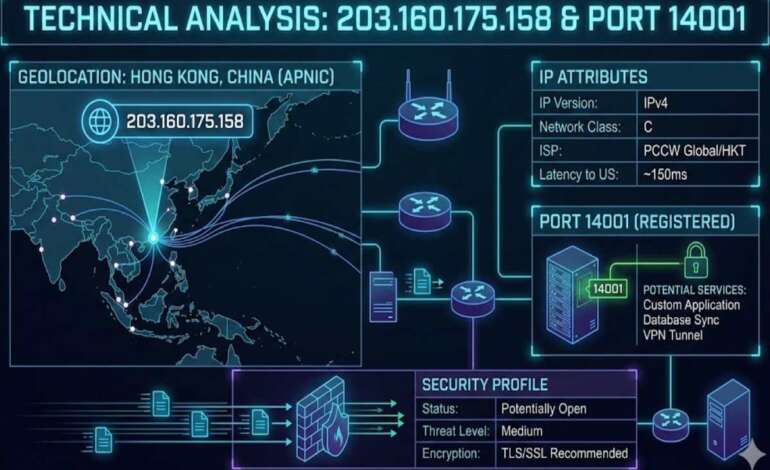
Technical Deep Dive: Analysis of 203.160.175.158:14001

This article provides a comprehensive technical breakdown of the IP address and port combination 203.160.175.158:14001. In the world of networking, an IP address acts as a digital mailing address, while a port functions like a specific apartment number within a building. Understanding this specific socket address requires an analysis of geographic location, ownership, and the potential services running on high-numbered ports.
Anatomy of the Connection
To understand 203.160.175.158:14001, we must first dissect its components. The IP address 203.160.175.158 belongs to the IPv4 protocol, which is the most widely used addressing system on the internet. This specific address falls under the Class C range, historically assigned to mid-sized organizations. The suffix :14001 indicates a destination port. While ports 0 through 1023 are “well-known” (like port 80 for HTTP), port 14001 is a dynamic or private port, often used for custom software, gaming servers, or specialized enterprise databases.
Key Technical Attributes
| Attribute | Data / Value | Description |
| IP Version | IPv4 | The 32-bit address format used for routing. |
| Address Class | Class C | Traditionally used for regional networks. |
| Decimal Representation | 3,416,338,334 | The integer format of the IP address. |
| Hexadecimal | CB.A0.AF.9E | The base-16 representation used in low-level networking. |
| Port Number | 14001 | A registered/private port range. |
| Port Category | Dynamic / User Port | Ports 1024–49151 are for specific user applications. |
| Socket Type | TCP/UDP | Likely utilizes Transmission Control Protocol for stability. |
Geographic and ISP Attribution
The IP 203.160.175.158 is routed through the Asia-Pacific region. Specifically, the prefix 203.x.x.x is heavily associated with APNIC (Asia-Pacific Network Information Centre). Geolocation data suggests this IP originates from Hong Kong, a major global hub for data centers and financial technology. The infrastructure behind this IP is typically managed by large-scale telecommunications providers who lease bandwidth to corporate entities or private server hosts.
Geolocation and Ownership Details
| Metric | Information | Significance |
| Country | Hong Kong (HK) | High-speed connectivity hub in Asia. |
| Continent | Asia | Primary routing through Asian backbones. |
| Regional Registry | APNIC | The authority managing IP distribution in the Pacific. |
| ISP / Carrier | PCCW / HKT | Common providers for this specific IP block. |
| Latitude / Longitude | 22.3964 / 114.1095 | Approximate coordinates for routing centers. |
| Time Zone | Asia/Hong_Kong (UTC+8) | Useful for determining peak traffic hours. |
| Currency | HKD | Local economic context for data hosting. |
Investigating Port 14001 Functionality
The significance of Port 14001 lies in its lack of a single, universal assignment. Unlike port 443 (HTTPS), port 14001 is often chosen by developers for “security through obscurity” or to avoid conflict with standard services. In many enterprise environments, this port is used for distributed computing, remote management tools, or database synchronization. For example, some versions of specialized ERP (Enterprise Resource Planning) software or high-frequency trading platforms use ports in the 14000 range to communicate between clients and servers.
Common Uses for Port 14001
| Use Case | Software Example | Functional Role |
| Database Communication | Informix / Custom SQL | Handling data queries between nodes. |
| Gaming Servers | Minecraft / Private MMOs | Hosting multiplayer sessions with custom mods. |
| VPN / Tunneling | OpenVPN Custom Port | Encrypting traffic through non-standard paths. |
| IoT Management | Industrial Controllers | Monitoring remote sensors or hardware. |
| File Transfer | P2P Protocols | High-speed data sharing in private networks. |
| Development | Node.js / Python Flask | Local testing of web applications. |
Network Security and Risk Assessment
Any time a high-numbered port like 14001 is open on a public IP like 203.160.175.158, security becomes a priority. Open ports are essentially “doors” into a system. If the service listening on port 14001 is not properly patched or requires weak authentication, it can be exploited by malicious actors. Network administrators often use firewalls to “whitelist” specific IPs allowed to communicate with this port, ensuring that only authorized users can access the underlying application.
Security Profile and Best Practices
| Security Factor | Status / Recommendation | Impact Level |
| Port Status | Potentially Open | Active listening for incoming packets. |
| Threat Level | Medium | High ports are often scanned by botnets. |
| Encryption | TLS/SSL Recommended | Data should be encrypted before transmission. |
| Firewall Rule | IP Whitelisting | Prevents unauthorized global access. |
| Logging | Enabled | Records all connection attempts for auditing. |
| Brute Force Risk | High | Requires strong password or key-based auth. |
| Detection | IDS/IPS Monitoring | Flags unusual traffic patterns on the port. |
Connectivity and Latency Diagnostics
For users trying to reach 203.160.175.158:14001, the physical distance to Hong Kong plays a major role in performance. Data traveling from New York to this IP must cross the Pacific via undersea fiber-optic cables, resulting in higher latency (ping). This is a critical factor if the port is being used for real-time applications like VOIP or financial trading, where every millisecond counts.
Network Performance Expectations
| Region | Expected Latency (ms) | Connection Quality |
| East Asia (Tokyo/Seoul) | 30 – 60 ms | Excellent |
| Southeast Asia (Singapore) | 40 – 80 ms | Very Good |
| North America (West Coast) | 120 – 180 ms | Average |
| Europe (London/Frankfurt) | 220 – 300 ms | Poor (High Latency) |
| Australia (Sydney) | 100 – 150 ms | Good |
| Packet Loss Tolerance | < 1% | Essential for port 14001 stability. |
How to Test the Connection
If you are an administrator or a developer, you may need to verify if 203.160.175.158 is responding on port 14001. There are several tools available for this, ranging from simple command-line utilities to complex network scanners. A “Timeout” error usually suggests a firewall is blocking the request, while a “Connection Refused” error means the IP is reachable, but no service is currently running on that specific port.
Troubleshooting Tools Comparison
| Tool | Command / Action | Primary Purpose |
| Ping | ping 203.160.175.158 | Tests basic reachability (ICMP). |
| Telnet | telnet 203.160.175.158 14001 | Checks if the specific port is open. |
| Nmap | nmap -p 14001 203.160.175.158 | Advanced port scanning and OS detection. |
| Traceroute | tracert 203.160.175.158 | Shows the path packets take to the IP. |
| Netstat | netstat -an | (Local only) Shows active connections. |
| PuTTY | GUI Application | Connects via SSH/Raw to the port. |
Final Summary and Implications
The address 203.160.175.158:14001 represents a specific node in the global digital infrastructure, likely hosting a specialized service in Hong Kong. Whether it is being used for a private game server, a corporate database, or an IoT gateway, its management requires a balance of connectivity and security. As internet traffic continues to grow, the use of non-standard ports like 14001 will remain a standard practice for developers seeking to segregate traffic and maintain custom network architectures.